

Is the DISC method really a good tool for selling?
The DISC method has generated a lot of buzz, establishing itself as a key sales support tool. So, is its reputation deserved or overrated? The answer is right here!

In short
4 min read
The DISC method is a behavioral assessment tool based on four pillars: Dominance (assertiveness), Influence (sociability), Steadiness (patience), and Conscientiousness (accuracy).
Applying DISC in sales meetings often relies on subjective impressions, carrying significant risks of bias and misinterpretation.
It is recommended to take the DISC test yourself to better understand your own cognitive biases and strengthen your emotional intelligence during interactions.
Transactional Analysis (TA) is an interesting alternative, as it focuses on analyzing real-time interactions rather than personality profiles.
Sales success does not rely solely on psychology, but primarily on mastering technical fundamentals and having a deep knowledge of one's products and market.
As a salesperson, you are constantly on the lookout for new knowledge and techniques to improve your sales performance.
The DISC method is one of the absolute musts in this field, and an abundant literature already exists on this topic. But at Sidely, we have our own take on the subject; yes, the DISC method is still a century old… 👴 So we can legitimately wonder if this profiling tool is still relevant when it comes to sales prospecting!
That is why, after looking at what this methodology consists of, we will see how it can be put into action in sales professions, and finally, we will question its relevance.
The DISC Method: Definition and History
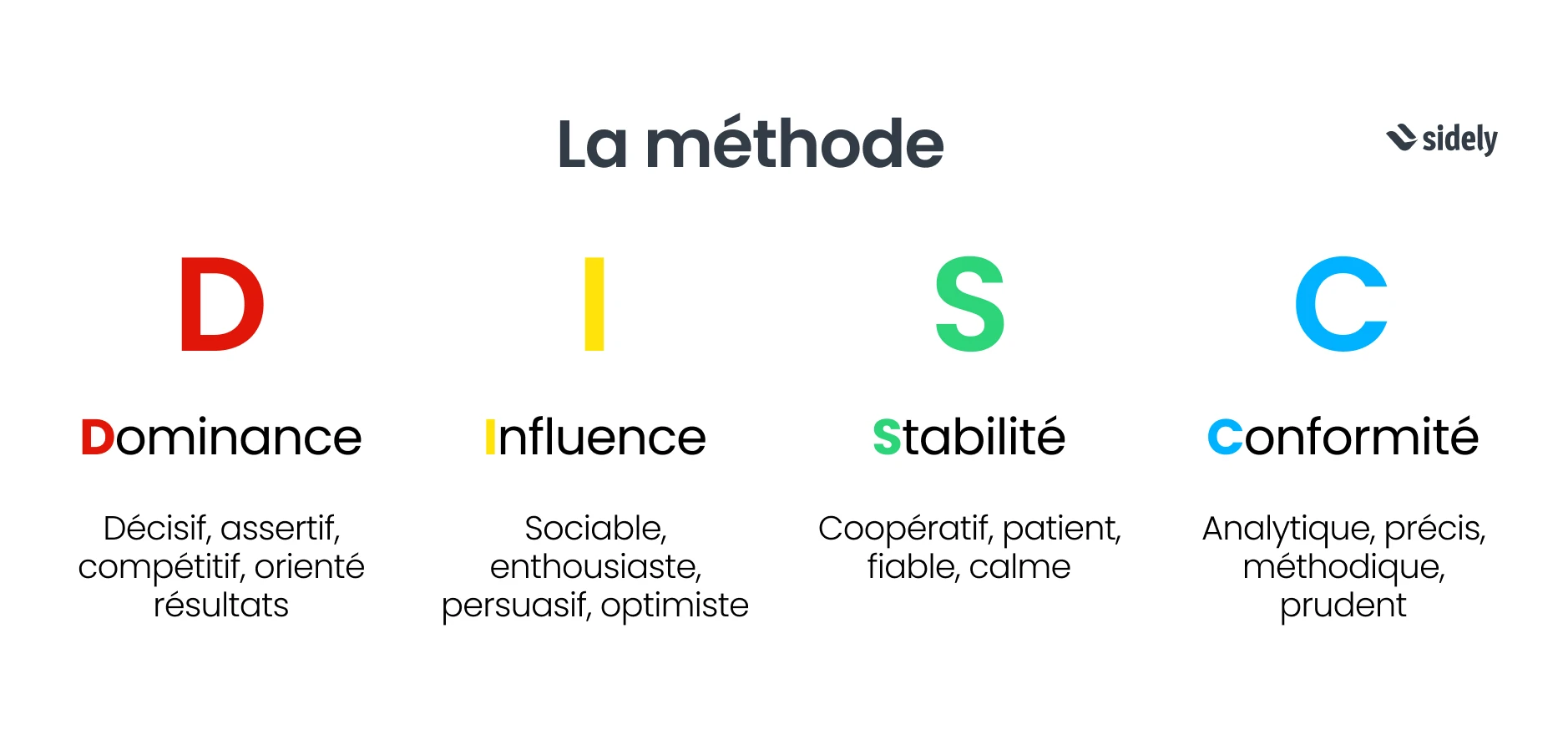
The DISC method is a behavioral assessment tool designed to understand personality traits and improve social and professional interactions. It is based on four main dimensions:
Dominance (D): tendency to be assertive * and results-oriented;
Influence (I): ability to persuade and be sociable;
Steadiness (S): inclination to be patient and reliable;
Conscientiousness (C): preference for structure and accuracy.
Assertiveness refers to a person's ability to express themselves and claim their rights without harming those of others. The "C" profile is sometimes referred to as "compliant".
The four profiles - dominance, influence, steadiness, and conscientiousness - were established by the work of psychologist William Moulton Marston, in the book Emotions of Normal People, published in 1928.
This research then inspired the creation of assessment tools like the DISC method, which now takes the form of a test that you can take to find out which profile(s) you belong to.
Because in the field of human resources, it is generally accepted that an individual can belong to different categories, and in different proportions. Thus, highly variable behaviors can be activated depending on the context and situation.
Also, to make it easier to read and absorb the results, color codes associated with each profile are generally used:
Dominance: red;
Influence: yellow;
Steadiness: green;
Conscientiousness: blue.
The DISC method is widely used in the professional world to improve communication, manage talent, and resolve conflict, adapting to the specific needs of individuals and organizations.
But the DISC method can also be used in the field of sales prospecting, to improve the effectiveness of interactions with prospects and increase closing rates.
Indeed, understanding the emotions and behaviors of your interlocutors can help you redirect your sales strategies.
Understanding Behavioral Styles
By using the DISC method, you can better understand your prospects' behavioral styles and adapt your approach accordingly.
Here is a chart that outlines the characteristics generally associated with each profile. The last row gives you keys to approach your contacts strategically.
Profile | Dominant (D) | Influential (I) | Steady (S) | Conscientious (C) |
|---|---|---|---|---|
Key Traits | Decisive, assertive, competitive, results-oriented | Sociable, enthusiastic, persuasive, optimistic | Cooperative, patient, reliable, calm | Analytical, precise, methodical, cautious |
Motivations | Power, control, rapid goal achievement | Recognition, social interactions, influence | Harmony, security, stable relationships | Accuracy, quality, compliance with standards |
Strengths | Leadership, quick decision-making, determination | Communication, inspiration, creating a positive environment | Listening, teamwork, reliability | Attention to detail, rigor, analytical ability |
Weaknesses | Impatience, tendency to take risks, sometimes authoritative | Lack of focus on details, impulsiveness | Resistance to change, conflict aversion | Perfectionism, tendency to be overly cautious, difficulty delegating |
Adapted Approach | Deliver direct, results-oriented presentations. Show how the product can solve their problems quickly and effectively. | Opt for an enthusiastic and positive approach. Use inspiring testimonials and stories, encourage social interactions and a friendly tone. | Build long-term relationships based on trust. Focus on details, security, and show the reliability of your product and company. | Provide in-depth analysis and tangible proof of your product's effectiveness. |
Information from the DISC profile can help you customize your approach to better meet the needs and expectations of the prospect / client. This allows you to play on the tone, the structure of the presentation, or even your sales arguments.
Over time, you can develop your communication program by learning to recognize different behavioral styles in everyday situations, and especially during your client meetings.
Finally, the DISC method is an interesting key to finding ways to better handle objections and defuse potential conflicts.
🤖 The DISC Method and Technology
There are now sales intelligence applications whose targeting is based on the DISC analysis of your prospects, like Crystal Knows. These tools suggest predicting the personality type of your target interlocutor by analyzing all the public information available on the internet. All this data is thus collected by the application and transcribed according to the DISC methodology.
Over time, the DISC method has clearly become a very popular tool in the field of sales prospecting. Sales directors and other sales managers regularly invite their sales reps to draw inspiration from it to adapt their speech, behavior - and even follow-up emails! - to the different types of prospects and clients they deal with.
⚠️ But be careful not to go off in all directions: at Sidely, we believe it is important to bring a little nuance to this discourse…
Explanations.
DISC: An Interesting but Insufficient Tool
Using the DISC method in human resources seems completely relevant, because in this case, tests allow recruiters to achieve results supported by reliable analysis tools and processes.
But for your prospects, how are you going to do it?
You're surely not planning to pull out your DISC test in the middle of a sales call. In practice, applying the DISC method in sales usually relies on "impressions." Not very scientific, is it! Admit that there is plenty of room for error based on a first impression…
You will need to remain very cautious when using this method in a sales meeting. Watch out for prejudices!
Watch Out for Misinterpretations
To identify the profile of an interlocutor, you still need to know how to interpret their answers and reactions. Up to now, unless proven otherwise, you are not a doctor of psychology. For example, it is difficult for individuals to know their own cognitive biases—those shortcuts our brain uses to process information quickly, but which can often lead us to incorrect or even irrational judgments.
In other words, by wanting to establish the psychological profile of the buyer, you will be inclined to project your desires, fears, impressions, and other complexes onto them. The result: a composite portrait that may be far from reality. Not to mention context factors you might be missing, such as your prospect's mood when you walk into the meeting!
That's why we recommend exploring complementary approaches that could help you make significant progress in managing your sales conversations.
Learning to Analyze Situations
As we have just seen, the DISC method is reliable when it is based on a written test. But in a face-to-face meeting, attitude and immediacy tend to take the lion's share. However, your own emotions and prejudices are in play, which multiplies the risk of wrong deductions.
It is therefore essential that you take the DISC test yourself first, to learn about your own profiles, and thus give yourself the means to strengthen your positive behaviors (those that foster good relationships and lead to sales), and mitigate / manage your negative reactions.
Other tools exist for this purpose. Let's mention, for example, transactional analysis (TA), a tool that allows you to discover and discern your typical social positionings, as well as those of your interlocutors. Unlike the DISC method, which focuses on personality analysis, transactional analysis invites you to explore interactions between individuals, and therefore allows for a very fine analysis of what is happening in real-time during a sales meeting.
--> Consequently: DISC + TA = Revenue?
⚠️ Not so fast… Sales is not just psychology!
Sales Techniques: Getting Back to Basics
Because Freud was neither a salesperson nor a sales manager, it is important to remember that sales performance starts with technical fundamentals and product and industry knowledge!
For sales enthusiasts, know that we recently explored tips for a successful discovery plan. This knowledge can be complemented by upskilling in the successive stages generally found in any commercial action:
Knowing your product;
Understanding the client;
Creating a relationship of trust;
Identifying the interlocutor's needs;
Presenting your solutions;
Closing the sale;
Customer loyalty etc.
In this rather typical plan, we see that the DISC method can be very useful in steps 2, 3, and why not 7. But we also see that a competent salesperson must master many other insights and techniques to improve their results.
In the end, let's keep in mind that a field salesperson must first know their products and their industry. For example, if you work in the retail sector, you can find our training intended for category managers here!
Finally, there are countless and valuable tools designed to support salespeople in the art of selling and conversation management, such as SPIN Selling, the Challenger Sale, or Solution Selling.
Many of you indeed ask us to explore these various sales enablement tools.
For the past five years, Corentin has supported more than 200 sales teams, making him one of the longest-serving members of the company. He has seen the product evolve alongside the industries he supports, giving him a deep understanding of actual use cases. Between onboarding calls and training sessions, he has built up rare, hands-on expertise: knowing exactly what saves teams time.
See also

Artificial intelligence and field professions: what our 2026 studies reveal
Adoption, barriers, use cases: discover what our three studies reveal about the role of AI among sector managers, sales representatives, and foodservice sales reps.

CHR and RHF Sales Representatives: portrait of a relationship-driven profession in the era of data
Equipment, productivity, AI: discover the major trends for the HORECA and food service sales profession in 2026 through our field study.

Pharmaceutical Sales Representative in France: Portrait of a Field Job Under Pressure
Compensation, aspirations, AI usage: discover the major trends in the pharmaceutical sales representative profession in 2026 through our field study.

Area Sales Managers in France: who are they and how is the profession evolving in 2026?
Compensation, aspirations, AI usage: discover the major trends in the field sales representative profession in 2026 through our field study.
The area manager professions in 2026
Discover the trends, the challenges, and the key figures.