

BATNA: The Best Alternative to a Negotiated Agreement for Successful Negotiations
What is BATNA? How to define and use it to strengthen your position in commercial negotiations with your distributors or clients.

In short
6 min read
The BATNA (Best Alternative to a Negotiated Agreement) refers to the best fallback solution to protect your interests and profitability in the event of a difficult negotiation.
Defining your BATNA beforehand allows you to anticipate objections, protect your margins, and remain consistent with the company's sales directives.
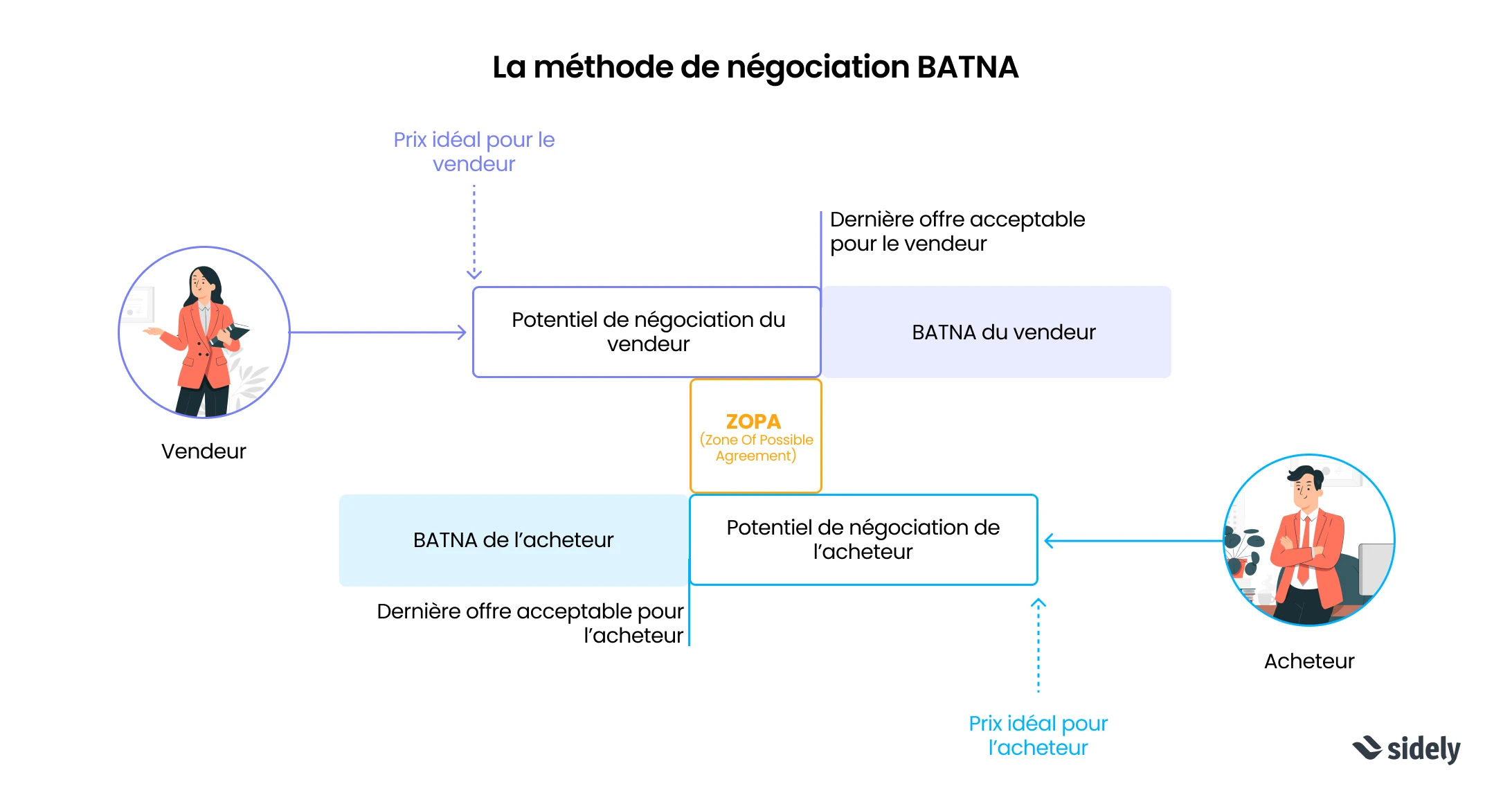
Knowing the buyer's BATNA helps define the ZOPA (Zone of Possible Agreement), thereby fostering a win-win collaborative negotiation.
Firmly defending your value proposition is essential to maintain the perceived quality of the offer and avoid damaging your credibility.
Knowing how to say no and accepting to walk away from an unprofitable sale strengthens the salesperson's confidence and paradoxically increases the closing rate.
Collectively preparing exit plans and defense strategies (battle cards) with sales management is a major lever for performance.
Every salesperson knows that a sale is rarely closed in the blink of an eye. Faced with you, the buyer has their own objectives and constraints. That is why the sales cycle usually leads to a negotiation phase. And if the goal is to sign, it cannot be done at any cost!
The good news is that there is a method to close under good conditions, and that is what we are going to look at in this article. 😎
BATNA: Your backup solution in negotiation
Batna is the acronym for “Best Alternative to a Negotiated Agreement”. It is a technique designed to conclude your sales under conditions that preserve your interests, such as your profit margin or your commission.
Batna is therefore the ultimate solution to activate when the negotiation is moving in the wrong direction. It is a safety net, a backup solution, aimed at avoiding price adjustments as much as possible and bypassing or limiting the prospect's demands.
Your BATNA is the compromise beyond which you refuse to go. It is also referred to as the “reservation value”, to designate the threshold below which the sale loses money. When this solution is rejected by the buyer, the seller must accept it and walk away from the sale. Because as a general rule, if the sale is not profitable, it is better to walk away.
We can also speak of reservation conditions: it is your last arrow, and you only shoot it when nothing else works.
The benefits of the BATNA method
The Batna is defined ahead of the meeting, so as to anticipate objections, and have one or more fallback plans when things get tough. By preparing their Batna, the seller approaches their negotiation in the best conditions.
The benefits are quite numerous. Here are the main ones:
Anticipate all possible scenarios and prepare exit plans;
Protect your profitability (and sometimes your bonuses!);
Boost self-confidence and master your subject;
Stay within the company's sales policy boundaries;
Defend your value proposition by adopting a consistent positioning.
It is all the more important to prepare yourself when your interlocutor is a professional negotiator or buyer. We think in particular of companies that have to negotiate with large-scale retailers.
Finally, Batna is also an effective tool to better manage your time: instead of getting locked into endless sales cycles, you will learn to ride the "crest of risk". Yes, sometimes you have to force destiny, and your Batna will allow you to get arbitrations, whether they are positive or negative. Next!
🧑🏫 The BATNA method was developed by Roger Fisher and William Ury in their 1981 book, Getting to Yes: Negotiating Agreement Without Giving In. They conceived it as a tool allowing negotiators to determine the best possible alternative if negotiations fail. This approach helps to strengthen the negotiating position by knowing when to leave the negotiating table and by having a solid backup plan.
Why is BATNA important in the negotiation process?
When objections multiply, or when the conditions requested by the buyer are too far from your objectives, you risk missing the sale or (worse!) closing a sale to your disadvantage. Not to mention the sellers' nightmare: signing a flawed contract that is finally rejected by the sales management, and having to announce it to the buyer.
Goodbye credibility!
To avoid these deviations, companies define rules that constitute a framework to be respected by sellers. This commercial policy provides in particular for the handling of objections, and the possible negotiation margins. It can also include a backup offer, i.e., a solution to be used as a last resort: this is the Batna.
What is the difference between Batna and Watna?
We also sometimes hear the term WATNA, for Worst Alternative To A Negotiated Agreement. This time, the party tries to imagine a worst-case scenario if no agreement is reached.
The most cited example to illustrate Watna is as follows: you want to sell your house, let's say at $300,000. But after months of waiting, only a single buyer makes an offer, for an amount of $180,000.
You then ask yourself the question: should I agree to negotiate with this potential buyer, or decline their offer? And to answer this question, you compare the $180,000 proposal with your WATNA, which is to find yourself with a house on your hands that no one wants.
ZOPA: The acceptable compromise for each party
But knowing your own limits is not enough. The art of selling is to step up to the buyer's stakes. That is why good salespeople also learn to identify the buyer's Batna. Because in fact, your interlocutor rarely tells you how far they are willing to go (and sometimes, they don't even know it themselves!).
Knowing your limit and the buyer's limit then makes it possible to establish a negotiation zone, which is called the zone of possible agreement (ZOPA). As the name suggests, zopa allows you to find common ground. By taking into account the last acceptable offers of each party, you reveal the solution that allows you to close the deal in a way that satisfies both of you.
In this sequence of reflection, you switch to win-win mode: a common reflection with the buyer that allows you to exit the negotiation-conflict in which everyone tries to win against the other.
🏆 Defending your value proposition
By default, a good buyer will always try to obtain maximum advantages, especially on the pricing side.
But, paradoxically, if they notice that the seller systematically makes concessions, this will tend to degrade their perception of the product and the salesperson. Indeed, in most industries (and especially in B2B), a serious seller sacrifices neither their price nor their margin, at the risk of looking like a market vendor!
It is therefore essential to defend your position with vigor in order to preserve the value of your offer, whether real or perceived. Furthermore, if the BATNA is not accepted, the salesperson must know how to back off, i.e., walk away from the sale, in the interest of consistency.
🥇 By learning to say no, you build your self-confidence, you strengthen the image of your product, and above all, you increase your closing rate!
How to define your BATNA
It is often the sales management that sets the limits not to be exceeded, especially regarding pricing. In this case, the Batna can be a rock-bottom price below which you cannot go, or a maximum percentage to allow on the starting price (you can try, at first, to quote a higher price than what is indicated in your price list, so as to land at the target selling price at the end of the negotiation).
However, the BATNA can perfectly well rest on elements other than the price. Besides, prospects can get stuck on other aspects related to the offer or the company. You can therefore choose to work on payment terms, the commitment period, a trial period, additional benefits etc. The only rule is to protect the margin.
To bring out the best ideas, we advise you to work on your Batna collectively with other salespeople and in agreement with the sales management. Remember that the entire sales team is involved, whether you are an inside or outside sales representative.
Workshops can reveal the best practices observed during meetings, so that each salesperson learns to master the negotiation techniques that work best. A CRM software will then be decisive in optimizing and evaluating sales performance.
Finally, many companies create battle cards. These tools serve to synthesize the strengths and weaknesses of one or more competitors, and to trigger the right counters during the sale or negotiation. You can integrate BATNAs into them to neutralize the perceived added values of each competitor.
5 examples of Batna solutions
Blocking condition | Situation | BATNA |
|---|---|---|
Tacit renewal | The B2B prospect categorically refuses to sign a contract with tacit renewal. | You invite them to accompany the contract with a termination letter (valid at maturity, of course), and schedule a customer follow-up to handle yourself. |
Current contract with a competitor | The prospect indicates that they will buy your service in 5 months when the contract they have with a competitor comes to an end. | Here, the prospect is not negotiating the price; they are just trying not to pay twice for the same service. In this exceptional case, you can consider buying out their current contract pro rata for the remaining months (1st year discount = competitor price / 12 x 5) or offer them a free trial period to ensure the customer converts. |
Price | The prospect indicates that they will sign if you grant them a 10% discount, but your management caps discounts at 5%. | You approve a 10% discount in exchange for a non-cancelable commitment over 2 or 3 years. |
Benefits | Your interlocutor asks for benefits that are normally reserved for customers who buy a premium offer. | You contractually guarantee the prospect that they will upgrade to the premium offer in year 2 with no price increase if the contract is maintained in the meantime. The premium rate will only apply starting in year 3. |
Payment upon order | The buyer does not have sufficient cash flow at the moment. | You offer three post-dated checks to cover the cost of the service while relieving pressure on the first installment. |
Margot has been working in Tech and SaaS for 8 years, with a multi-product experience that has given her a unique understanding of business challenges. On a daily basis, she analyzes, relentlessly tests, and relies on facts to shed light on market trends and help sales teams move forward.
See also

Artificial intelligence and field professions: what our 2026 studies reveal
Adoption, barriers, use cases: discover what our three studies reveal about the role of AI among sector managers, sales representatives, and foodservice sales reps.

CHR and RHF Sales Representatives: portrait of a relationship-driven profession in the era of data
Equipment, productivity, AI: discover the major trends for the HORECA and food service sales profession in 2026 through our field study.

Pharmaceutical Sales Representative in France: Portrait of a Field Job Under Pressure
Compensation, aspirations, AI usage: discover the major trends in the pharmaceutical sales representative profession in 2026 through our field study.

Area Sales Managers in France: who are they and how is the profession evolving in 2026?
Compensation, aspirations, AI usage: discover the major trends in the field sales representative profession in 2026 through our field study.
The area manager professions in 2026
Discover the trends, the challenges, and the key figures.