

Back margins: legal and commercial stakes for brands
Although regulated by law, back margins still govern negotiations with your distributors. Discover how your brand can take advantage of them.

In short
3 min read
The back margin is a deferred rebate granted by a supplier to its distributor in exchange for achieved commercial objectives.
Although the term is common, the law prefers the legal designation "other financial benefits".
French legislation has strictly regulated this practice since 2006 (Dutreil amendment, Chatel law) to limit abuses and define the threshold for resale at a loss.
The actual purchase price now integrates these financial benefits, modifying the structure of front and back margin rates.
It is advisable for brands to absorb these margins through economies of scale, to establish degressive systems, to put distributors in competition with each other, and to demand concrete counterparts (merchandising, visibility).
Like all brands that sell their products in large-scale retail, you are bound to anticipate and manage the demands of retail chains during annual negotiations. Among the friction points that cause tension for most manufacturers are back margins: a practice that, although regulated by law for about twenty years, continues to generate much debate in the supermarket industry.
What do you need to anticipate to prepare for these discussions? This is what we will explore in this article: we will start with the definitions to master, then review the regulatory framework, and list a series of best practices allowing you to stay on course with your commercial goals despite integrating back margins into your distribution agreements.
Back margin in large-scale retail: what is it?
The back margin generally corresponds to a rebate applied by a supplier to its distributor at the end of a financial year, and in return for a commercial objective achieved.
In practice, back margin is often used by supermarket chains to increase their profits by reducing the share paid to manufacturers on sales of their products. This practice is made possible by a deferred payment system and must be included in the distribution contract.
More rare, or even non-existent in large-scale retail, it sometimes happens that the manufacturer initiates the setup of a back margin, which they use to encourage their partner points of sale to boost sales, in exchange for a financial reward in the form of a bonus. This time, the balance of power is rather in favor of the supplier. This case is often the work of a giant in its industry that has the power to influence its resale network.
Legislation has regulated back margin since 2006, in order to limit its harmful effects on the economics of brands, which are often forced to accept sometimes abusive financial practices to avoid having their products de-listed from supermarkets.
Technically, the commercial goals giving rise to the application of back margin are varied and depend on the chain concerned: sales volume, manufacturer participation in logistics, increase in the sales revenue of a category, etc.
Finally, as we will see below, the term "back margin" has no legal significance. The law prefers the term "other financial benefits".
Front margin, back margin and loss-leader threshold
To understand the stakes of back margins for both producers and retailers, one must master the related terms that describe the business model of large-scale retail.
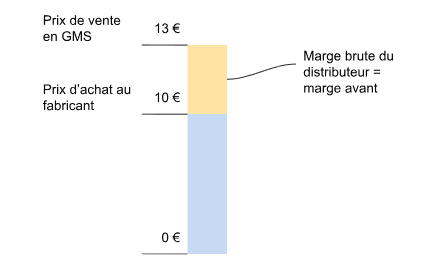
Front margin represents the traditional margin generated by the sale of a product or service. It is obtained by subtracting the sale price excluding taxes invoiced by the supplier from the sale price excluding taxes to the consumer. On this topic, we recently explained how to get your distributors to lower their margin rate on the sale of your products.
The loss-leader threshold (SRP) refers to the floor price below which the resale of a product is prohibited or regulated by legislation. In other words, it is the minimum amount at which a good can be sold in order to protect fair competition and prevent harmful trade practices.
Finally, the effective purchase price refers to the actual cost incurred by a business when acquiring a product or service. It includes not only the declared or displayed purchase price, but also all expenses directly associated with the purchase. These additional expenses can include costs such as delivery fees, import taxes, or transport or storage costs, etc.
The term "triple net" is sometimes used to refer to the price paid by the distributor, after incorporating invoice discounts, deferred rebates, and other commercial and logistical cooperation services.
French Law’s consideration of back margins
Historically representing up to 40% of the price invoiced by the supplier to the distributor, back margins caught the attention of legislators starting in 2006. This was followed by a series of measures taken to contain and regulate the phenomenon.
Voted on July 1, 1996, the Galland Law had already established an initial framework on the notion of back margin by stating that "the effective purchase price is the unit price appearing on the invoice increased by turnover taxes, specific taxes related to this resale, and the cost of transport." In other words, for a product, the true purchase price corresponds to the amount indicated on the invoice to which taxes and transport induced by the resale of this product are added.
Excluding financial agreements not integrated or subsequent to the purchase invoice, this formulation modified the loss-leader threshold formula and constituted a new tool for analyzing the sources of distributor profitability, particularly with the concepts of front margin and back margin.
Let us remember, however, that selling at a loss has been prohibited in France since 1963. Hence the subtlety of using back margins, which do not appear on purchase invoices and are therefore de facto excluded from the cost price calculation.
In 2006, the Dutreil amendment modified the commercial code by introducing a new definition of the effective purchase price, from which it would now be necessary to deduct "all other financial benefits granted by the seller expressed as a percentage of the net unit price of the product, and exceeding a threshold of 20% [...]"
In 2008, the Chatel law once again modified the concept of the loss-leader threshold by allowing distributors to include the famous "other financial benefits" in the price. The latter can thus sell at a price lower than that indicated on the purchase invoice, provided they are able to prove that the sums "advanced" to customers are indeed paid to them afterwards, otherwise the term selling at a loss would apply.
The same year, the law for the modernization of the economy reduced legal payment terms, with the aim of limiting the impact of deferred payments.
5 tips to leverage the back margin used by your distributor
In large-scale retail, commercial negotiations are annual. And, for your brand, the success of this exercise will greatly contribute to the achievement of your commercial goals (gaining market share, increasing sales revenue...).
This is why it is crucial to prepare for it conscientiously, and not to sign anything without having fully understood all the stakes that will flow from it.
While it is sometimes vital for the buyer to set a back margin in the agreement, here are a few tips that will allow you to limit its impact on your profitability, or even, in case of sales success, reap the benefits.
Absorb the back margin through a reduction in your manufacturing cost: to do this, calculate a sales target that allows for substantial economies of scale sufficient to keep a margin unchanged despite a lower unit payback.
Establish a sliding scale system with different tiers giving rise to different rebate percentages. This system can allow you to avoid sacrificing too large a share of revenue when a goal is barely met. Multiplying tiers allows you to correlate rebates with results: to save a lot, your distributor will have to sell a lot.
Put your distributors in competition: if the retail chains - or independent points of sale - offer you different conditions, use the most interesting proposals to gain leverage in discussions with others.
Produce advanced analyses of your sales. Sellout data helps you understand the performance of your products by retail chain, point of sale, and geographical area. By knowing the potential of your products by store type, you are no longer at the mercy of buyers and their proprietary data.
Multiply requests for counterparts: in a negotiation, it is rare to get everything you want. This is why it is advisable to ask for more than you expect to get. If you are not in a position to refuse a deal from a purchasing center or a store, list as many counterparts as possible, such as checkout displays or merchandising, etc.
By following these different recommendations, we hope to help you better prepare for the next annual negotiations. Defining your commercial goals is the first step of a successful negotiation. Understanding the financial mechanisms of your distributors is also a prerequisite for the proper conduct of discussions.
Ultimately, your goal is to ensure that every commercial gesture you agree to generates a proportional counterpart. Consistent with your trade marketing strategy, the give-and-take logic applies perfectly to back margin, which should thus allow you to improve your sales revenue, and if possible, your profit.
Margot has been working in Tech and SaaS for 8 years, with a multi-product experience that has given her a unique understanding of business challenges. On a daily basis, she analyzes, relentlessly tests, and relies on facts to shed light on market trends and help sales teams move forward.
See also

Artificial intelligence and field professions: what our 2026 studies reveal
Adoption, barriers, use cases: discover what our three studies reveal about the role of AI among sector managers, sales representatives, and foodservice sales reps.

CHR and RHF Sales Representatives: portrait of a relationship-driven profession in the era of data
Equipment, productivity, AI: discover the major trends for the HORECA and food service sales profession in 2026 through our field study.

Pharmaceutical Sales Representative in France: Portrait of a Field Job Under Pressure
Compensation, aspirations, AI usage: discover the major trends in the pharmaceutical sales representative profession in 2026 through our field study.

Area Sales Managers in France: who are they and how is the profession evolving in 2026?
Compensation, aspirations, AI usage: discover the major trends in the field sales representative profession in 2026 through our field study.
The area manager professions in 2026
Discover the trends, the challenges, and the key figures.