

Field SFA: how to structure and manage sales activity
Route planning, standardizing visits, managing KPIs: how SFA software concretely structures the activity of your field sales representatives.

In short
6 min read
SFA CRM transforms a sales strategy into a concrete framework with measurable and manageable actions.
Structuring field activity helps standardize sales practices by defining precise goals and prioritizing strategic points of sale.
The continuous optimization of routes, through map visualization and planning, ensures better frequency and sector coverage.
Standardizing visits ensures uniform execution in line with headquarters' expectations, while saving time for sales representatives.
The reliability of real-time and time-stamped data replaces self-reporting with objective indicators, thereby facilitating managerial decision-making.
In many sales organizations, the observation is the same: field execution lacks consistency, visibility into activity remains partial, and management still too often relies on self-reported data.
Yet, sales performance does not depend solely on individual talent. It relies on the collective ability to structure activity, standardize practices, and ensure data reliability. This is precisely where CRM SFA comes in. More than a simple tracking tool, it constitutes a real framework that transforms a sales strategy into concrete, measurable, and manageable actions.
In this article, we will look at how to use your CRM SFA software to structure your field activity, standardize your visits, and make your data reliable, in order to gain consistency, visibility, and performance.
How to structure your field activity with your CRM SFA?
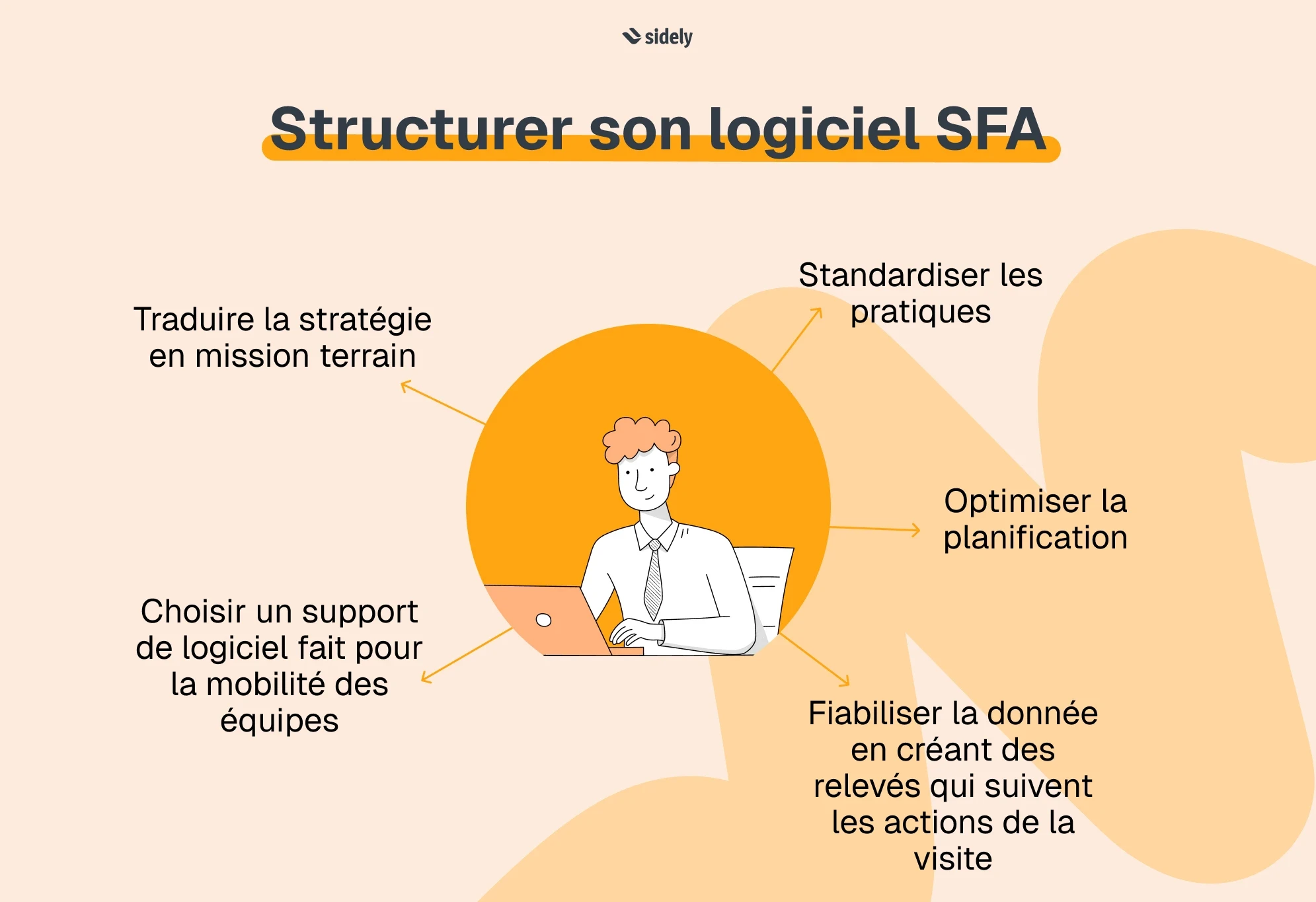
To structure sales execution with SFA software, you must organize the work and the framework beforehand. Use your SFA software as an organizational framework that transforms a sales strategy into consistent, measurable, and manageable field actions.
In other words, your sales reps must know what to do, when, and where. To achieve this, they will find the information directly in the CRM SFA:
Schedule visits in advance
Prepare for visits
Prioritize the most strategic points of sale
Visualize each territory on a map
Anticipate the actions to be taken before each meeting
Each visit has a clear objective: listing, merchandising, negotiation, promotional follow-up, order taking.
Define a clear execution framework
An SFA must first translate your sales strategy into operational rules. It is the application foundation of your sales culture.
Concretely, this involves:
Defining precise objectives by territory, chain, or customer profile
Prioritizing high-potential points of sale
Assigning specific missions, such as product launches or promotional operations
The software thus becomes the operational relay for decisions made at headquarters.
Plan and optimize routes
Sales execution depends heavily on the quality of planning. The SFA software must enable:
Map visualization of territories
Route optimization
Automatic prioritization based on potential or objectives
Tracking scheduled vs. completed visits
By effectively planning and optimizing your sales routes, you structure not only the content of the visits but also their frequency and coverage.
Prepare your week from the desktop application before going on the road, ideally late Friday afternoon, when your mind is still focused on priorities.
Standardize your visits: apply the same method everywhere
Standardizing does not mean rigidifying. It means adopting a common method to be more efficient and consistent: structure relies on uniformity of practices.
Your CRM SFA allows you to fill out structured forms tailored to each type of visit, add photos to prove execution, record key information without forgetting anything, and structure reports to avoid incomplete information...
Every sales rep follows the same framework, which saves time in the field and, above all, guarantees consistent execution across the entire territory.
How to manage your field activity with SFA software?
Managing means transforming field activity into reliable data to make better decisions. This is what the CRM SFA enables: it helps you analyze, measure, and adjust after execution. It helps you be better prepared and secure your results.
Make your data reliable: enter useful and actionable information
Poorly entered, incomplete, or forgotten data can lead to poor analysis, and therefore to an inappropriate decision. The quality of sales management depends directly on the reliability and quality of information reported from the field.
Your CRM SFA helps you secure this reliability by:
Centralizing all store and customer information in a single tool
Avoiding double entries and information loss
Automating certain data collection to limit errors
Synchronizing data in real time
Maintaining a clear and structured history of your actions
Thanks to this structure, management no longer manages based on declarations or impressions, but on objective and comparable indicators from one territory to another.
The more accurate and complete your data, the better your manager can analyze your performance, identify areas for improvement, and showcase your results to executive leadership.
Good habit: complete your reports immediately after the visit, while the information is still fresh, and systematically validate the visit so that it is integrated into reporting and goal tracking.
Track indicators and adjust in real time
A CRM SFA allows for continuous adaptation of field actions based on observed results. Indeed, managing is not just about analyzing numbers at the end of the month, but rather having continuous visibility into the activity to react quickly when necessary.
With the CRM SFA, you can:
Track field KPIs in real time
Identify gaps between objectives and execution
Measure territory coverage and adherence to priorities
Spot underperforming areas
Quickly adjust actions and objectives
Decisions are no longer based on a delayed review, but on updated, immediately actionable data.
Save time to sell more
The final goal is simple: spend more time selling and less time on administration.
Thanks to automation:
Reports are generated faster
Follow-ups are scheduled
Information is accessible in seconds
You can thus devote more energy to negotiation, developing your territory, and customer relationships.
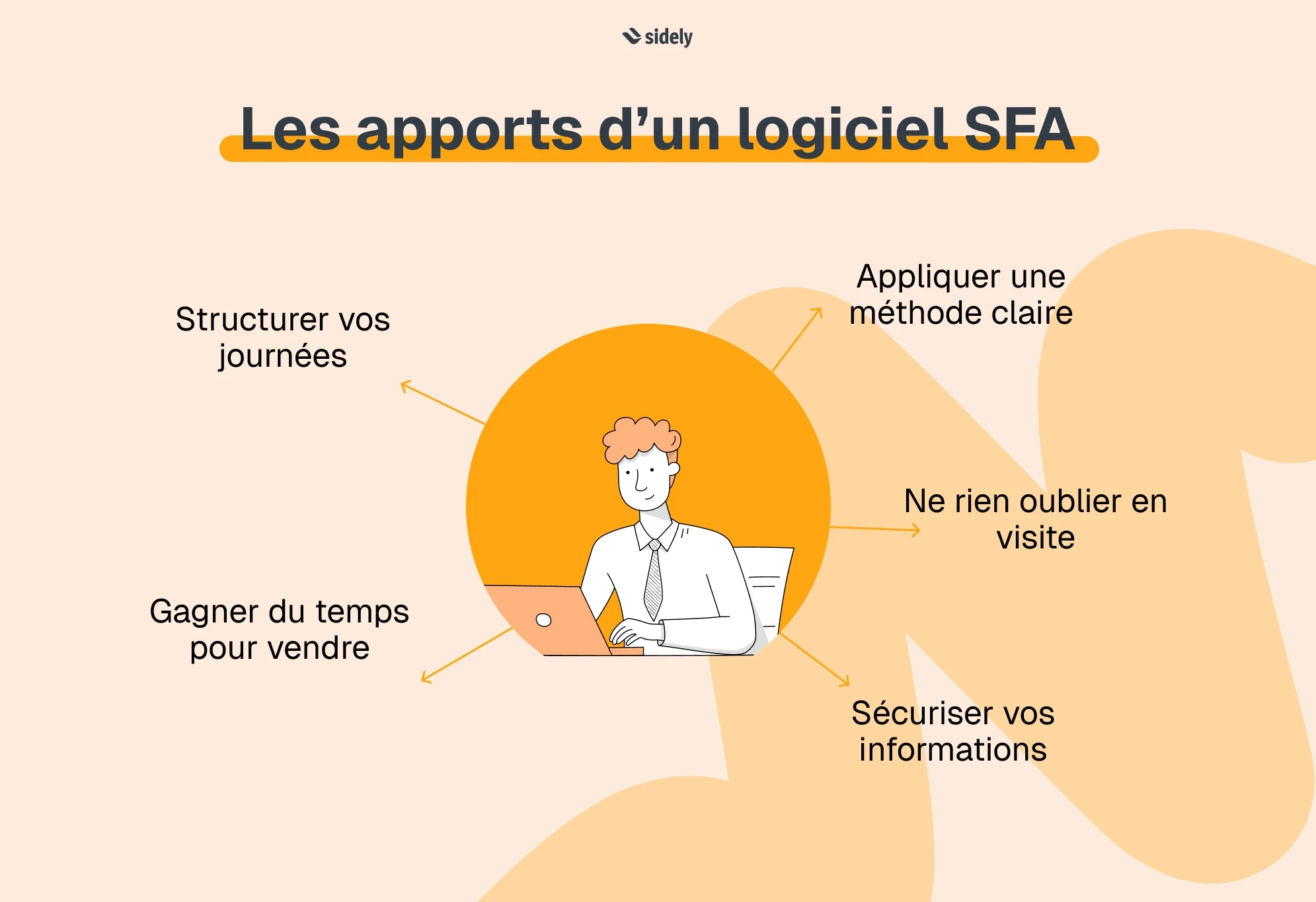
Your SFA software is not an extra tool. It is your field assistant. The more rigorously you use it, the more it becomes a performance driver for you and the team.
Concrete example of using an SFA in retail
Let's imagine a national cereal brand that sells:
a classic range (wheat, chocolate, honey),
an organic range,
a new high-protein product launched this quarter.
Territory managers visit hypermarkets and supermarkets to:
check product availability,
negotiate displays,
monitor promotions,
take orders.
Let's see how the CRM SFA concretely structures their work.
Structure the route: prioritize strategic stores
Without CRM SFA
The sales rep organizes their route based on habit or geographical proximity. They risk forgetting:
a high-potential store,
a promotion to check,
a priority product launch.
With CRM SFA
The software:
Prioritizes stores where the new protein cereal needs to be listed.
Highlights points of sale that had out-of-stock items the previous week.
Highlights stores with low shelf share.
The sales rep starts their day with:
a clear list of priorities,
an optimized route,
precise objectives for each visit.
Standardize the store visit
Before the visit
In the application, a "Protein Cereal Launch" mission is assigned.
It contains:
Check shelf presence
Measure the number of facings
Check the displayed price
Negotiate an endcap if available
Take a photo of the shelf
During the visit
The sales rep follows the structure of their form in the application:
Checkboxes
Required field for the number of facings
Required photo if the endcap is set up
Comment if the store refused
Every visit follows the same framework, nationwide. Result:
Consistent execution
No key information forgotten
Comparable data from one store to another
Ensure reliable field data
The sales rep notes:
3 facings instead of the negotiated 5
Out-of-stock on the organic range
Refusal to set up the new product
They immediately enter this information into the CRM SFA. The data is:
Timestamped
Geolocated
Centralized
Accessible to the regional manager in real time
At headquarters, trade marketing can:
Identify underperforming chains
Adjust sales pressure
Measure the impact of the product launch
We move from a field feeling to actionable data.
Manage the promotional operation
Let's imagine a "buy 2 get 1 free" promotion for 3 weeks.
Thanks to the CRM SFA:
Headquarters tracks the % of stores visited in real time
It measures the endcap display rate
It compares promo presence and sell-out performance
If a region is falling behind:
The regional manager reacts immediately
They reallocate route priorities
Thus, execution is no longer self-reported; it is measurable.
💡What teams need to remember
For a cereal brand, CRM SFA enables you to:
- Visit the right stores at the right time
- Apply the same method everywhere
- Never forget anything on the shelf
- Prove execution
- Transform each visit into strategic data
For the past five years, Corentin has supported more than 200 sales teams, making him one of the longest-serving members of the company. He has seen the product evolve alongside the industries he supports, giving him a deep understanding of actual use cases. Between onboarding calls and training sessions, he has built up rare, hands-on expertise: knowing exactly what saves teams time.
See also

Artificial intelligence and field professions: what our 2026 studies reveal
Adoption, barriers, use cases: discover what our three studies reveal about the role of AI among sector managers, sales representatives, and foodservice sales reps.

CHR and RHF Sales Representatives: portrait of a relationship-driven profession in the era of data
Equipment, productivity, AI: discover the major trends for the HORECA and food service sales profession in 2026 through our field study.

Pharmaceutical Sales Representative in France: Portrait of a Field Job Under Pressure
Compensation, aspirations, AI usage: discover the major trends in the pharmaceutical sales representative profession in 2026 through our field study.

Area Sales Managers in France: who are they and how is the profession evolving in 2026?
Compensation, aspirations, AI usage: discover the major trends in the field sales representative profession in 2026 through our field study.
The area manager professions in 2026
Discover the trends, the challenges, and the key figures.