
Product cannibalization: marketing definitions and best strategies
What is product cannibalization? How to detect, measure, and implement strategies to limit it without holding back innovation.

In short
5 min read
Precise definition of product cannibalization in a marketing and sales context
Methods and key indicators to detect and measure the phenomenon within one's product mix
Analysis of cannibalization's impacts on profitability and market share
Operational strategies to limit self-competition while preserving innovation dynamics
Role of offer segmentation and price positioning in product line management
In marketing, cannibalization occurs when a product or service captures the revenue generated by another, usually older item.
This phenomenon represents a significant commercial and financial risk for manufacturers, but it can also be initiated by them, integrating perfectly into assortment strategy and category management.
Here, Sidely invites you to an in-depth analysis of the issues of product cannibalization: after exploring marketing theory, we will look at the risks of involuntary cannibalization and the reactive actions that marketing must implement.
We will then see how cannibalization can contribute to the commercial success of your brand, with concrete examples.
Cannibalization: definitions and marketing theory
The cannibal effect is a widespread phenomenon in which different products of the same company compete for a common target. This situation is common when a new product is launched by a manufacturer, but can occur in other contexts, such as insufficient differentiation or excessive use of promotions.
The wider a range is (diversity of product lines) or the deeper it is (variety within the same line), the more the risk of cannibalization increases. Items can then compete with each other, especially if they meet similar needs.
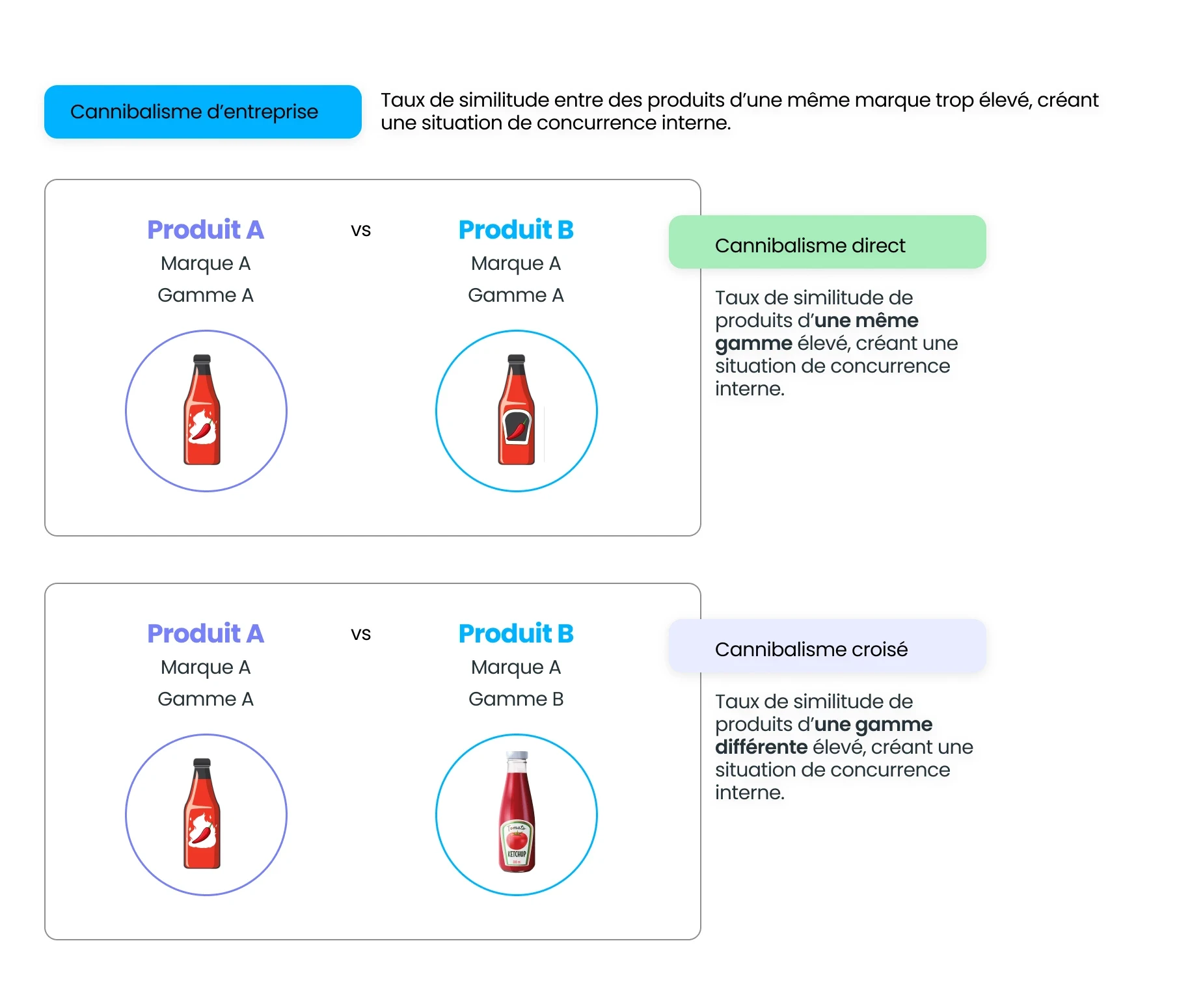
If the similarity rate of the products is too high, they can substitute for one another, creating a situation of internal competition, sometimes referred to as corporate (or market) cannibalism.
We speak of direct cannibalization when very similar products of the same range compete directly. There is cross-cannibalization when products from different ranges or close segments meet similar needs.
Cannibalization is often linked to the product life cycle, and allows companies to gradually replace a product that is reaching maturity or decline with a new offering. This is a way to control the evolution of the product portfolio, anticipating the decline of aging items.
On the other hand, cannibalization can be a strategic tool to occupy shelf space, preempt customer needs, and slow down competition (go to the second part of the article to explore cannibal strategies!).
💡Cannibalization and retail: the phenomenon of cannibalization can also occur at the point-of-sale level - retailers must then rethink their territorial coverage - but also across channels, the most typical case being competition between stores and e-commerce websites. Brands use omnichannel marketing to avoid these side effects.
Measuring product cannibalization
Companies must take care to constantly monitor the risks of cannibalization within their assortment.
When launching a product, it will be useful to measure the rate of cannibalization of existing products by the new one.
Cannibalization rate formula
Cannibalization rate = (Loss in sales of the old product / Total sales of the new product) × 100
The overall market share will also allow verification of whether the launch results in an increase in total sales or simply a transfer between products.
Finally, cross-price elasticity will prove useful in determining if a lower price on the new product sharply decreases demand for the old products.
Cross-price elasticity formula
We seek to measure the impact of a price change in product X on the sales volume of product Y.
Exy = % change in sales of X / % change in price of Y.
If Exy > 0 → products X and Y are substitutable (e.g., tea and coffee); If Exy < 0 → products X and Y are complementary (e.g., coffee and filters); If Exy ≈ 0 → the products are independent.
💡Read on the same theme: How your brand can exploit price elasticity in supermarkets
Production costs and profitability: understanding the impact of cannibalization
When suffered involuntarily, cannibalization reflects a poor understanding of consumer behavior and expectations.
In addition to reducing sales of certain items and blurring brand perception, sales cannibalization can have a considerable impact on the profitability of a company that multiplies manufacturing costs for products that compete with each other.
Observing cannibalization will then serve to cull ranges and optimize the assortment. By focusing its sales strategy on high-contribution products, the brand repositions its offering and improves its profit margin.
In practice, the company can review the marketing mix for each individual item. This involves considering the 4Ps of each item (product, price, promotion, and place) to avoid - or manage - overlaps.
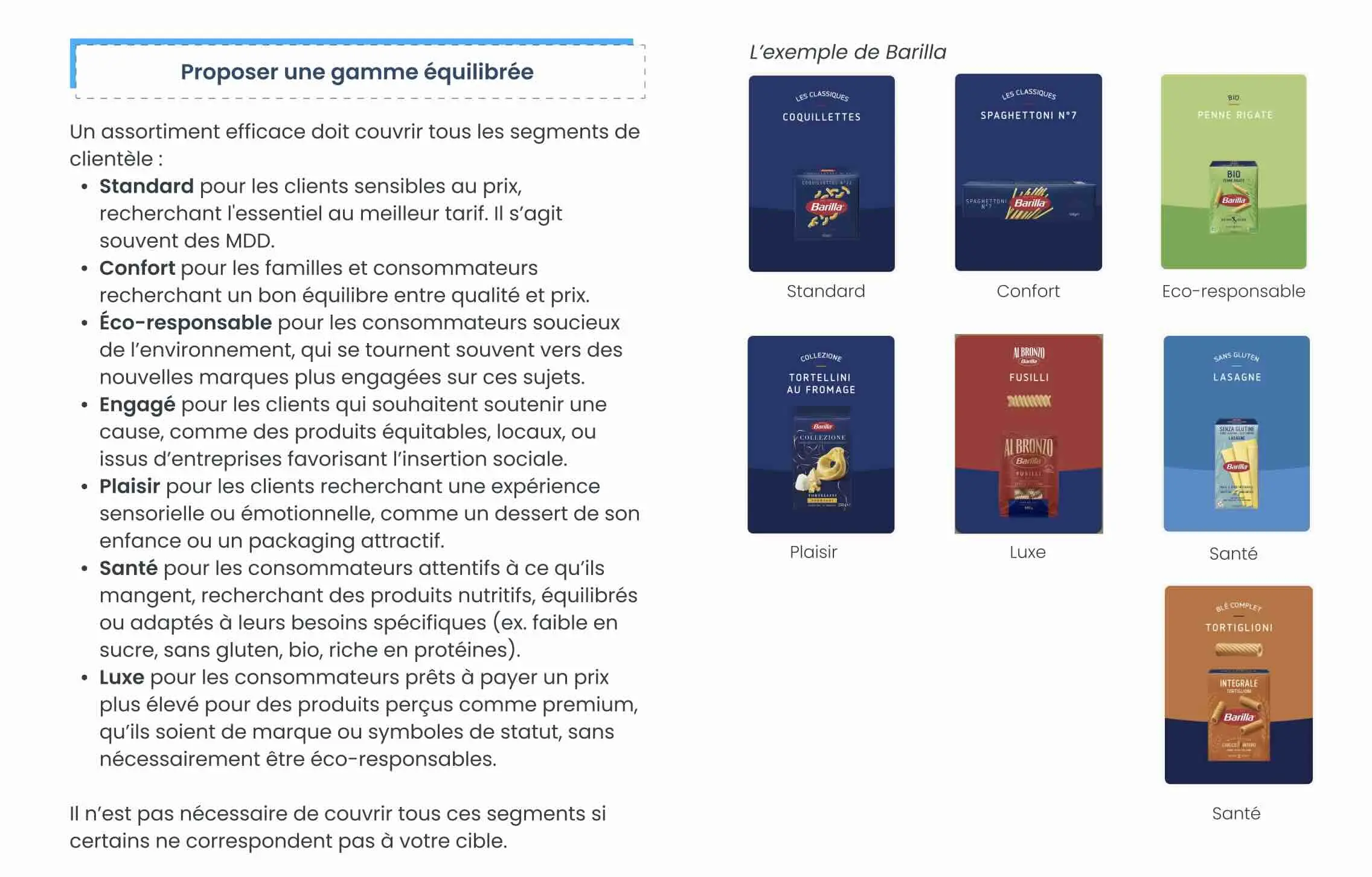
An effective segmentation will then prevent the same buyer persona from having to choose one product to the detriment of another. In the event of product complementarity, the company can develop a cross-selling strategy, such as with coffee and filters.
And we are going to look precisely at how brands can trigger cannibalization strategically.
Cannibalization strategy
Product cannibalization is often a deliberate and beneficial strategy when it is part of an overall vision for growth, market share defense, or offering optimization. Two scenarios can be distinguished:
Offensive cannibalization: a company launches a new product to gain market share, even if it means reducing sales of an existing product.
Defensive cannibalization: it deliberately competes with itself to prevent a competitor from winning over its customers.
In both cases, it is a strategic choice aimed at strengthening or protecting its market position.
Here are several scenarios where it is intentionally implemented by a brand.
Strategic objective | Strategy implemented | Example |
|---|---|---|
Prevent a competitor from capturing customers | Launch a competing product before a new player arrives | Apple launches the iPad Mini to counter compact tablets |
Improve margin by pushing a premium product | Steer consumers toward a more profitable offering | Fast-food chains promote "gourmet" burgers with a better margin |
Optimize a product portfolio and reduce costs | Replace several items with a unified product | A yogurt manufacturer groups several ranges under one single brand |
Evolve brand image to attract a new target | Replace a historical product with a more modern version | Coca-Cola introduces Coca-Cola Zero to meet new health trends |
Encourage consumers to replace their old products | Launch a product with exclusive features or technical advancements | Smartphone manufacturers release new models every year. Planned obsolescence is an abuse of this strategy |
Occupy the entire market spectrum and avoid competition | Segment the market and develop as many versions of a product as there are different targets | Car manufacturers offer a model in gasoline, hybrid, and electric versions |
You can download the entire study here!
💰 Offering renewal is sometimes used as a hidden inflation policy to increase revenue - or margin - per unit. Category managers can also use it to support a category redesign project.
The key is to properly manage this dynamic to ensure it does not lead to an overall erosion of margins or consumer confusion.
If the company finds it difficult to verify the existence of involuntary revenue transfers through these calculation methods, it is possible to call on data science experts (consultants or agencies), but also to acquire a Retail CRM.
In order to validate the segmentation of segments and products and prevent duplicate offers, marketing can also measure the product similarity rate.
Measuring similarity between two products
There are many methods to establish similarity between two products or services. Depending on the scenario, a company can explore several of them.
Method | Description | Example Application |
|---|---|---|
Comparison of product characteristics | Compare objective criteria such as ingredients, components, features, size, etc. | Two smartphones compared on screen, battery, processor, etc. |
Analysis of consumer uses and benefits | Look at whether products meet the same needs and usage situations | A protein yogurt and a protein-rich milkshake targeting athletes |
Study of consumer perceptions | Surveys or semantic analysis on how products are perceived | If consumers judge that Pepsi and Coca-Cola taste the same |
Pricing and positioning similarity | Compare price positioning and target market | Two organic shampoos sold at the same price in supermarkets |
Analysis of sales substitution | See if an increase in sales of one product leads to a drop in another | If the rise in Coca-Cola Zero sales decreases those of Coca-Cola Light |
Semantic distance and text mining | Analyze product descriptions with algorithms to measure their structural proximity | Two product sheets analyzed via NLP to see if they are close |
Formula for a weighted similarity score
To establish a good assortment strategy, manufacturers can calculate a similarity score (usually between 0 and 1).
This involves assigning a weight to each criterion (design, features, price, etc.) to establish a weighted average.
Calculation method:
It is established that product A and product B have:
80%: common characteristics (design, features);
60%: similarity in usage;
90%: price proximity.
With weights of 50%, 30%, and 20%, the similarity score would be:
S = (0.8 x 0.5) + (0.6 x 0.3) + (0.9 x 0.2) = 0.76
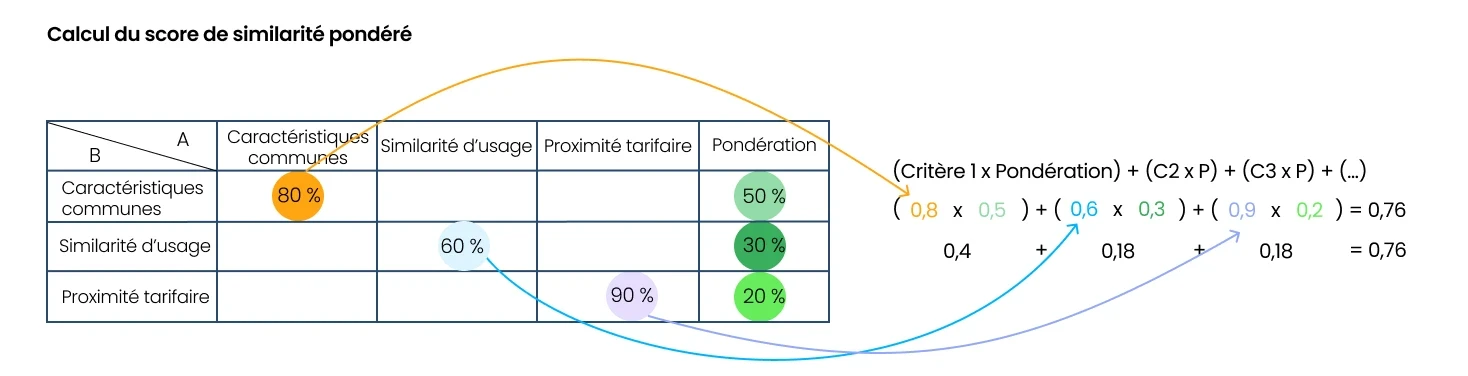
A score of 0.76 indicates strong similarity. In such a scenario, the company could:
Stop selling one of the two products;
Define different channels for each product;
Change the pricing model and / or marketing communication to reduce the similarity score.
Example:
A new zero-sugar soda has a 90% similarity rate with an existing diet drink, risking cannibalizing the sales of the former instead of attracting new customers.
👉 The brand reviews the packaging and marketing, targeting another segment (e.g. athletes vs. general public). Cannibalization is then minimized despite the high similarity in product characteristics.
🧠 Whether companies use manual methods like the ones we have just detailed or predictive algorithms integrated into specialized software, the goal is always to anticipate cannibal effects rather than discovering them in sell-out analysis!
Despite the risks it poses to manufacturers, cannibalization, when intentional, controlled, and measured, proves to be an indispensable asset for range management, marketing and commercial strategy, and the product life cycle.
Companies that master these theories and manage to effectively implement them in their distribution strategy can then dominate their market through optimized assortment management.
Margot has been working in Tech and SaaS for 8 years, with a multi-product experience that has given her a unique understanding of business challenges. On a daily basis, she analyzes, relentlessly tests, and relies on facts to shed light on market trends and help sales teams move forward.
See also

Artificial intelligence and field professions: what our 2026 studies reveal
Adoption, barriers, use cases: discover what our three studies reveal about the role of AI among sector managers, sales representatives, and foodservice sales reps.

CHR and RHF Sales Representatives: portrait of a relationship-driven profession in the era of data
Equipment, productivity, AI: discover the major trends for the HORECA and food service sales profession in 2026 through our field study.

Pharmaceutical Sales Representative in France: Portrait of a Field Job Under Pressure
Compensation, aspirations, AI usage: discover the major trends in the pharmaceutical sales representative profession in 2026 through our field study.

Area Sales Managers in France: who are they and how is the profession evolving in 2026?
Compensation, aspirations, AI usage: discover the major trends in the field sales representative profession in 2026 through our field study.
The area manager professions in 2026
Discover the trends, the challenges, and the key figures.