

How to get 100% out of your CRM as a pharmaceutical representative?
How can pharmaceutical sales representatives optimize their CRM usage? Key features, best practices, and use cases to maximize field efficiency.

In short
9 min read
Optimize your route planning by finely segmenting your pharmacies (status, potential, needs) to focus your efforts on high-impact points of sale.
Maintain a reliable pharmacy database, enriched in real-time while you're on the move, so you never miss a field opportunity.
Use the CRM's map view and geographical selection tools to organize logical itineraries, thereby reducing travel times.
Systematically document each visit, interaction, order, and merchandising action to ensure rigorous traceability compliant with industry regulatory requirements.
Strengthen customer relationships by leveraging the complete history of exchanges, allowing for precise personalization of your approach and long-term loyalty.
Centralize your reports and performance indicators in the CRM to facilitate reliable and instant reporting to your management or laboratories.
Each distribution channel has its own specific features, and each commercial function has its own requirements. The profession of pharmaceutical sales representative is no exception. As a medical sales representative, you are the link between the laboratory (or brand) and pharmacies and hospitals. You play a key role in promoting, distributing, and highlighting products to pharmacies, drugstores, buying groups, or purchasing centers.
Your daily routine is dense and multifaceted: prospecting new points of sale, presenting new products or laboratory highlights, negotiating commercial terms, taking orders (or transmitting them), training pharmacy teams, setting up visibility materials, ensuring accurate sales follow-up (performance, out-of-stocks, field feedback), and, of course, reporting your actions to headquarters.
In this context, it is impossible to be successful without an adapted sales tool. A CRM for pharmaceutical representatives is a tool designed to support medical sales representatives in planning visits, tracking interactions, regulatory traceability, and strengthening relationships with pharmacies, hospitals, and practitioners. Used according to CRM best practices specific to the pharmaceutical industry, a pharma CRM becomes a true co-pilot that helps optimize your products' presence in pharmacies, secure effective and lasting distribution, boost your brand awareness among pharmacy teams, and strengthen customer relations through rigorous follow-up.
Provided, of course, that you have a good CRM SFA software and make full use of it. In this article, we show you how to transform your CRM into a sales efficiency driver at every stage of your field mission.
Using your CRM to plan and target your pharmacy visits
When managing a large territory, with dozens or even hundreds of pharmacies to visit, organization becomes a central priority. As a pharmaceutical representative, you cannot be everywhere, all the time. You must plan intelligently, prioritize effectively, and focus your efforts where they will have the greatest impact.
Segment your pharmacies intelligently
Even before planning, start by structuring your portfolio in the CRM. Create segments based on useful criteria:
Pharmacy status (chain, independent, buying group)
Order volume or estimated potential
Type of clientele (local, tourist, specialized...)
Collaboration history
Presence of POS materials or visibility granted to your products
Engagement or training level of the pharmacy team
Use custom fields or qualification forms to automate this segmentation right from the first visit.
Rely on an up-to-date pharmacy database
Rely on a reliable pharmacy database integrated into your CRM, containing updated contact details, CIP codes, product information, affiliation with a buying group or distributor, and physical visit and order histories.
You save time by not having to look for this information elsewhere, and you prepare each visit in a more targeted manner.
Continuously enrich your database in the field
During your sales rounds, do you occasionally spot a pharmacy you didn't know yet? Thanks to Google Maps integration, add it directly to your CRM from your mobile, even while traveling.
This allows you to continuously enrich your portfolio, never miss an opportunity, anticipate your next actions, and keep your database up to date!
Respect visit frequency
In the pharmaceutical sector, visit frequencies are not left to chance. For some laboratories, they are even regulated or contractualized: one visit per month, every 45 days, once a quarter... In addition to the legal aspect, it is a matter of relationships: visiting too rarely risks being forgotten. Visiting too often risks being intrusive.
To manage this, set a frequency for each point of sale. Then, create reminders in your CRM that tell you when visits are overdue and for which points of sale. You can then organize your rounds according to current priorities.
Plan your rounds on a map
Use the map view of your CRM to build logical and profitable routes. Thanks to the lasso selection tool:
Select pharmacies, drugstores, hospitals, clinics... based on their classification, status, or potential
Create geographically consistent visit groups
Integrate already scheduled appointments to optimize your route
A good CRM also allows you to connect your routes to Waze or Google Maps, to adapt your journeys in real time and improve flow.
Using your CRM to track interactions and field actions
The role of the pharmaceutical representative involves rigorous tracking of interactions with pharmacies. To remain efficient and compliant with regulations, you must keep an accurate record of all your visits, commercial actions, and orders.
Qualify your points of sale in a structured manner
Before visiting a pharmacy or drugstore, make sure you have the right information. Thanks to your CRM, you can create or use qualification surveys adapted to your sector (type of pharmacy, clientele, products on shelves, ordering policy, associated distributor...).
This allows you to quickly assess the potential of each point of sale, prioritize your visits, and adapt your sales pitch. A pharmacy with high potential is not approached in the same way as a small independent retail outlet. The key is personalization.
What to do in your CRM:
Use a standardized form for each first visit.
Make certain fields mandatory to ensure data consistency.
Add conditional criteria to guide the qualification (e.g. "if distributor = xxx, then display pricing terms").
Document the visibility of your products
Your CRM should become your field memory. After each visit, take the time to record the presence of your products, adherence to promotional features (POS displays, store windows, shelf displays), and negotiated merchandising conditions.
This allows you to accurately track the actual visibility of your product lines, identify points of sale that do not comply with agreements, and better prepare your follow-ups or upcoming promotional events.
What to do in your CRM:
Use a pharmaceutical merchandising audit form.
Take photos at the point of sale and attach them to the pharmacy's profile page.
Track the presence of your products by range, location, and period.
Save time on writing reports
A good practice is to write the visit report immediately after your meeting, directly in your CRM. This prevents details from being forgotten, ensures better quality information, and frees up time for your next actions.
If your CRM offers a voice dictation feature, use it to dictate your notes quickly and naturally. The system automatically transcribes and associates your words with the correct pharmacy.
Take orders directly in the field
Some pharmacies order directly, others through their purchasing group. In either case, you can record an order in real-time in your CRM, preventing re-entry or transmission errors.
What you can do:
Generate a purchase order on a mobile or tablet.
Have the pharmacist sign it directly on the screen.
Send it automatically by email to headquarters, the distributor, or customer service.
Keep a record in the customer history to better track volumes, rotation, and planned follow-ups.
Comply with legal traceability requirements
In the pharmaceutical sector, you are subject to specific traceability obligations: frequency of visits, transparency of exchanges, and compliance of actions. Your CRM helps you formalize your reports, structure your monitoring, and prove your actions in the event of an audit or a request from your management.
What to set up:
A compliant report template, completed after each visit.
A time-stamped history of visits, with on-site check-in.
An automatic tracking of visits made and upcoming, to ensure compliance with the schedule.
Using your CRM to strengthen relations with practitioners and pharmacists
In an environment as competitive as healthcare, with rival laboratories, demanding purchasing groups, and highly solicited pharmacists, the quality of the sales relationship becomes a key differentiator.
And this relationship cannot rely solely on memory or intuition: it must be supported by structured data, available at any time. This is where your CRM becomes essential.
Build a complete history
Every exchange with a pharmacy, doctor, or hospital must be tracked in your CRM. This allows you to find, in one click, the history of discussions, products already presented, objections raised, commitments made, or needs expressed during the last visit.
What to do in your CRM:
Systematically enter the points covered during each meeting.
Add clear and actionable notes, which can be viewed by your manager or colleagues in case of a handover.
Associate each action with an objective (order taking, audit, event follow-up, training, etc.).
You thus gain sales consistency and professionalism, even when you have not seen a customer for several months.
Better understand and anticipate needs
Your CRM must also allow you to centralize the specific expectations of your contacts: desired inventory, training level of the pharmacy team, promotional material received or requested, logistical or commercial business constraints.
Because a good follow-up relies on the ability to personalize your pitch at each visit. This level of precision is impossible to maintain without a suitable tool.
Tips for use:
Create a "specific need" field in the point-of-sale profile.
Program automatic reminders to anticipate future actions (resending POS material, quote follow-up, visit on a specific date...).
Identify high-potential key accounts, and define specific visit frequencies.
Turn every interaction into an opportunity
A well-used CRM supports you before, during, and after the visit:
Before: you define the objective of your visit, identify points to cover, and consult the history.
During: you note key information, suggest a promotional event, and adapt your pitch.
After: you quickly write up your report, plan the follow-up, and create automatic reminders.
Thanks to rigorous management, a simple routine visit becomes an opportunity for additional revenue. This is where you move from the role of a visitor to that of a true business partner.
Build a long-lasting relationship
Loyalty comes from the consistency of exchanges and the relevance of your offerings. By making the most of your CRM, you become able to:
Follow up with a customer at the right time, without being intrusive.
Send useful information (product sheet, result of a promotional action).
Highlight a performance (growth in sales, beautiful display setup).
Adapt your sales pitch to the season, current health news, or an identified customer issue.
It is this level of follow-up that makes the difference over time: your contacts electronic records show that you know them, that you are organized, and that you arrive with concrete solutions. Result: the relationship is strengthened, orders are repeated, and trust is built.
Using your CRM to ensure regulatory compliance in pharmacies
In the pharmaceutical sector, every field action is potentially subject to a strict regulatory framework. Unlike other distribution channels, you work in a healthcare sector, and this implies specific legal obligations: transparency, safety, and traceability. A CRM compliant with the pharma sector is essential to guarantee the traceability of visits, regulatory compliance, and transparency of field actions.
Respecting the regulatory framework of the profession
As a pharmaceutical representative, you are governed by the Public Health Code. Your missions relate more to medical promotion and information than to classic selling. The CRM allows you to take this into account by:
Enriching organization profiles with approved products, validated indications, and distributed materials to prove that your message is compliant.
Setting up specific visit types (medical information, training, promotion) to distinguish regulated objectives from sales activities.
Adding reference documents (SmPC, product documentation, compliance certificate) directly accessible during the visit.
Systematically tracking visits
To ensure compliance, every interaction must be justified. The traceability of visits by a pharmaceutical representative is therefore important to comply with the legal framework. Your CRM allows you to:
Enter visit reports immediately after visiting, with the expected details: date, contact person, product presented, materials provided.
Use standardized forms and records (medical visit, merchandising, training) to structure data entry and ensure nothing is forgotten.
Attach supporting documents (presentation slide shown, photos of installed POS, signature of the pharmacist-owner, etc.).
Create a dedicated report template for regulated visits, with mandatory fields and built-in compliance checks.
Tracking provided training
In-pharmacy training is an organized, regulated act that must be provable in the event of an audit. Here is how to structure this activity in your CRM:
Before training:
Plan a dedicated visit with the objective set to "training".
Indicate the expected attendees, the products concerned, and the educational objectives.
Attach the planned materials (PDF, presentation, videos...).
During training:
Record the number of actual participants, the topics covered, and questions asked.
Check off the content actually presented, via an integrated form.
Add, if necessary, an electronic signature from the pharmacy supervisor.
After training:
Complete the report with qualitative feedback.
Schedule a reminder for a future follow-up or in-depth session.
Automatically archive the session in the point of sale's history.
You will thus be able to demonstrate at any time the training actions carried out, with complete traceability.
Consolidating your data for reporting
In case of a request from headquarters, a laboratory, or an audit:
Export a detailed report of actions taken: training sessions, visits, orders, installed POS.
Filter by period, geographical area, product, or representative.
Present concrete proof of your field efforts, supported with figures, documented, and compliant.
💡 Tip: create a monthly dashboard in your CRM to track your key metrics: number of training sessions completed, audit visits, materials handed over, customer coverage rate...
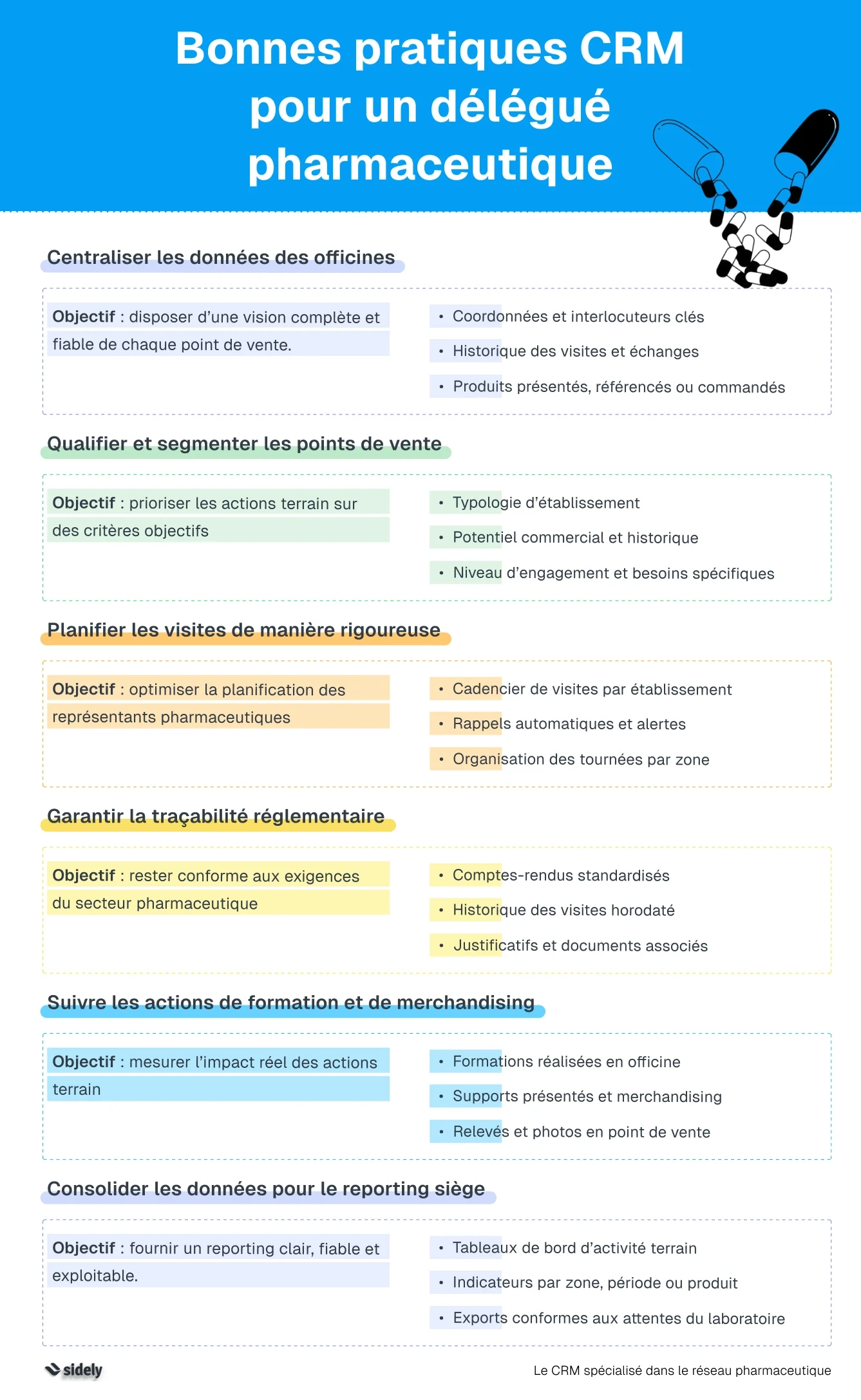
CRM Best Practices for a Pharmaceutical Representative
A high-performing CRM for pharmaceutical representatives relies on structured, compliant, and field-oriented usage. Here are essential CRM best practices in the pharmaceutical industry to improve efficiency while meeting regulatory requirements.
Centralize pharmacy and facility data
Contact details and key contacts
History of visits and exchanges
Products presented, distributed, or ordered
Associated group, central office, or distributor
✅ Objective: have a complete and up-to-date view of each point of sale in the CRM.
Qualify and segment points of sale
Type of establishment (pharmacy, drugstore, hospital...)
Sales potential and history of collaboration
Engagement level and specific needs
Contractual or recommended visit frequency
✅ Objective: prioritize field actions based on objective and consistent criteria.
Plan visits rigorously
Visit schedule defined by establishment
Automatic reminders in case of delay
Rounds organized by area and priority
Visualization of visits on a map
✅ Objective: ensure efficient planning for pharmaceutical representatives and optimize time in the field.
Guarantee the regulatory traceability of actions
Standardized and time-stamped visit reports
History of visits and actions taken
Clear distinction of visit types (information, training, promotion)
Associated supporting documents (assets, photos, signatures)
✅ Objective: ensure complete traceability of visits by the pharmaceutical representative and remain compliant with the pharma sector.
Track training and merchandising actions
Visits dedicated to training pharmacy teams
Tracking of presented materials and topics covered
Merchandising audits and photos at the point of sale
Scheduling of follow-up actions
✅ Objective: measure the impact of field actions beyond order taking.
Consolidate data for headquarters reporting
Dashboards by period, area, or product
Tracking of visits, training sessions, and instore events completed
Data export for the laboratory or management
Coverage and field activity metrics
✅ Objective: provide reliable, actionable reporting that meets the expectations of the laboratory.
Margot has been working in Tech and SaaS for 8 years, with a multi-product experience that has given her a unique understanding of business challenges. On a daily basis, she analyzes, relentlessly tests, and relies on facts to shed light on market trends and help sales teams move forward.
See also

Artificial intelligence and field professions: what our 2026 studies reveal
Adoption, barriers, use cases: discover what our three studies reveal about the role of AI among sector managers, sales representatives, and foodservice sales reps.

CHR and RHF Sales Representatives: portrait of a relationship-driven profession in the era of data
Equipment, productivity, AI: discover the major trends for the HORECA and food service sales profession in 2026 through our field study.

Pharmaceutical Sales Representative in France: Portrait of a Field Job Under Pressure
Compensation, aspirations, AI usage: discover the major trends in the pharmaceutical sales representative profession in 2026 through our field study.

Area Sales Managers in France: who are they and how is the profession evolving in 2026?
Compensation, aspirations, AI usage: discover the major trends in the field sales representative profession in 2026 through our field study.
The area manager professions in 2026
Discover the trends, the challenges, and the key figures.