
How can hospitality sales representatives get 100% out of their CRM?
CRM best practices for hospitality sales reps: prospecting, customer follow-up, order taking, and field loyalty.

In short
9 min read
Optimization of prospecting through fine qualification and rigorous segmentation of the establishment portfolio.
Centralization of client data (history, contacts, orders) for better visibility and effective management.
Structuring of sales follow-up and negotiations to avoid lost opportunities and streamline client relations.
Delivery of essential field functionalities such as mobile order taking and mapping to increase responsiveness.
Implementation of preventive alerts to anticipate churn (loss of clients) and secure loyalty.
Strengthened coordination with distributors through data sharing to maximize the impact of sales visits.
The daily life of a HoReCa sales representative is intense. Highly competitive pressure, a fast-paced prospecting rhythm, and a dense sector—every day requires energy, responsiveness... and great organization.
In a market where establishments regularly change their menus, competition is felt even more. To stand out, you must be consistent, relevant, and capable of offering the right products and the right actions at the right time.
But in the field, lack of visibility remains a real obstacle. Many sales reps waste valuable time trying to find the right contacts, the right information, or properly following up on unresolved leads. This leads to missed opportunities, dry spells... and sometimes lost customers.
This is where the HoReCa CRM becomes an ally. Well-utilized, it structures your prospecting, helps you better track your active accounts, and gives you all the tools to maintain the relationship over time. Before a visit, it prepares your pitch. During, it guides you on the actions to take. After, it allows you to follow up on the next steps, without forgetting anything.
But first, it must be adapted to your field reality: frequent visits, required responsiveness, short sales cycles, and omnipresent competition.
A HoReCa sales CRM is a tool designed to support the field sales representative through their entire sales cycle: from prospecting to customer loyalty, as well as tracking negotiations and order-taking. By applying the right CRM practices adapted to the constraints of the HoReCa sector, the sales rep gains visibility, organization, and efficiency in the field, without weighing down their daily routine.
In this article, let's discover how to transform your CRM into a true commercial co-pilot to boost your prospecting, better track your accounts, and consolidate your results in the HoReCa market.
Using your CRM for HoReCa prospecting
In the HoReCa sector, establishments are numerous. Neighborhood cafes, tourist brasseries, semi-gastronomic restaurants, independent hotels, or large chains: each point of sale has its own specificities, its clientele, its menu, and therefore, its commercial potential. Unless you can be in two places at once, you need to prioritize which establishments to visit.
Qualify well, to prioritize well
To ensure you are visiting the right establishments, you must qualify them well beforehand. Ask yourself the following questions:
What is the real foot traffic of the establishment?
What is the profile of its clientele?
Do they work with a distributor? Is it one of your partners?
What is the volume potential for your product (number of taps, storage capacity, type of menu...)?
Ideally, a qualification survey is already in your CRM. If it hasn't been set up by your manager or CRM manager, ask for it to be done, because qualification is key. In fact, a large establishment does not necessarily guarantee high volumes. Conversely, a small, highly frequented neighborhood bar can became an excellent loyal customer. And only a thorough qualification will allow you to identify that.
Visit the right establishments
Your CRM will help you gain clarity and focus your efforts where the return on investment is the highest. An industry-specific CRM allows you to centralize your data, match it with your targeting criteria, and map out your sector precisely.
To avoid driving around at random and risking missing the best establishments, you must first segment your portfolio (type of establishment, sales volume, associated distributor...) in your CRM. Once this is done, filter the points of sale based on objective criteria (foot traffic, client profile, estimated volume...). Finally, open your map in your CRM. The map allows you to visualize prospecting areas, segment establishments by status (customer, prospect, to visit), and plan your routes according to your objectives.
With a CRM adapted to the field, you can easily build and enrich your prospect database. For example, on Sidely, the Google Maps integration allows you to add an establishment in one click from your smartphone, view its website and menu, and integrate it into your pipeline in real time. It is a simple but powerful reflex: every time you pass by an establishment you do not know, you can qualify it immediately or save it for a future visit.
This is particularly useful because the HoReCa market changes very quickly. Business turnover, amplified by recent economic developments, makes an up-to-date database absolutely essential. A CRM connected to reliable sources like Google My Business prevents you from wasting time on businesses that are closed, incorrectly targeted, or already saturated.
Using your CRM for HoReCa sales tracking
In the HoReCa industry, relationships are a key driver of performance. But for a negotiation to succeed, your pitch alone won't be enough. You still need to keep a clear record of interactions, follow-ups made, and next steps... or risk missing out on great opportunities.
This is surely why HoReCa sales reps generally make good use of CRMs: to structure each interaction and optimize sales tracking. You can record completed meetings, create a sales order, note the specific needs of the business, schedule a follow-up... and centralize everything in the customer history. At a glance, you know where you stand, what is left to do, and how to prioritize your tasks. Above all, you know when you need to go back and see your prospect or new customer if you want them to (re)sign.
Another key element to consider: your distributors. In HoReCa, 80% of the market is controlled by them. Knowing which distributor an establishment works with allows you to immediately adapt your pitch.
Are you already listed? Capitalize on it.
Is that not the case? You will know if you need to open a new account or go through a different entry point.
Remember to link each establishment to a distributor, filter your database based on this criterion, and plan your routes accordingly. You save time, tailor your argument, and target your efforts better.
Even better: you can organize shared sales routes with your distributors or brand ambassadors. By sharing your data, you identify common points of sale to visit, align your goals, and maximize the impact of your visits. A well-structured CRM helps you coordinate these actions, prepare your meetings in advance, and extract maximum value from them.
Finally, to manage your sales performance, a clear and visual opportunity pipeline is essential. It allows you to know how many establishments are in the process of converting, at what stage of negotiation they are, and where to focus your effort to accelerate sales.
Using your CRM to convert your HoReCa prospects
Converting a prospect into a customer often depends on a first order. If your CRM allows you to manage order-taking directly, you save precious time and avoid data entry errors or missed follow-ups.
Directly on the field, during your meeting, offer an assortment tailored to each establishment, taking into account its profile, its needs, its history with your brand(s), or its distributor. You apply the correct prices and negotiated discounts. You can then generate an order form right from your mobile app. The document is exported in PDF format, ready to be shared or signed on the spot with the customer.
Using the order-taking feature directly at the point of sale will allow you to seal the deal immediately, without friction. Once the order is placed and signed, it is automatically saved in the CRM. No need for tedious data reentry at the end of the day, nor to locate scattered notes. You can proceed to the next visit with complete peace of mind.
This step is also the opportunity to note essential information for activating your new customer: number of kegs or cases ordered, POS material needs, delivery terms, opening hours, logistics contact... All these elements are centralized and available at any time.
For brands running launch or loyalty programs, it is also possible to define specific goals per establishment, track their progress, and reward the most engaged customers. This strengthens the relationship and promotes upselling.
Finally, if your products have specific logistics constraints (freshness, limited stock, short shelf-life...), the CRM becomes an ally in managing order frequencies, adjusting volumes, and avoiding overstocking or losses. A forgotten order can quickly turn into an out-of-stock situation at the bar. Conversely, an excess can lead to waste or discourage the client. Hence the value of a reliable tool to plan, anticipate, and deliver just what's needed.
Using your CRM to cultivate loyalty among HoReCa clients
As we mentioned earlier: converting a prospect into a customer requires a first order. For this customer to become an active client, you need to step away from the order process and they must reorder without your direct intervention. And that takes time. Especially in a sector as competitive as HoReCa, where brands can easily be replaced by another option in a distributor's catalog. Customer retention is a commercial lever to maintain performance.
And that starts right at activation. Once the first order is delivered, take the time to check how it went. Let the first dinner service pass, then make a courtesy call. Don't talk about your products just yet. The goal is to show that you are there, available, and that you care about the customer's experience. This attention builds the relationship and facilitates future sales. To do this, as soon as the first order is placed, set a reminder in your calendar (linked to your CRM) the day after delivery. Adjust the time based on the type of establishment: a bar owner won't answer the phone at 8:00 AM, but a restaurant owner might.
Next, track every step of activation: presence of POS material, highlighted products, setup conforming with what was agreed. To do this, pay a courtesy visit to your new establishments a few weeks after the first delivery. Thanks to the reviews and photos taken, you know if the marketing assets were received, in what condition, and if replacements are needed.
You can also track your clients by status (active, at risk, inactive...) and adjust your actions accordingly. A drop in order frequency or longer gaps between purchases can be a sign that a competitor is moving in or that your products are not moving well in the establishment. With a tailored CRM, you receive churn alerts and can intervene quickly.
Additionally, monitor the frequency of your orders. Too early, and you push them to overstock. Too late, and you lose a sale. The CRM helps you find the right timing, based on the profile of each customer, to follow up and offer them a new order. It also allows you to keep a clear history of volumes, contacts, sales, and to suggest an upsell, a new range, or a promotional offer at the right moment.
Finally, do not forget that your brand's visibility is part of retention. If your products are no longer on the menu, or if they are no longer highlighted, the connection fades.
Retaining clients is therefore about anticipating, tracking, and strengthening the customer bond. And for that, you need reliable, up-to-date, and central data.
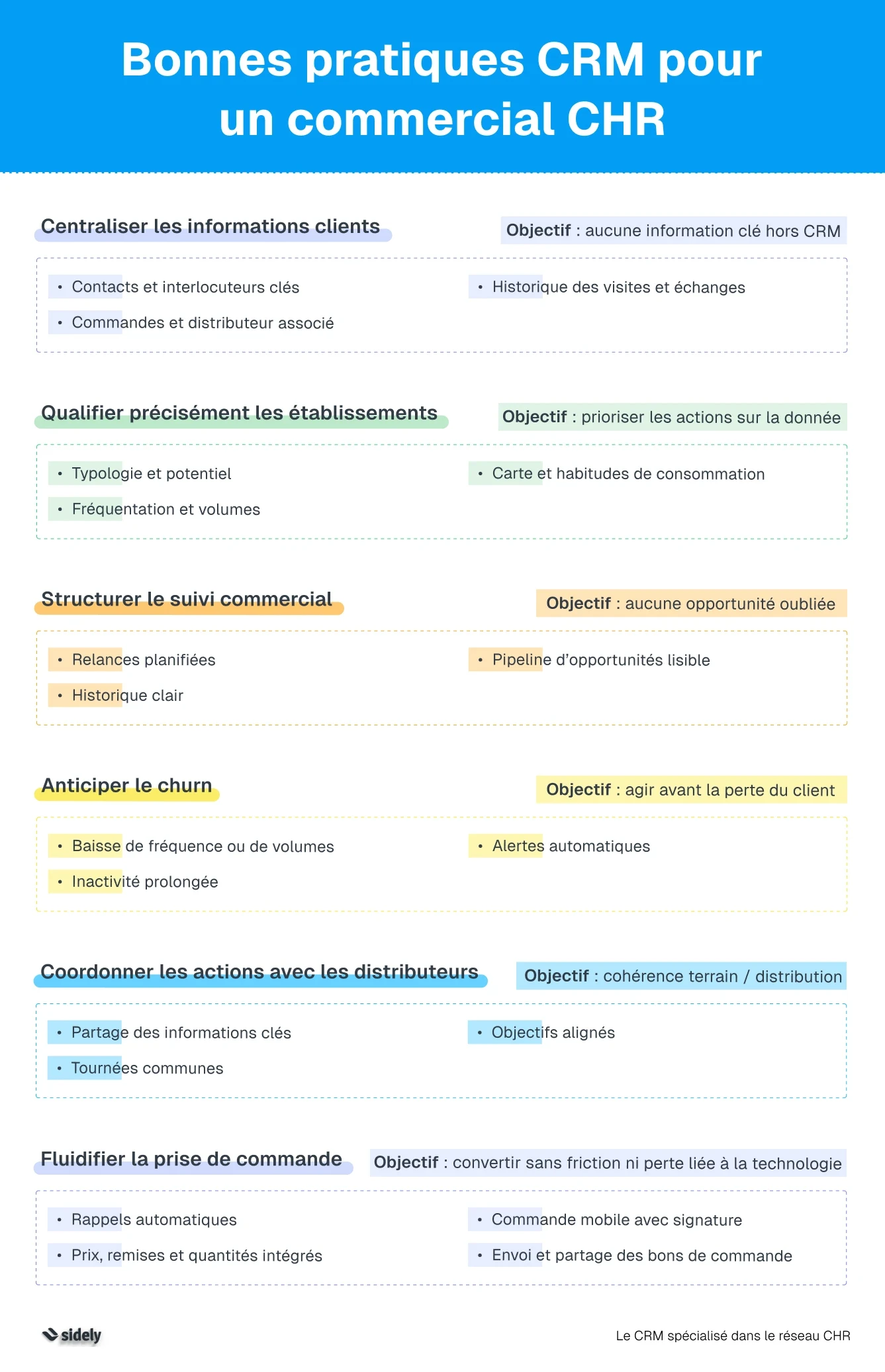
CRM Best Practices for a HoReCa Sales Representative
To be truly effective in the field, a HoReCa sales CRM must be used in a structured way that aligns with the realities of the market. Here are the essential best practices to get the most out of your CRM in HoReCa, while gaining efficiency without weighing down the sales rep's daily routine.
Centralize all customer information in the CRM
A CRM only brings value if all key information is consolidated inside it. Centralizing data provides a clear and shared view of each establishment at any time.
Decision-makers and operational contacts
History of visits and exchanges
Past and current orders
Distributor linked to the establishment
✅ Acceptance criterion: no key information stored outside the CRM.
Precisely qualify each HoReCa establishment
Sales performance relies on a detailed and uniform qualification of the points of sale. A well-qualified establishment makes it easier to prioritize actions and customize the pitch.
Type of establishment
Estimated business potential
Foot traffic and dynamics of the venue
Menu offerings and volume consumed
✅ Acceptance criterion: prioritization based on objective data, not on intuition.
Ensure consistent and structured sales tracking
A good HoReCa sales CRM ensures you never lose track of negotiations and helps organize your activity over time, even with a dense portfolio.
Scheduled and context-aware follow-ups
Clear and actionable conversation history
Readable and up-to-date opportunity pipeline
✅ Acceptance criterion: no opportunities neglected due to lack of follow-up.
Anticipate churn risks thanks to CRM alerts
In a highly competitive sector like HoReCa, customer loss is often preceded by weak signals. The CRM allows you to detect them in time to act quickly.
Drop in order frequency
Decrease in volumes or ordered value
Slowing of product rotation
Prolonged inactivity
✅ Acceptance criterion: stepping in early, before the client switches to a competitor.
Coordinate efficiently with distributors
Sales success in HoReCa also relies on good coordination with distributors. The CRM facilitates the alignment of actions and the preparation of joint visits.
Sharing key information on establishments
Organizing joint sales routes
Aligning goals and field priorities
✅ Acceptance criterion: consistent messaging and actions among the brand, sales rep, and distributor.
Simplify and secure order management
Order taking is a crucial moment in the business relationship. A well-utilized CRM should streamline conversion and eliminate any friction related to technology.
Automated order reminders
Management of prices, quantities, and discounts directly in the CRM
Order-taking on mobile or tablet with on-site signature at the point of sale
Automatic dispatch of order sheets to internal and external contacts
Quick sharing of order sheets right from mobile
✅ Acceptance criterion: a simple, reliable ordering process without client loss due to technical constraints.
FAQ: CRM and sales performance in HoReCa
Why is a CRM indispensable in HoReCa?
What is the difference between a generic CRM and a HoReCa CRM?
What mistakes should be avoided with a HoReCa CRM?
A well-used CRM is not an extra tool. It is a daily support for any sales rep who wants to work smarter: it helps you plan your routes, qualify your establishments, track your negotiations, streamline order-taking, and cultivate your customer relationships over time.
It is by structuring your actions that you will save time, gain clarity... and get results. What if you started using it as your field assistant?
Margot has been working in Tech and SaaS for 8 years, with a multi-product experience that has given her a unique understanding of business challenges. On a daily basis, she analyzes, relentlessly tests, and relies on facts to shed light on market trends and help sales teams move forward.
See also

Artificial intelligence and field professions: what our 2026 studies reveal
Adoption, barriers, use cases: discover what our three studies reveal about the role of AI among sector managers, sales representatives, and foodservice sales reps.

CHR and RHF Sales Representatives: portrait of a relationship-driven profession in the era of data
Equipment, productivity, AI: discover the major trends for the HORECA and food service sales profession in 2026 through our field study.

Pharmaceutical Sales Representative in France: Portrait of a Field Job Under Pressure
Compensation, aspirations, AI usage: discover the major trends in the pharmaceutical sales representative profession in 2026 through our field study.

Area Sales Managers in France: who are they and how is the profession evolving in 2026?
Compensation, aspirations, AI usage: discover the major trends in the field sales representative profession in 2026 through our field study.
The area manager professions in 2026
Discover the trends, the challenges, and the key figures.