

Understanding the Insurance Industry Players
Insurance company, broker, general agent, commercial inspector... Discover the role of each player in the insurance industry and how they interact.

In short
8 min read
The French insurance market is a complex organization that employs over 150,000 people and relies on a value chain structured around risk production, distribution, underwriting, and claims management.
The insurance company is the central and founding player: it designs products, financially carries the risk, and defines the rules under which intermediaries operate.
The underwriter plays a crucial technical role by deciding, outside of automated processes, on the acceptance, rejection, or specific pricing of non-standard risks.
Distribution relies on profiles with various statuses: the general agent (an exclusive representative tied to a company), the broker (an independent representing the client), and the business finder (simple introductions).
There is a clear distinction between the insurance advisor (often an employee, focused on client relations and receiving leads) and the field sales representative (actively prospecting and developing a portfolio).
The sales inspector does not sell directly to policyholders but holds a strategic role in activating, training, and developing the performance of networks (agents, brokers).
The claims manager steps in after the sale to process compensation, with their work serving as a major driver for customer loyalty and satisfaction within the value chain.
With €222 billion in premiums collected in 2023 (France Assureurs), the French insurance market is one of the largest in Europe. It is based on a complex organization, the result of decades of regulation, specialization, and evolving distribution channels. Between companies, mutual insurers, brokers, general agents, and the many sales profiles revolving around them, the sector employs over 150,000 workers directly employed in insurance companies in France.
However, this wealth of players is also a source of confusion. For a customer, it is difficult to know whether their contact is speaking independently or on behalf of the company. For a recruiter, the boundary between a commercial inspector and a field sales representative is not always obvious. And for an organization looking to build partnerships or structure its sales force, understanding who does what is an essential prerequisite.
In this article, we will map out all the players in the insurance sector, from the institutions that bear the risk to the teams that manage claims, including all the profiles that distribute, sell, and manage networks. For each player, we detail their role, their scope of action, and their interactions with other stakeholders in the chain.
Who is this article for?
To industry professionals who want to clarify the boundaries between roles, to sales representatives looking to better understand their environment, and to businesses that collaborate with insurance players.
The industry structure: understanding the value chain
Before diving into the details of each player, it is useful to visualize the insurance value chain as a whole. It revolves around four main phases:
Risk Production → Distribution → Underwriting → Claims Management
Each phase mobilizes specific players with well-defined roles. The insurance company steps in right from the product creation stage, intermediaries and sales reps take over to distribute it, the underwriter evaluates and accepts the risks, and the claims manager comes into play when a covered event occurs.
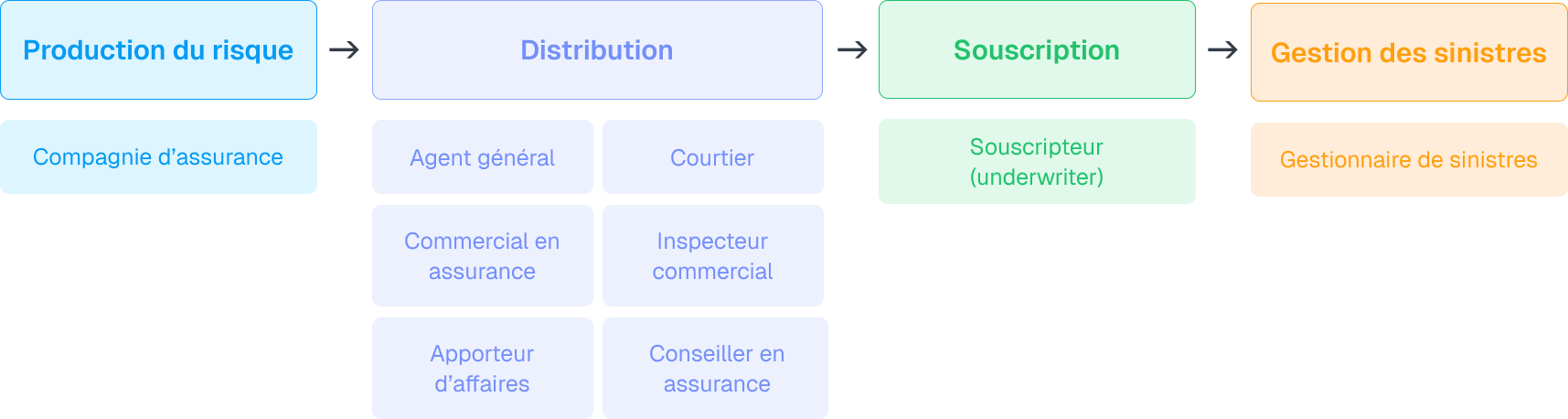
This overall vision is essential because it helps to understand that each player does not operate in a silo, but is part of a chain logic where each link conditions the next. For example, a field sales rep who does not understand the role of the underwriter will struggle to build convincing cases. A broker who ignores the internal mechanics of a company will be less effective in their negotiation.
Institutional players: who carries the risk?
Even before a contract is signed or a sales rep picks up their phone, two players lay the foundations of the entire chain: the company, which creates the product and assumes the financial risk, and the underwriter, who decides on a case-by-case basis if this risk is acceptable. They are the ones who define the rules of the game.
The insurance company
The insurance company is the founding player of the chain. It is the one that financially carries the risk: in exchange for a premium paid by the policyholder, it commits to compensating the losses covered by the contract. To assume this role, it must have sufficient capital, calibrated according to the European Solvency II standards.
But the company is not just a risk carrier. It is also a product designer: it defines the guarantees, exclusions, deductibles, and pricing rules. It sets the conditions under which risks can be accepted, and then delegates their commercialization to a network of distributors.
Three structures carry risk, but differ in their legal status and governance:
The insurance company is a commercial company (SA or SE) with shareholders. Examples: AXA, Allianz, Generali.
The mutual insurer (governed by the Mutual Insurance Code) is a non-profit structure, with no shareholders, governed by its members. Examples: MAIF, MACIF, Harmonie Mutuelle.
The provident institution is jointly managed by representatives of employers and employees. It mainly covers collective risks in businesses (death/disability, collective health insurance). Examples: Malakoff Humanis, AG2R La Mondiale.
The company is at the heart of the network. It mandates general agents to distribute its products exclusively, approves brokers who wish to place risks with it, and employs its own sales inspectors to manage these networks. It also sets the conditions under which underwriters can accept non-standard risks.
The underwriter
The underwriter is often unknown to sales teams, and yet, they play a decisive role in making sales happen.
The underwriter is the technical guarantor of risk on the company side. When a "standard" risk meets the criteria defined by the company, it is accepted automatically. But as soon as a case presents specificities, such as a company with a significant claims history, an atypical industrial risk, or a non-standard profile, it is the underwriter who analyzes the case and decides to accept it, reject it, or price it with specific conditions.
In technical branches (commercial risk, construction, transport, special risks), the underwriter holds considerable authority. They can set high deductibles, impose reduced guarantees, or request risk inspections before any commitment.
For a sales rep who needs to structure their prospecting, document their interactions, and track their opportunities over time, having a sales CRM or a sales dashboard tool can make a real difference in the quality of the cases sent to the underwriter.
Good to know
In some companies, experienced brokers or agents benefit from underwriting authority, meaning they have the right to accept certain risks on behalf of the company, within contractually defined limits. This is a token of trust and efficiency that rewards the top-performing intermediaries.
Distribution players: who sells insurance?
Distribution is the most active phase in terms of players. This is where customer relationship, sales acquisition, and retention happen. Several profiles coexist, with quite distinct statuses, mandates, and compensation models.
The general insurance agent
The general agent is an exclusive representative of an insurance company. Unlike brokers, they can only distribute products from the company that appointed them. In exchange for this exclusivity, they benefit from signage, brand awareness, management tools, and commercial and technical support.
The general agent is a self-employed worker, governed by a professional status specific to the sector. They head their own agency, potentially employ staff, and manage a customer portfolio for which they are primary responsible. They receive commissions on collected premiums.
Their scope of activity is generally local or regional: they know their area, maintain close relationships with their clients, and represent the company during key moments (signing contracts, reporting claims, renewals). This local footprint is part of broader strategies for insurers' regional development, aiming to strengthen market coverage and customer proximity.
Difference with brokers
The distinction is fundamental: the general agent represents the company, whereas the broker represents the customer. The general agent cannot search for a better price from a competitor; they are tied to their company. The broker, on the other hand, is free to place risks wherever they deem best for their client.
In France, general agents represent one of the densest distribution networks in the sector. According to AGEA, there are approximately 12,000 general agents spread across the country. This regional network remains a major asset for reaching SMEs and individuals in areas where salaried networks have little presence.
The insurance broker
The broker is an independent intermediary, a representative of their client and not the insurance company. Their role is to search the market for guarantees best suited to their client's needs, at the best quality-price ratio. This approach is often part of portfolio development strategies, particularly through cross-selling. To practice, they must be registered with the ORIAS under the status of Insurance Broker.
The broker is compensated mainly through commissions paid by the companies with which they place risks. These commissions are deducted from the premiums paid by the customer. In some cases, particularly in large corporate brokerage, part of the compensation may also be billed directly to the client as fees.
The world of brokerage is itself very diverse:
Retail brokers: they work with individuals and small businesses (VSEs/SMEs) on relatively standardized products (auto, home, health, life/disability).
Wholesale brokers: they work with other intermediaries (agents, other brokers) to whom they offer underwriting capacity on specific risks.
Specialist brokers: they focus on technical niches (industrial risks, agricultural risks, cyber-risks, art, aviation, etc.).
Large brokerage networks (Verspieren, Gras Savoye, Verlingue, Marsh, etc.) employ dozens or hundreds of staff. At the other end of the spectrum, many brokers are human-sized operations or independents.
The insurance business finder
The business finder is an intermediary status, often overlooked, which holds a growing place in the insurance ecosystem.
The business finder is not an employee of the company or broker they work with. They are paid on a finder's commission basis, in proportion to the contracts closed thanks to their introductions. They do not have the right to advise the client on the choice of contract; that role belongs to an authorized intermediary. Their role is strictly limited to making commercial introductions.
To operate legally, the insurance finder must be registered with the ORIAS under the status of Insurance Intermediary (IAS). This registration requires meeting professional competence, integrity, and professional indemnity insurance conditions. The ACPR (French Prudential Supervision and Resolution Authority) monitors compliance with these obligations.
Difference with brokers and advisors
Unlike brokers, business finders cannot compare offers or advise clients: they limit themselves to recommendations. Unlike insurance advisors (often employees), they have no subordination relationship with an insurance company or network. It is a flexible profile, used in particular by real estate networks, accountants, or car brokers to generate additional income.
The insurance advisor
The insurance advisor is a profile closer to a salaried sales representative than an independent intermediary. They are mainly found in three types of structures:
The salaried networks of companies (own branch agencies, call centers)
The bancassurance players (Crédit Agricole Assurances, BNP Paribas Cardif, Société Générale Insurance, etc.)
The large mutual insurers with a direct agency network
Their role is centered on customer relationship: greeting, analyzing needs, presenting guarantees, signing contracts, and portfolio follow-up. They generally work in branches or by phone, managing an existing portfolio as well as inbound prospecting. Unlike brokers, they do not have placement freedom: they distribute their employer's products.
Distinction with field sales representatives
The difference with the insurance sales representative lies in stance and prospecting style. The advisor often waits for the client to come to them or responds to inbound leads. The field sales rep, on the other hand, is active in acquisition: they prospect, start sales cycles, and manage more complex B2B relationships.
This reality is reflected in broader role challenges, particularly around prioritizing actions or the quality of client discovery, as detailed in approaches surrounding the sales discovery phase.
Field sales players: who develops the portfolio?
While intermediaries distribute, field sales reps conquer. Their role is not to passively introduce or advise, but rather to go out and find new clients, negotiate, and build a portfolio.
The insurance sales representative
The insurance sales representative is the driving force behind commercial growth in the sector. Their daily routine is all about acquiring new clients and growing their portfolio.
Their missions vary depending on their target market:
In B2C (individuals), they manage a geographical area, prospect, and advise clients on their home, auto, health, or life/disability insurance needs.
In B2B SME, they target business owners to offer solutions in commercial multi-risk, car fleet, collective life/disability, or professional liability.
In the key accounts segment, they manage long sales cycles involving multiple stakeholders (CFO, HRD, Risk Manager) and customized solutions.
Their typical week alternates between prospecting (outbound calls, CRM updates, follow-ups), client meetings (discovery, offering presentations, negotiations), and administrative follow-up (quotes, submission to underwriters, active contract management). These challenges are directly linked to matters like setting sales objectives or the cost of a mis-targeted sales visit.
In structures equipped with a CRM tailored for field teams, they have tools to manage their pipeline and prioritize their actions.
The insurance sales inspector
The sales inspector is a profile often confused with the field sales representative, mistakenly. Their role is fundamentally different: they are not there to sell directly to policyholders, but to animate and develop a network of distributors (general agents, brokers, sometimes bank advisors).
Concretely, the sales inspector regularly visits the intermediaries in their area to:
Train them on new products and guarantees
Motivate them commercially, setting their goals
Help them build complex cases or prepare bids
Solve technical or administrative issues blocking sales
Identify growth opportunities in their region
They are, in a way, the outsourced sales director for their intermediaries.
Difference with classic sales representatives
Where the sales rep sells, the inspector makes sales happen. Their effectiveness is measured not by their own sales, but by the performance of the network they manage. It is a profile that requires as much training and relationship-building skills as commercial ones. They must know how to influence without hierarchical authority, making it a demanding role.
For a company distributing through independent agents or brokers, the sales inspector is the main leverage to activate the network. A poorly managed network is a network that sells little or sells competitors' products. Companies therefore invest heavily in their sales inspection teams, providing them with tracking and management tools for network activity.
Management players: who handles processing after the sale?
Once the contract is signed, the customer relationship does not stop; it enters its most sensitive phase. This is where the claims manager steps in, often invisible on commercial charts, but whose work directly conditions customer satisfaction and, ultimately, the retention rate of the portfolio.
The claims manager
The claims manager steps in after the sale, when a policyholder reports an event covered by their contract. Their role is to process the claim and handle compensation in compliance with the purchased policies.
Concretely, the claims manager:
Receives and registers claims
Verifies the case conformity with policy coverage
Mandates loss adjusters if necessary (auto expert, property surveyor, medical expert...)
Negotiates settlement with the policyholder or their legal advisors
Processes payments in compliance with regulatory deadlines
In France, the Badinter law imposes strict deadlines for personal injury auto claims; the IRSI convention regulates property claims between insurers; the IRCA convention governs claims settlements between auto companies. The claims manager is the guarantor of compliance with these rules.
The relationship between sales reps and claims managers is often underestimated, yet it is strategic in several ways:
A poorly compensated customer is a lost customer, and potentially one who speaks negatively about the company to their network. Sales reps have every interest in flagging problematic cases to managers.
In B2B, sales reps are sometimes contacted directly by their clients during a major claim. Knowing the contacts in management allows them to act as a helpful interface.
The loss ratio of a client portfolio can influence renewal terms: an informed sales rep knows how to anticipate these situations to prepare for negotiating with the underwriter.
Good to know
In companies structured around "account management," sales reps and claims managers follow the same client portfolios together. This model, common in the corporate market, promotes service quality and loyalty.
In companies structured around "account management," sales reps and claims managers follow the same client portfolios together. This model, common in the corporate market, promotes service quality and loyalty.
Player | Reporting structure | Primary mission | Key contact | Compensation |
|---|---|---|---|---|
Insurance company | Carry the risk, design products | All players | Premiums net of claims | |
Underwriter | Company | Analyze and accept risks | Brokers, agents, sales reps | Fixed salary |
General agent | Company (exclusive mandate) | Exclusively distribute | Clients, sales inspectors | Commissions on premiums |
Broker | Independent (client mandate) | Compare and place risks | Clients, companies | Commissions + fees |
Business finder | Independent | Introduce, generate leads | Brokers, agents | Finder's commission |
Insurance advisor | Salaried network / bank | Advise and retain the client | Clients | Fixed salary + performance bonus |
Insurance sales rep | Company / brokerage | Prospect and grow revenue | Prospects, B2C/B2B clients | Fixed salary + performance bonus |
Sales inspector | Company | Animate and develop the network | Agents, brokers | Fixed salary + performance bonus |
Claims manager | Company / delegated manager | Investigate and settle claims | Policyholders, adjusters, sales reps | Fixed salary |
The insurance sector is not opaque by nature, it is simply dense. Each player has a precise place in an interdependent value chain, with distinct roles, mandates, and compensation models.
Understanding this organization is useful at all levels: for a field sales representative who wants to better qualify their prospects, for an inspector looking to strengthen relationships with a network of agents, or for sales management wanting to structure their distribution strategy.
And this is where tools make the difference. Managing an insurance sales force, whether it's a team of B2B sales reps or a network of inspectors managing distributors, requires strict organization: tracking visits, managing portfolios, field reporting, channel-specific goals. This is precisely what Sidely allows to structure and manage daily.
Taina left her position as Area Manager at AB InBev for marketing and communications, a true career choice. Having experienced the reality of the sales force from the inside, she writes about the profession without ever distorting it. She doesn't just talk about the field; she comes from it. Outside the office, she tracks down the best tables in town: finding the right spot is a serious business.
See also

Artificial intelligence and field professions: what our 2026 studies reveal
Adoption, barriers, use cases: discover what our three studies reveal about the role of AI among sector managers, sales representatives, and foodservice sales reps.

CHR and RHF Sales Representatives: portrait of a relationship-driven profession in the era of data
Equipment, productivity, AI: discover the major trends for the HORECA and food service sales profession in 2026 through our field study.

Pharmaceutical Sales Representative in France: Portrait of a Field Job Under Pressure
Compensation, aspirations, AI usage: discover the major trends in the pharmaceutical sales representative profession in 2026 through our field study.

Area Sales Managers in France: who are they and how is the profession evolving in 2026?
Compensation, aspirations, AI usage: discover the major trends in the field sales representative profession in 2026 through our field study.
The area manager professions in 2026
Discover the trends, the challenges, and the key figures.