

How to get 100% out of your CRM?
Discover how to fully leverage your sales CRM: choosing the right solution, its role, usage...

In short
10 min read
Getting 100% out of a CRM means leveraging all the features that meet your actual needs rather than every single available option.
Success relies on a rigorous selection process based on precise specifications that distinguish essential features from secondary ones.
The implementation phase must be structured to foster collective adoption and adapt business processes to the chosen tools.
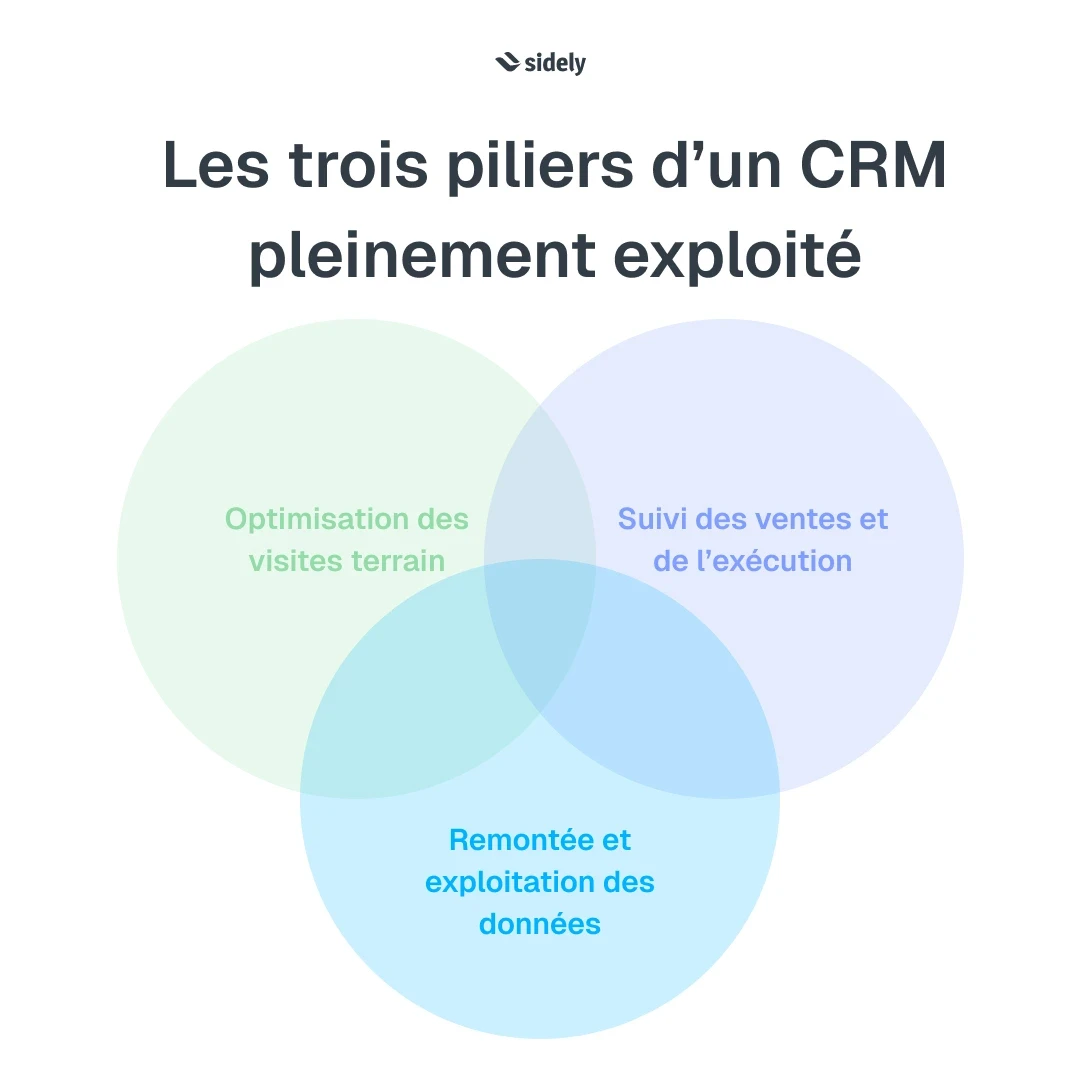
The effectiveness of the CRM rests on three cross-cutting pillars: optimizing visits, rigorous sales tracking, and reliable utilization of field data.
Each role within the organization (director, sales representative, manager) derives a different operational value from the tool, thereby ensuring its global performance.
CRM is often presented as the ultimate answer to all sales challenges. And, to a certain extent, that is true. But on one essential condition: that it is truly adopted and used by all of your teams, from sales reps to the CRM Manager. Without this collective adoption, you will never be able to exploit its full potential and turn your CRM solution into the strategic asset it should be.
A CRM software is not a magic wand, but a tool that must be mastered. Just like in a game of poker, everything depends on how you play your hand, and not necessarily on the cards you have.
In this article, we will look at how to make your CRM a real driver of performance at the point of sale, regardless of your role in the organization.
Exploiting 100% of your CRM: a relative concept
First, let me share my vision of what it means to "get 100% out of your CRM." Getting the most out of your CRM does not mean using 100% of the available features, but exploiting 100% of those that meet your actual needs.
If you find that your needs only require a small part of the solution (for example, 50% of the features), this may indicate that your CRM project was oversized. In this case, it is legitimate to question the suitability of the chosen solution and, if necessary, consider a more appropriate tool.
From selection to implementation: how to fully exploit your CRM
If you are reading this, it is probably because your company is already equipped with a CRM or SFA. You are now looking to understand how to fully leverage the potential of your sales solution.
By fully exploiting your CRM, you will transform it into a real performance driver: automation of time-consuming tasks, optimization of visits, structured sales, improved data quality... In short, a CRM exploited to 100% is an investment that pays off, a satisfied management team, and more effective sales representatives.
But how do you manage to get the best out of your CRM? This relies on two key steps.
Phase 1: choosing the CRM solution
The first step consists of selecting the solution suitable for your needs. For this, drafting precise technical specifications is essential. It must distinguish between:
Indispensable features, without which the CRM would not address your challenges.
Secondary features, which can be an asset, but whose absence is not a dealbreaker in choosing the solution.
Some solutions even publish the list of their features on their website, which makes comparison easier.
During this phase, you start from your concrete problems (for example: "my sales reps take too long to do their routes", "I have too high of a rate of wasted store visits", "I can no longer get an accurate picture of what is happening in the field"...), and you identify the solution capable of solving them.
You can also plan for specific developments tailored to your business. These custom-made features are often the most exploited, because they directly address your priorities.
Phase 2: CRM implementation
Once the solution is chosen, the implementation phase begins. This must be framed and structured for successful adoption. You will then have:
The features of the chosen CRM/SFA solution.
Specific developments carried out for your company (optional).
At this stage, the approach is reversed compared to phase 1: you start from the solution itself to analyze how its various features can address your issues. Certain options, initially deemed secondary, can prove valuable when they are integrated into your processes.
Let's take a concrete example. You opt for a CRM that integrates user rights and roles management. Until now, every collaborator had access to all data without restriction. By leveraging this feature, you define differentiated access: sales representatives only see information that concerns them, while managers have a more global view. This gives you a simplified interface for field teams and increased security for sensitive data.
The three pillars of a fully exploited CRM
The three pillars we present here are not chosen at random. They form the foundation of any business CRM designed for mobile sales teams, because:
They cover the entire store visit cycle: from preparation beforehand to the in-field execution and post-visit analysis;
They meet the expectations of all hierarchical levels, from operational sales reps to sales management, making them truly cross-functional pillars;
They determine the effectiveness of all other features: automation, alerts, integrations, and AI only have an impact if visits are well organized, sales tracking is structured, and data is reliable.
These three pillars are the foundation upon which everything else is built.
Pillar 1: field visit optimization
The first pillar of a specialized CRM lies in smart visit planning. It saves time in organizing routes by prioritizing stores based on criteria such as numeric distribution, sales potential, or merchandising alerts.
Schedules and routes are optimized based on location, which limits unnecessary travel. Store profiles, enriched with a complete history (assigned objectives, past visits, previous audits), offer a clear view even before entering the aisle.
The impact is immediate: more targeted visits, better time allocation, and much more effective field coverage.
Pillar 2: sales tracking and execution
The second pillar concerns sales management and store execution. Without a suitable tool, opportunities get lost, promotions are poorly monitored, and some orders slip through the cracks during reporting. A CRM eliminates these pitfalls.
This visibility fosters better execution, stronger responsiveness to clients, and, ultimately, a tangible increase in sales.
Pillar 3: Data reporting and exploitation
The third pillar, often underestimated, is the collection and utilization of field data. Too often, reports are incomplete, submitted late, or difficult for headquarters to utilize. A specialized CRM fixes this weakness by guiding the sales representative with tailored forms: numeric audits, shelf photos, voice dictation to speed up input.
Management thus has a solid foundation for adjusting sales strategy, while field teams benefit from concrete, actionable feedback.
One tool, several roles: to each their own challenges
A business CRM is not used in the same way by everyone. Depending on one’s role in the organization, people work differently with the sales solution. Every user finds a different value in it. Here is how.
The Sales Director: global steering
For the sales director, the CRM is the cockpit. It offers a consolidated view of field activity: visits completed, promotion execution, orders taken, or even linear shelf share.
Thanks to dashboards, they can track key indicators and measure performance in real time.
The tool also allows them to align teams with commercial priorities, detect high-potential areas, and quickly adapt strategy.
The Area Manager: effectiveness in store
Where the sales director steers a big-picture view, the area manager focuses on the daily routine. For the latter, the CRM is primarily a pocket assistant that structures their point-of-sale visits.
The tool allows them to prioritize high-potential stores, prepare each visit with a complete history, and save time.
During the visit, they can place an order, perform a shelf audit, or check a promotion in just a few clicks. At the end of the route, the report is automated and sent to headquarters. The CRM thus becomes the guarantor of their daily effectiveness and field productivity.
The On-Trade Sales Rep: local prospecting and customer loyalty
A different distribution network means different objectives. An On-Trade (HoReCa) sales rep's mission includes prospecting new establishments, developing local sales, and retaining existing clients. This is why HoReCa sales teams are often larger than in grocery retail (GMS).
To take full advantage of their CRM, they can segment targets (bars, hotels, restaurants), plan appointments, and track ongoing negotiations. They have a detailed history for each client, which facilitates follow-ups and strengthens the business relationship. The CRM also allows them to detect drops in order volume and act quickly. In other words, it is the tool that helps them grow their portfolio and build lasting relationships with venues.
The Medical and Pharmaceutical Rep: compliance and relationship tracking
When selling parapharmaceutical products, training is highly important. That is why the CRM must enable this follow-up, and combine regulatory rigor with close relationships, if pharmaceutical reps want to pull the full potential from their commercial software.
The tool allows them to plan visits while respecting mandatory frequencies, track every interaction with doctors and pharmacists, and enter complete reports that comply with requirements. The CRM also facilitates relationship management: history of exchanges, expressed needs, required follow-ups. For labs and headquarters, it ensures transparent reporting and optimal field coverage. In this specific field, the CRM is as much a guarantee of compliance as a tool for commercial performance.
The CRM Manager: between data quality and administration
Here, the CRM is a tool for administration, customization, and supervision. They ensure field standardization, set up workflows adapted to field needs, and make sure the solution remains simple to use to encourage adoption. Their role is also to produce reliable reporting for management and to evolve the CRM at the pace of business needs. For a CRM manager, getting 100% out of the tool means ensuring a robust data foundation and a seamless experience for all users.
Sales Agencies: between client tracking and transparency
Here, we are not talking about a role within a company, but about a separate business entity that has its own CRM needs. For a sales agency, the CRM addresses a dual challenge: managing clients and reporting back to partner brands.
The tool makes it possible to centralize all multi-brand information, track the activity of the agency's reps, and produce clear, regular reports. Each brand must benefit from total transparency regarding visits made, results obtained, and field performance.
Internally, the agency gains efficiency and credibility thanks to reliable, consolidated data. The CRM then becomes a trusted partner and the buffer that reinforces the trust relationship between the agency, its clients, and its partners.
Fully exploiting your CRM does not mean using all of its features, but rather those that meet your actual needs. This involves two key steps (solution choice and implementation) followed by daily usage structured around three fundamental pillars: field visit optimization, rigorous tracking of sales and execution, and reliable data reporting.
Each role finds specific value in the tool. But it is especially in their complementarity that the CRM reveals its full potential: a more efficient sales rep, a better-informed manager, and headquarters capable of steering its strategy on a solid foundation.
Margot has been working in Tech and SaaS for 8 years, with a multi-product experience that has given her a unique understanding of business challenges. On a daily basis, she analyzes, relentlessly tests, and relies on facts to shed light on market trends and help sales teams move forward.
See also

Artificial intelligence and field professions: what our 2026 studies reveal
Adoption, barriers, use cases: discover what our three studies reveal about the role of AI among sector managers, sales representatives, and foodservice sales reps.

CHR and RHF Sales Representatives: portrait of a relationship-driven profession in the era of data
Equipment, productivity, AI: discover the major trends for the HORECA and food service sales profession in 2026 through our field study.

Pharmaceutical Sales Representative in France: Portrait of a Field Job Under Pressure
Compensation, aspirations, AI usage: discover the major trends in the pharmaceutical sales representative profession in 2026 through our field study.

Area Sales Managers in France: who are they and how is the profession evolving in 2026?
Compensation, aspirations, AI usage: discover the major trends in the field sales representative profession in 2026 through our field study.
The area manager professions in 2026
Discover the trends, the challenges, and the key figures.