
Furniture and home decor network in France: a guide for manufacturers
Retail brands, distribution channels, market size, and challenges for manufacturers: everything you need to understand about the furniture and home decor network in France.

In short
15 min read
The French furniture market is demonstrating a strong capacity for adaptation despite a decline in overall demand in 2024.
Distribution is structured around large specialized stores (IKEA, BUT, Conforama), DIY and food retailers, and a growing e-commerce sector.
Price image is the predominant criterion for French consumers, favoring accessible retailers and private labels.
The sector is evolving toward more responsible models (eco-design, made in France) and omnichannality, which has become the norm for both brick-and-mortar and e-commerce retailers.
Commercial success now depends on rigorous execution (trade marketing and retail execution) across a complex and competitive distribution network.
Artificial intelligence and omnichannality are major strategic levers to optimize performance and visibility for manufacturers.
In a tense economic context, the French furniture and decoration market is showing a remarkable capacity to adapt. Indeed, despite an overall decline in demand in 2024, certain players are maintaining excellent commercial results, while new trends are injecting a dynamic momentum that brings opportunities for manufacturers in the sector.
For any brand wishing to grow in this market, a fine-tuned understanding of its ecosystem is essential, particularly due to a rich and diverse distribution network.
Here, Sidely offers you an in-depth exploration of the furniture and decoration network in France.
Our analysis will highlight the market structure, its key players, and its preferred distribution channels. We will then decipher the major trends rewriting the rules of the sector. Finally, we will examine the relational mechanisms between brands and distributors, identifying winning strategies to get listed and maximize your commercial performance.
Overview of the French Furniture Market
To understand the furniture and decoration network, let's start by identifying the different types of players that compose it.
Market Organization, Segments, and Distribution Channels
In the top position for furniture sales, we find large specialized stores such as IKEA, BUT, Conforama, Maisons du Monde, Alinéa, Fly, Habitat, and Roche Bobois. These players are also present online with omnichannel offerings.
Next come players from related industries; large DIY stores like Leroy Merlin or Castorama position themselves in this market in a secondary manner, as do large food retailers such as E. Leclerc, Carrefour, or Monoprix, which leverage the unmatched foot traffic of their stores (hypermarkets and supermarkets) to capture a significant market share.
The furniture market also includes specific segments such as outdoor furniture, fitted kitchens, or bedding, each with several renowned brands, such as Cuisines Schmidt or Mobalpa in the kitchen specialist category.
Finally, some players position themselves in small equipment / variety stores - which is notably the case with GIFI - or hard discount and clearance, with players like Action (the favorite brand of French consumers across all sectors!) or Stokomani.
Despite the strength of brick-and-mortar retail in France, a growing share of revenue is captured by players specialized in e-commerce, with platforms like Amazon, Cdiscount, La Redoute (with its subsidiaries La Redoute Intérieurs and AM.PM), or ManoMano. Foreign players like Wayfair have also managed to capture a large share of the French market. Finally, e-commerce includes many pure players, such as Miliboo, Kave Home, Drawer, Sklum, Home24, and Westwing, each in their own niche (furniture, decoration, private sales, etc.).
💡Some of these distributors are also manufacturers, such as Tikamoon or H&H.
We can thus categorize the furniture network into distribution channels, each with its own purchasing logic, logistical constraints, and expectations towards brands.
Category | Representative Brands | Description |
|---|---|---|
Large Specialized Furniture Retail | IKEA, Conforama, But, Maisons du Monde, ALINEA | Complete range of furniture and decoration for all areas of the home, wide selection at accessible prices. |
Premium / Design Retailers | Roche Bobois, BoConcept, Ligne Roset, Cassina | High-end brands prioritizing quality, aesthetics, and original creations designed by renowned designers. |
Discount / Variety Stores | GIFI, Centrakor, Action, La Foir'Fouille, Stokomani | Outlets focused on low prices, varied selection of decoration and accessible small furniture, fast product rotation, and strong promotional appeal. |
General Food & Hypermarket Retail | Carrefour, Leclerc, Auchan, Casino | Hypermarkets and supermarkets with "home equipment" aisles or corners, offering convenience and competitive pricing to their regular customer base. |
Specialized Decoration Stores | Casa, Zara Home, Søstrene Grene, Habitat | Decoration and home accessories, regularly updated trendy collections, mid-range positioning. |
DIY Stores with Decoration Department | Leroy Merlin, Castorama, Bricorama, Brico Dépot, Mr. Bricolage | Distributors of building materials and tools that have expanded their offering to home staging and decoration. |
E-commerce Pure Players | Made.com, Westwing, Wayfair, ManoMano, La Redoute Intérieur | 100% online players, wide range of home products, innovative digital shopping experience, and optimized logistics. |
Concept Stores / Independent Boutiques | Fleux, Merci, The Cool Republic, Empreintes | Outlets with a carefully curated atmosphere offering a sharp selection of original pieces, often artisanal or ethical. |
Kitchen Specialists | Schmidt, Cuisinella, Mobalpa, Ixina, Socoo'c | Custom kitchen design (personalized layout, advice, and installation), ranges extending from entry-level to high-end and associated services (financing, warranties). |
Garden Furniture | Truffaut, Jardiland, Botanic, Hesperide, Fermob | Equipment dedicated to outdoor spaces, seasonal ranges combining functionality and weather resistance. |
Bedding | Grand Litier, La Compagnie du Lit, Maison de la Literie, Tempur, Maliterie | Sleep industry specialists (mattresses, bed bases, and accessories), messaging focused on comfort and well-being, personalized advice. |
DNVBs and Short Supply Chains | Tediber (bedding), Made in Design, Popus Editions, La Fabrique à Déco, Blomkal | Digitally native brands and manufacturers favoring short supply chains, offering a value proposition centered around transparency, eco-responsibility, and a direct relationship with the consumer. |
Source: http://www.ameublement.com
The Market in a Few Key Figures
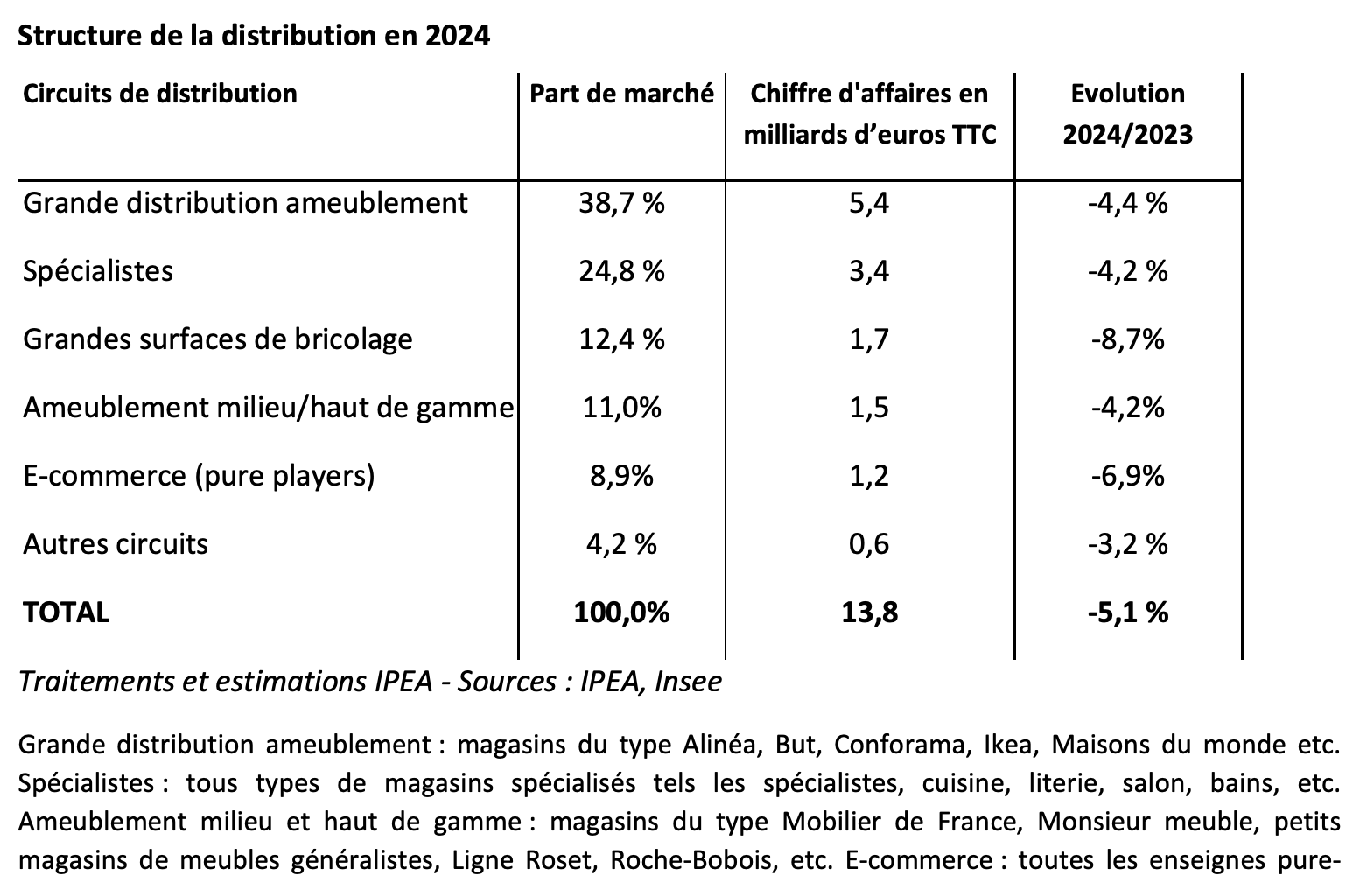
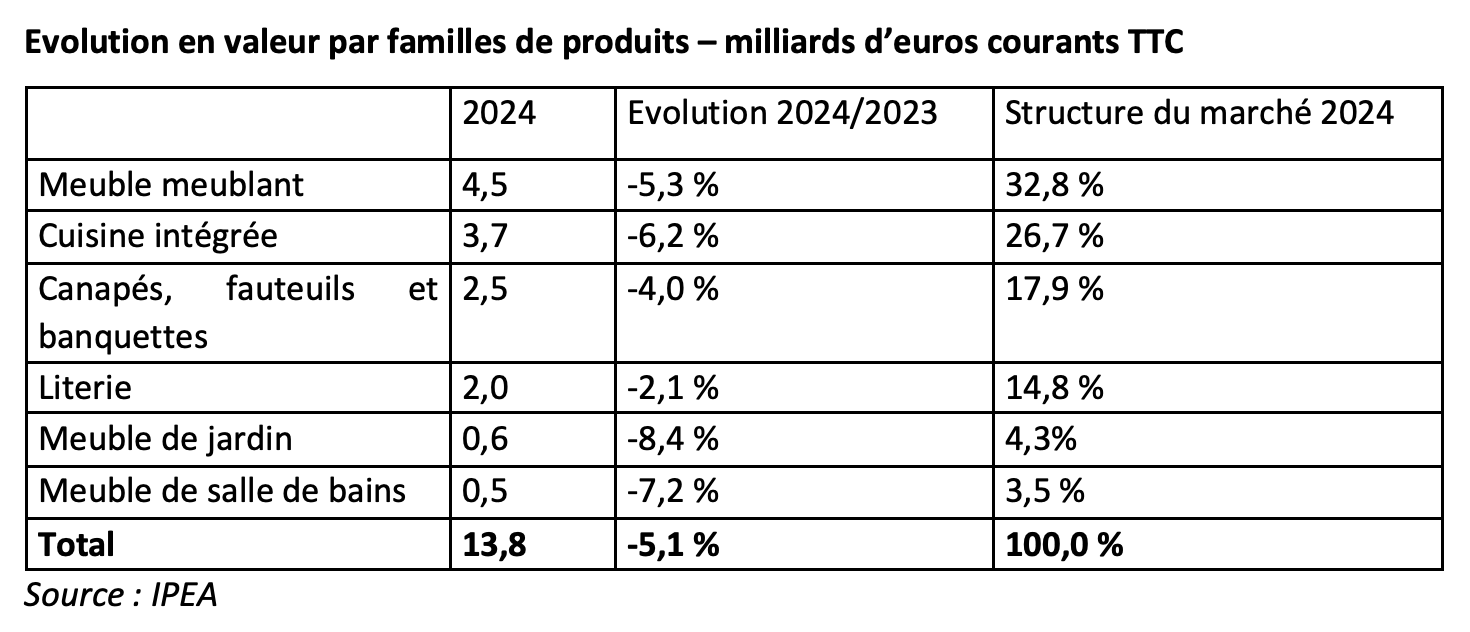
L’Ameublement français places the tax-inclusive value of the furniture market at EUR 13.8 billion in 2024, representing a 5.1% decline compared to 2023. Market activity is characterized by an overrepresentation of replacing existing furniture compared to new purchases (real estate projects or moving in).
Large specialized furniture stores capture nearly 40% of sales, whether in-store or online. The only segment that still largely escapes them is built-in kitchens; here, players like Cuisines Schmidt or Mobalpa reign supreme. This segment, moreover, absorbs a quarter of the French furniture budget.
If we were to add other specialists (living room, bedding, etc.), this channel could literally dominate the sector in terms of weight. Next come DIY stores (13%). Although still in the minority, pure players like Cdiscount or Veepee are closing in on 10% market share. There is also steady growth in office furniture sales from 2020 to 2023.
The outdoor furniture market, meanwhile, is valued at 700 million euros (Xerfi), with sustained growth in recent years. The segment is dominated by the same specialized furniture retailers (Ikea, But, Conforama, etc.) and DIY stores (Leroy Merlin, Castorama, etc.) as indoor furniture.
Furthermore, while traditional retailers face the rise of pure players, especially in decoration, economic tension is pushing many French people to turn to the second-hand market. Price sensitivity also works in favor of private labels, which capture 20% of new product revenue.
Finally, some manufacturers are very popular in the French market: Ligne Roset, BoConcept, Gautier, Steelcase, and Roche Bobois are also highly popular across France. It is worth noting that independent artisans remain extremely present in the furniture economy, although their share of the final revenue is less than 20%.
The year 2024 saw all channels decrease in value, as French households still felt that their purchasing power was eroding, although this fact is contested by economic data. Thus, caution and savings won out over the urge to spend.
Source: www.ameublement.com
💡A Resilient Sector
Good traffic on websites specialized in furniture confirms that French consumers are actively thinking about their interior design, even if many purchase projects are being postponed until a more stable economic climate arrives.
Furthermore, although overall performance in 2024 shows a decline, the total number of physical outlets has not decreased in recent years, demonstrating good resilience of the sector to the combined effects of Covid and inflation.
2025 could mark the return of growth in household consumption, as analyzed by
L’ameublement français
Leading Retailers and Key Figures
The French furniture market remains dominated by a few large physical retail brands, starting with IKEA, the undisputed leader, with a turnover of 3.7 billion euros in France (2023) and a network of 36 stores across the country. Distributing its own products, the Swedish giant cannibalizes a large part of the channel to the detriment of industrial manufacturers.
Next come BUT and Conforama, now brought together under the same banner since their merger within the Mobilux group. Together, they form the largest furniture network in France by number of points of sale. BUT has around 330 stores for an estimated turnover of 2.1 billion euros, while Conforama maintains around 170 stores for a turnover of around 1.7 billion euros (2023).
Among other specialized chains, Maisons du Monde stands out for its home-decor positioning and national footprint, with more than 230 stores in France and an overall turnover of 1.5 billion euros (2023), a significant portion of which is generated online.
Alinéa, following restructuring, currently operates about twenty stores for a turnover of approximately 500 million euros. Fly, whose visibility has shrunk, retains a few dozen corporate or franchised outlets. And Habitat, now owned by Cafom, continues its activity with about ten stores.
Finally, Roche Bobois, positioned in the premium segment, has around 80 points of sale in France, with a global turnover of 534 million euros (2022), a significant portion of which is generated in France.
Retailer | Category | Latest Known Revenue (France) in €M | Year (Revenue) | Number of points of sale (France) | Possibility to list your products |
|---|---|---|---|---|---|
IKEA | Generalist Furniture | 3,700 | 2024 | 36 | 100% private label |
BUT | Generalist Furniture | 2,122 | 2022 | 323 | Lists third-party brands |
Conforama | Generalist Furniture | 1,762 | 2023 | 178 | Lists third-party brands |
Maisons du Monde | Furniture & Decoration | 1,002 | 2024 | 193 | Lists third-party brands (partial) |
Alinéa | Generalist Furniture | 183 | 2023 | 30 | Essentially private label |
Monsieur Meuble | Generalist Furniture | 150 | 2022 | 100 | Lists third-party brands |
Roche Bobois | High-end Furniture | 119 | 2023 | 340 | Exclusive or co-developed collections |
Ligne Roset | Design Furniture | 101 | 2023 | 150 | 100% private label |
Habitat | Furniture & Decoration | 65 | 2022 | 25 | Lists third-party brands (partial) |
Fnac/Darty | Home Appliances & Electronics | 7,900 | 2023 | 840 | Lists third-party brands |
Leroy Merlin | DIY | 7,860 | 2023 | 126 | Lists third-party brands |
Castorama | DIY | 2,061 | 2024 | 94 | Lists third-party brands |
Gifi | Decor & Small Furniture | 1,300 | 2023 | 570 | Lists third-party brands |
Centrakor | Decor & Variety | 1,000 | 2023 | 450 | Lists third-party brands |
La Foir’Fouille | Decor & Variety | 815 | 2022 | 250 | Lists third-party brands |
Cuisines Schmidt | Custom Kitchens | 670 (global) | 2023 | 357 | 100% private label |
Mobalpa | Kitchens & Storage | 486 | 2022 | 239 | 100% private label |
Maxi Bazar | Decor & Variety | 250 | 2023 | 57 | Lists third-party brands |
Maison de la Literie | Bedding | 20 | 2020 | 148 | Lists third-party brands |
E-commerce
In France, online sales represent around 17% to 20% of the furniture and decoration market (FNAEM, IPEA estimates, 2023). This share is growing steadily, driven by pure players and omnichannel strategies. It is worth noting that the decoration segment is more digitized than heavy furniture. Furthermore, some players, like La Redoute or Maisons du Monde, generate more than 50% of their sales online.
Although their results by product category are not made public, some e-commerce sites generate significant revenue in furniture, starting with Amazon and Cdiscount (€2.2 billion in revenue across all categories), with a highly developed furniture and decor offering.
La Redoute (La Redoute Intérieurs and AM.PM) also positions itself as a reference in the sector, with an overall turnover of 1 billion euros in 2022, over 90% of which was generated online.
ManoMano, specialized in DIY and home improvement, shows more than 900 million euros in business volume, with a significant share in home furnishings. Among specialized pure players, Miliboo (€41M revenue, 2022), Kave Home, Drawer, Sklum, Home24, or Westwing occupy specific niches, from design creations to private sales. Some, like Tikamoon, combine online distribution with manufacturing.
Retailer | Latest Known French Revenue | Year (Revenue) | Marketing Positioning | Type of Player | Start of FR E-commerce | Possibility to list your products |
|---|---|---|---|---|---|---|
Amazon | 12,000 | 2023 | Generalist, competitive prices | Generalist Marketplace | 2000 | Lists third-party brands |
La Redoute Intérieurs | 1,200 (international) | 2022 | Family-oriented, trendy, accessible | Distributor / Private Label | 2014 | Large share of store brand (MDD) |
AM.PM | Included in La Redoute | 2022 | High-end, refined | Private Label (La Redoute) | approx. 2005 | Essentially private label |
Cdiscount | 1,039 | 2024 | Aggressive pricing, wide choice | Marketplace & Distributor | 1998 | Lists third-party brands |
Maisons du Monde | 622 (e-commerce + stores) | 2023 | Varied styles, decor & furniture | Distributor / Style Creator | 2010 | Mostly store brand (MDD) |
ManoMano | 1,200 (Europe) | 2022 | DIY, garden, decor | Specialized Marketplace | 2013 | Lists third-party brands |
Kave Home | 262 (Europe) | 2022 | European design, sustainable | Manufacturer / Private Label | approx. 2015 | Private label, but collaborations possible |
Tikamoon | 115 | 2023 | Solid wood, natural, durable | Manufacturer / Private Label | 2008 | 100% private label |
Miliboo | 43 | 2023 | Accessible design, direct-to-factory | Manufacturer / DNVB | 2007 | 100% private label |
Drawer | 19 | 2023 | Scandinavian, industrial, design | Distributor / Pure Player | 2011 | 100% private label |
Sklum | Not disclosed | Vintage & Nordic inspiration | Distributor (Spanish) | approx. 2018 | 100% private label | |
Home24 | Not disclosed | Wide choice, intermediate prices | Distributor / Pure Player | 2015 | Lists third-party brands | |
Westwing | 13 | 2023 | Premium, flash sales | Distributor / Decor Sales Club | 2011 | Partner brands and multi-brand private sales |
Furniture Market: Key Consumer Trends
The furniture market is currently impacted by several major trends and shifts. The first is none other than the 2021 health crisis, which completely reshaped the sector.
The Covid Crisis and Market Transformation
The lockdowns and health measures of 2020 and 2021 deeply transformed the furniture industry. To start with, many retailers suffered significant losses during this period:
Conforama was taken over by Mobilux;
Habitat escaped judicial liquidation by re-emerging under the name vente-unique.com;
Also placed in receivership in 2020, Alinéa is undergoing a major strategic restructuring to return to profitability between 2025 and 2026, and so on.
The pandemic also triggered other transformations. While the furniture market was historically correlated with the real estate market, sales of indoor furniture and decoration can now hold steady even when construction is sluggish.
French consumers have gotten used to spending more time at home, including working there, and this leads many households to spend more to feel good at home, notably by updating their furniture.
At the same time, urban life is leading many families to opt for functional furniture adapted to smaller living spaces. Finally, this new blend of private and professional life invites manufacturers to improve - and make more discreet - the integration of technology in the home.
Price Image at the Heart of Consumer Choice
Another strong trend: EY-Parthenon teaches us that when French consumers are asked about the reasons that lead them to prefer one store over others (across all sectors), they cite - in this order - price accessibility and promotional offers, followed by convenience and pleasure, and finally CSR policy.
Price image is therefore, unsurprisingly, a major topic for all furniture retailers, as well as their suppliers, through a ripple effect. This economic reality plays directly into the hands of store brands (MDD) and the second-hand market.
In the decoration segment, IKEA stands out as the favorite brand of French consumers. Leclerc is favored for food (let’s not forget that large food supermarkets are highly active in the furniture and decoration sectors).
In 2021, Statista placed Leroy Merlin and Action (two non-specialized players) on the podium of the favorite furniture retailers for French consumers. The statistics site indicated that "the favorite furniture and decoration retailers of French consumers are those that offer the most attractive prices." However, caution is required: French consumers remain sensitive to quality and trust.
"The favorite furniture and decoration retailers of French consumers are those that offer the most attractive prices" (Statista).
Current Styles and Trends
The French furniture market is moving towards more responsible, flexible, and connected models. Consumers favor eco-design (local manufacturing using recycled materials), durable products, and value brand transparency (traceability).
Personalization is a major focal point: demand is growing for furniture that can be configured online, adapted to tastes and space constraints. In an urban context marked by a lack of space, modular, multi-functional furniture that is easy to transport is increasingly attractive.
Consumer habits are also changing. Rental, subscription, or second-hand options are developing as alternatives to outright purchase. In response, some manufacturers are adopting on-demand production, reducing inventory, and focusing on direct sales.
The digital experience is also transforming the buying journey, with tools like augmented reality allowing consumers to visualize furniture in their homes before ordering.
Finally, emotion and style remain essential: artisanal pieces, limited-edition collections, or objects with a story to tell capture attention. In terms of decoration, organic shapes, natural materials (solid wood, stone, rattan), and earthy tones create warm interiors, in line with current desires for comfort and authenticity.
Forward-Looking Vision
In a furniture sector contested by rivals of varying sizes and natures like hypermarkets, specialized stores, and online pure players, we must expect to see continued external growth, territorial footprint reorganization, and other strategic alliances.
Artificial intelligence will be increasingly utilized to accelerate the detection of online and offline trends and strategic decision-making in all areas (store locations, merchandising, promotional offers, design, etc.).
Finally, omnichannel has become the rule, as all major traditional retailers have developed online sales. The reverse path is also happening, as La Redoute / AM-PM now has a network of physical points of sale! And for other e-tailers, agreements are being forged with major retail names to develop corners or shop-in-shops.
Lastly, despite a much slower transition than announced over the past 10 years, Made in France products continue to generate considerable anticipation, among both professionals and consumers.
Supplier / Distributor Relationships: From Listing to Sales Performance
Like any industrial manufacturer in the furniture and decoration sector, you have likely noticed that your sales performance is highly correlated with the quality of your relationships with retail brands.
Here, four key areas need to be explored:
Getting listed;
Adapting to the omnichannel era;
Developing trade marketing;
Excelling in retail execution.
Let's develop each of these areas together.
1) Listing: Integrating into Distributor Strategies
To enter the distribution networks in the furniture & decoration sector, you must meet selection criteria that are often demanding and vary by channel.
Distributors expect high-turnover products that generate good revenue per linear meter. Gross margin and commercial terms (discounts, participation in promotions, logistics) are decisive in the listing decision. Your assortment must therefore target commercial performance above all else.
In parallel, buyers look for ranges in line with their stylistic and price positioning. Good product segmentation, differentiating products, and attractive design are strong assets. Eco-design or Made in Europe can also tip the scales.
Finally, retail chains increasingly value committed brands: material traceability, certifications, responsible manufacturing, coherent CSR policies, etc. This plays a role in both brand image and the level of interest in co-marketing or co-communication campaigns.
2) Adapting Your Strategy to Omnichannel Distribution
The furniture and decoration sector has fully integrated omnichannel logic: the majority of retail chains now combine physical points of sale, proprietary e-commerce sites, marketplaces, and sometimes mobile apps or social networks as complementary sales channels.
This is why your ability to deliver quickly, without damage, with up-to-date inventory (or a mastered dropshipping model) is essential. Returns and customer service must be well-organized. Some distributors require a warehouse in France. Integrating tools like a PIM or an ERP with EDI connectors to automate flows and synchronize catalogs will be a decisive asset.
The rise of omnichannel distribution also has a significant impact on the quality of visuals, the richness, and optimization of product pages (precise dimensions, inspiring descriptions, videos, or 3D views), particularly online. Some distributors impose strict content standards.
Finally, it will be crucial to practice a consistent pricing strategy across all channels: aligning your pricing will avoid channel conflict and preserve margins, sometimes using exclusive products for specific channels.
More broadly, a rigorous brand image management must be observed across the entire network: consistent messaging, visuals, storytelling, and customer experience on the web, in-store, and on marketplaces. Sales performance is intimately linked to the clarity of your value proposition.
3) The Strategic Role of Trade Marketing in Furniture & Decoration
In a sector where the physical point of sale remains central, trade marketing plays a key role in strengthening the presence of brands in retail chains. As a supplier, you will want to design, in collaboration with distributors, actions that maximize visibility, product rotation, and consistency of the customer experience.
Concretely, this involves:
Targeted commercial operations: promotions, seasonal highlights, bundles, or packaged offers.
Sales support tools: POS materials, banners, displays, specific catalogs, material samples.
Negotiating shelf space and displays: end-cap placements, window displays, customized corners.
Supporting product launches: coordination between marketing teams and distribution networks to ensure good listings and efficient market placement.
The goal of trade marketing is thus to align the objectives of brands with those of distributors, relying on field data, sell-out analyses, and shared growth objectives.
4) Retail Execution: Ensuring Performance at the Point of Sale
The concept of retail execution encompasses all actions aimed at ensuring the correct execution of commercial and marketing strategies in-store. In furniture and decoration, where the visual experience, product layout, and availability play a crucial role, this discipline becomes an essential performance lever.
It notably includes:
Monitoring product presence: ensuring that items are correctly on shelves, out of stock is avoided, and they comply with the merchandising plan.
Checking promotional setups: verifying the actual presence of POS materials, promotional offers, and furniture in negotiated areas.
Measuring compliance: regular audits on layout, pricing, the condition of display furniture, or the cleanliness of the brand space.
Collecting field data: photos, shelf space measurements, out-of-stock rates, competitor pricing... which feed analysis tools to optimize the strategy.
How Sidely Optimizes Trade Marketing and Retail Execution
The Sidely CRM was designed for field sales teams and brands concerned with effectively managing their retail presence.
We help you align your trade marketing plans with reality on the ground, giving sales reps the means to track the correct execution of agreements (placements, promotions, POS displays, or product visibility).
Thanks to custom reporting features and geolocated photo capture, you can measure the impact of your actions in just a few clicks. Sidely also centralizes all data collected during store visits (out-of-stocks, prices, shelf share, promotional displays), offering a clear and actionable vision to adapt campaigns, refine merchandising, and improve collaboration with distributors.
Result: better tracking of in-store operations, maximized sales opportunities, and a measurable return on investment for trade operations.
For the past five years, Corentin has supported more than 200 sales teams, making him one of the longest-serving members of the company. He has seen the product evolve alongside the industries he supports, giving him a deep understanding of actual use cases. Between onboarding calls and training sessions, he has built up rare, hands-on expertise: knowing exactly what saves teams time.
See also

Artificial intelligence and field professions: what our 2026 studies reveal
Adoption, barriers, use cases: discover what our three studies reveal about the role of AI among sector managers, sales representatives, and foodservice sales reps.

CHR and RHF Sales Representatives: portrait of a relationship-driven profession in the era of data
Equipment, productivity, AI: discover the major trends for the HORECA and food service sales profession in 2026 through our field study.

Pharmaceutical Sales Representative in France: Portrait of a Field Job Under Pressure
Compensation, aspirations, AI usage: discover the major trends in the pharmaceutical sales representative profession in 2026 through our field study.

Area Sales Managers in France: who are they and how is the profession evolving in 2026?
Compensation, aspirations, AI usage: discover the major trends in the field sales representative profession in 2026 through our field study.
The area manager professions in 2026
Discover the trends, the challenges, and the key figures.