

The e-cigarette market
An overview of the French electronic cigarette and e-liquid market: key figures, regulations, major players, and distribution channels.

In short
8 min read
The French electronic cigarette market is valued at 1.65 billion euros, driven by 3.6 million vapers.
The e-cigarette is mainly adopted as a leverage to reduce the tobacco budget (65% of motivations) rather than for health (23%).
It has established itself as a risk reduction alternative, with 700,000 French people having quit smoking thanks to it.
The market is structured around refillable devices (pods, mods) while disposable electronic cigarettes (puffs) have been banned since February 2025.
France holds a world leader position for the production of e-liquids, with nearly 70% of the volumes sold locally under strict quality standards.
In 2024, the French electronic cigarette market continued its growth, reaching an estimated revenue of €1.65 billion. This increase is supported by the rising number of vapers, estimated at 3.6 million, and by the continuous hike in traditional tobacco prices, with a pack of cigarettes costing an average of €11, and a planned increase to €12 in 2025.
In this context, the electronic cigarette appeared as an alternative that is both more economical and healthier. It is now widely perceived as less harmful to health than tobacco, which prompts many smokers to turn to it in a risk reduction approach, or even for progressive cessation. For many, it represents an intermediate step toward quitting tobacco completely, by facilitating the transition without abruptly breaking away from the physical hand-to-mouth motion and nicotine dependency.
Despite scientific uncertainties regarding its long-term effects, the electronic cigarette continues to spark the interest of the medical community and is the subject of extensive research. However, the market must face increasing regulatory supervision, notably the ban on disposable electronic cigarettes ("puffs") voted in February 2025, which could influence consumer behaviors. Nevertheless, its adoption continues to grow, driven by innovation, new usages, and the search for less harmful solutions compared to traditional tobacco.
What is an electronic cigarette?
Appearing in China in the early 2000s, the electronic cigarette, also called an e-cigarette or vape, progressively conquered the global market before being marketed in France in 2010. Its success is built on its innovative operational mechanism, allowing users to inhale a flavored vapor rather than smoking combustible tobacco.
It consists of three essential components: a battery, which powers the system, a tank, designed to hold the e-liquid, and a coil, which heats the liquid to produce vapor. This simple mechanism allows users to replicate the motions of smoking while offering an alternative to tobacco.
Over the years, the market has structured itself around several product categories tailored to different consumer profiles:
Disposable electronic cigarettes (puffs), convenient and accessible, have long attracted beginners. However, they have been banned in France since February 2025 because of their environmental impact and their growing popularity among young people.
Pods, refillable systems in a compact format, offer simplified use while remaining discreet and efficient.
Mods and boxes, intended for experienced vapers, allow for more power and customization.
In addition to these devices, e-liquids play a central role in the vaping experience. They are available in a wide range of flavors and compositions, with or without nicotine, depending on individual preferences. Today, more than 7,700 flavors are offered, ranging from classic tastes (tobacco, menthol) to fruity or dessert gourmet flavors. This diversity strongly contributes to the adoption of the electronic cigarette, offering a customizable experience to each vaper.
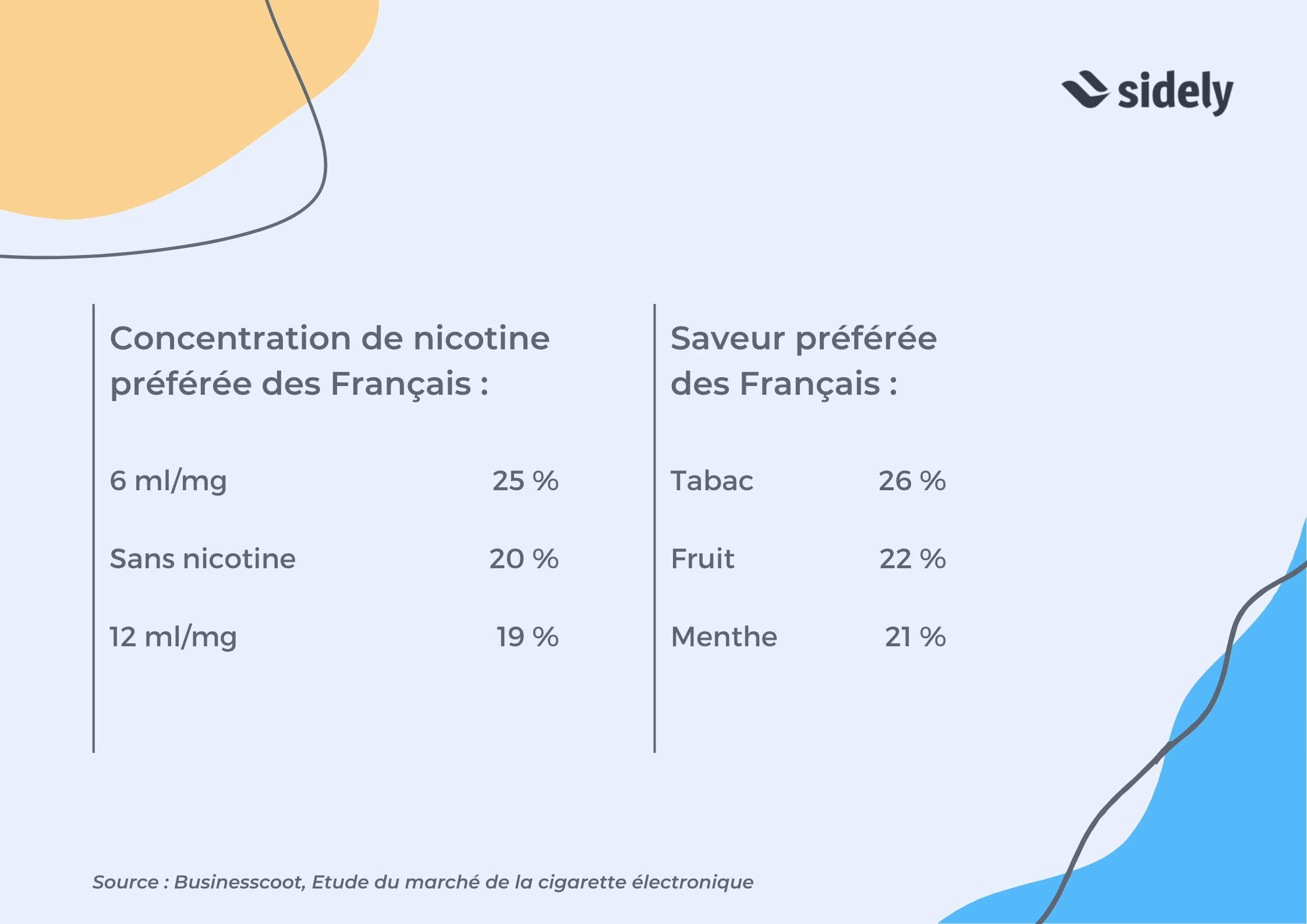
Electronic Cigarettes and Tobacco: Between Economy and Health
Vaping: A choice dictated by the wallet before health?
Contrary to popular belief, the primary motivation for switching to electronic cigarettes is not health, but cost. Indeed, 65% of vapers adopt the e-cigarette primarily to reduce their tobacco budget, while health only comes in second place with 23% of motivations.
The average budget of a vaper swings between €35 and €55 per month, while a typical smoker spends an average of €100 to €200 if they consume half a pack a day.
That said, the health aspect also plays a key role. According to the French Public Health Agency barometer (2017), the electronic cigarette helped 700,000 French people quit smoking. Today, 58.8% of vapers are still tobacco smokers, while 41.2% are former smokers.
In the second half of 2016, 2 million people attempted to quit smoking. Among the replacement solutions, the e-cigarette took the lead with 26.9% of attempts, ahead of nicotine replacements (18.3%) and help from a healthcare professional (10.4%).
E-cigarette: A danger or a safer alternative?
The debate over the risks associated with electronic cigarettes remains open. 57% of French people believe that it is less harmful than classic cigarettes, and the agency Public Health England asserts that it is 95% less dangerous than traditional tobacco.
However, the World Health Organization (WHO) considers the e-cigarette to be "undeniably harmful", particularly because of its effects on lung diseases.
A booming market on a global scale
The global electronic cigarette market has experienced significant growth in recent years, with revenue estimates varying by source. According to Research Nester, it was valued at $30 billion in 2023 and estimated to have reached approximately $35 billion in 2024, with a projection of $67 billion by 2036. This corresponds to a compound annual growth rate (CAGR) of about 30% over the 2024-2036 period. Other analyses confirm this upward trend, estimating that global revenue exceeded $30 billion in 2024. This expansion is explained by the search for alternatives to traditional tobacco, the growing appeal of vaping among young adults, and constant innovations in the sector.
The United States remains the primary market for electronic cigarettes, with a high adoption of products and a particularly diverse supply. Europe stands out with a structured regulatory framework and growing acceptance of vaping in several countries. The Asia-Pacific region, for its part, shows a marked increase, particularly in China, the main manufacturing center, and in Japan, where technological innovation plays a key role. This distribution reflects contrasting regional dynamics, but they converge toward a global expansion of the market.
The electronic cigarette in France: A structured and growing market
In France, the electronic cigarette has widely developed in recent years, attracting an increasing number of consumers. Today, about 3 million people vape, representing 5.5% of the adult population, including 2.3 million regular users. With these figures, France ranks among the three largest global markets, alongside the United Kingdom and Malaysia.
Several factors explain this craze: the continuous rise in the price of tobacco, the perception of a lower risk associated with vaping, and the diversity of available products. In this context, the French market is gradually structuring itself, supported by an increased presence of specialized players, dedicated shops, and a constantly evolving regulatory framework. However, regulation of the sector remains a subject of debate, balanced between the desire for control and the necessity to support an alternative to tobacco.
What you need to know about vaping regulation in France
The sale and use of electronic cigarettes in France are governed by a set of strict rules resulting from national and European law. Here is the essential information for anyone wishing to enter the sector:
Regulated use: Vaping is banned in closed public places such as transport, school establishments, or workplaces. Sales are restricted to adults only.
Advertising and sales: Advertising is strictly limited, authorized only at sales points or in spaces reserved for professionals. Online sales are permitted but regulated (age verification, ban on vending machines).
Product standards: Nicotine-containing e-liquids are limited to 20 mg/ml of nicotine, in bottles of 10 ml maximum. Cartridges must not exceed 2 ml. Labeling is mandatory with safety mentions and health warnings.
Mandatory notifications: Before launch on the market, products must be registered with ANSES via the European EU-CEG platform. Post-market monitoring is also required.
Regulatory updates: The ban on disposable electronic cigarettes (puffs) was voted in February 2025 and is set to come into force within the year. Other developments are being considered at the European level, particularly regarding packaging and taxation.
This question of regulation is all the more central as France plays a key role in developing standards governing vaping at the European level. Advertising, sales to minors, and composition of e-liquids: all these aspects are strictly monitored by authorities, who also closely watch studies on the long-term effects of vaping. Despite these constraints, the French market remains dynamic, driven by innovation, changing consumer habits, and the growing interest of smokers wishing to switch away from tobacco.
E-liquids: French production
One of the major strengths of the French market lies in the quality of its e-liquids, with nearly 70% of e-liquids sold in France coming from national production. This local manufacturing meets high demand, with between 1,500 and 2,000 bottles sold each month. While almost all vaping devices (e-cigarettes, vapes, or puffs) sold in France are imported from China, the situation is completely different for e-liquids.
France has established itself as one of the most dynamic countries in Europe in this sector, supported by the rise of a local industry structured around quality, traceability, and safety. "Made in France" has become a strong selling point for consumers, who increasingly favor products deemed more reliable, better controlled, and compliant with demanding health standards.
About fifty independent laboratories are currently established in the country, among which are Gaïatrend, a benchmark player in Europe, as well as Vincent dans les Vapes (VDLV), Alfaliquid, Le French Liquide, and Curieux. They all share the same requirement for quality, with rigorously monitored manufacturing processes. Indeed, French e-liquids comply with the AFNOR standard (XP D90-300), which defines strict criteria for ingredient purity, microbiological control, and final product safety. Regular laboratory testing allows for detecting the eventual presence of unwanted substances such as formaldehyde, acrolein, or certain heavy metals.
Compositions are also carefully handled: propylene glycol (PG) and vegetable glycerin (VG) serve as the base, complemented by food-grade flavorings from the food industry, pharmaceutical-grade nicotine – generally of European origin – and, occasionally, a very small amount of water or alcohol. This transparency on ingredients and processes attracts a clientele that is increasingly attentive to the safety of the products they consume.
By focusing on traceability, health quality, and responsible local production, French manufacturers have successfully built a strong market position. However, they must deal with major challenges: higher production costs than imported e-liquids (notably from China or the United States), a constantly evolving European regulatory framework, and growing expectations regarding eco-responsibility. To address this, many brands are now committing to sustainable practices, rethinking their packaging or offering formulas with less impact on the environment.
Electronic cigarette market trends
The electronic cigarette market, in France as well as globally, is undergoing rapid evolution, driven by technological innovations and increasingly precise expectations from consumers. This sector has matured and professionalized, with better product traceability, a higher quality offer, and a progressive standardization of practices. The demand for devices with high battery life remains strong: vapers look for e-cigarettes capable of operating all day without frequent recharging. Furthermore, connected e-cigarettes are transforming the user experience, allowing real-time tracking of consumption and personalization of sessions via mobile applications.
E-liquids with more natural ingredients are also gaining ground. With a reduction in additives and controversial ingredients, consumers favor healthier and more transparent formulations. We are thus witnessing a general premiumization of products: vapers are looking for premium e-liquids, often made in France, but also for reusable, durable, and customizable devices, offering a richer taste and sensory experience.
Innovation continues to push limits, with the arrival of multi-compartment models, waterproof designs, and even devices equipped with fingerprint scanners, to enhance security and customization.
At the same time, an ethical and ecological awareness is emerging around electronic cigarettes. Single-use products, such as puffs, highly popular among young people, are in steep decline. This development is driven by a political resolve to protect minors and reduce environmental impact. The ban on puffs was voted in early 2025, with implementation expected in the course of the year.
Finally, stricter regulations – whether in advertising, flavors, or taxation – present new challenges to the industry. In this fast-changing context, industry players must show agility and responsibility to continue innovating while respecting an increasingly strict legislative framework.
Distribution channels
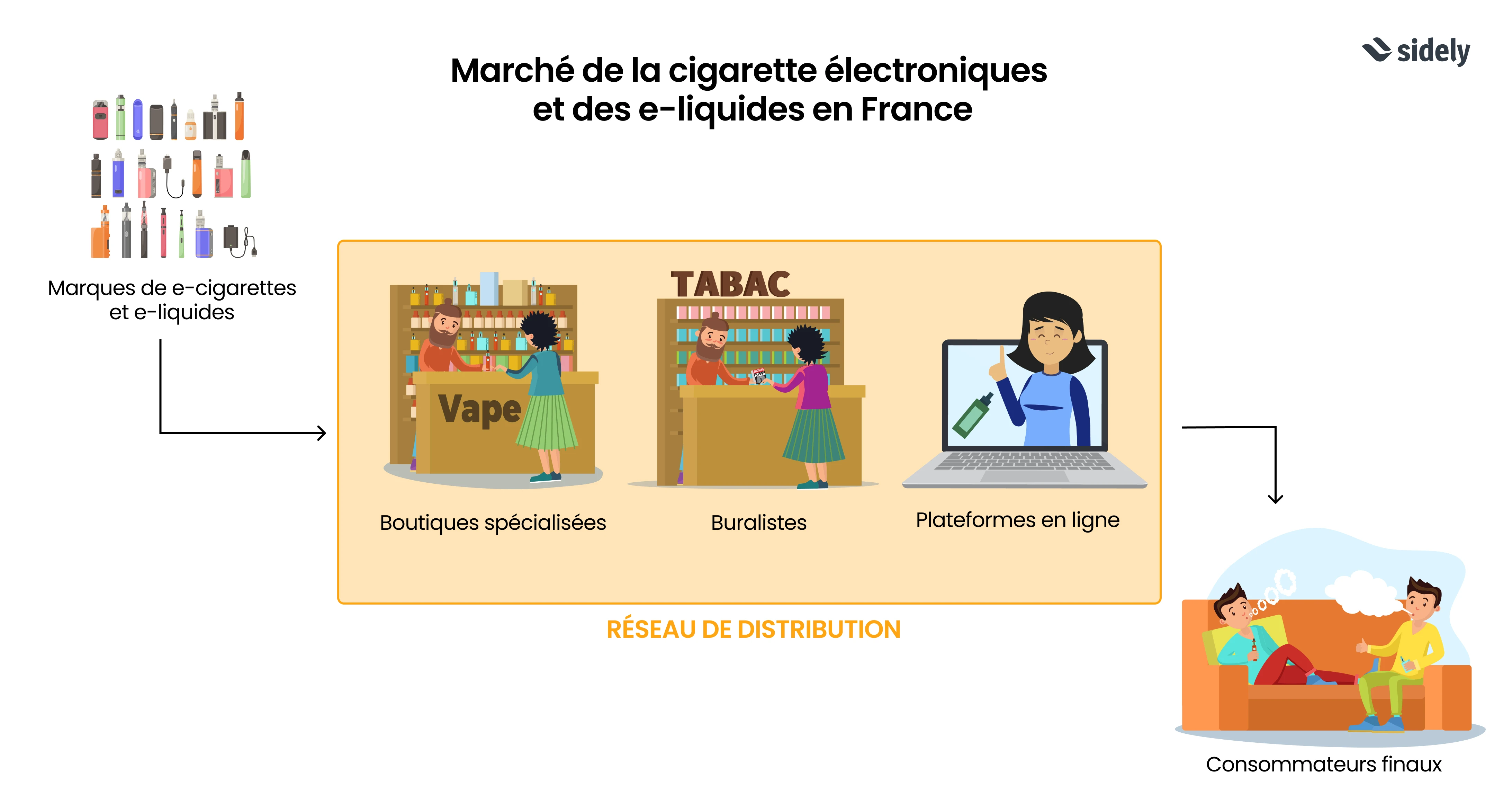
The electronic cigarette market relies on three major distribution networks, each playing a key role in its development:
Specialized stores (vape shops), true reference points for vapers, featuring a wide selection of products and personalized advice.
Tobacconists, who are diversifying their offer by progressively integrating electronic cigarettes in response to declining tobacco sales.
Online platforms, which attract buyers with their vast catalogs and attractive prices, despite stricter regulations.
Brick-and-mortar stores remain by far the majority choice, with about 70% of vapers preferring to buy in-store, compared to 27% who opt for online platforms. This sustained dominance is explained by the importance of advice, guidance, and the relationship of trust with specialized sellers.
Today, France has about 3,300 vape shops, while tobacconists are strengthening their presence in this booming market.
Finally, some retail chains have established themselves as essential references. Vapostore, Cigusto, Clopinette, and Le Petit Vapoteur are among the major players, helping to structure and energize the sector with well-established networks and innovative strategies.
How to (better) distribute your electronic cigarettes?
In France, the majority of electronic cigarette sales take place in physical points of sale, notably in specialized vape shops and at tobacconists. According to a Xerfi study, specialized stores alone account for 60% of electronic cigarette sales.
Optimizing prospecting with retailers
Developing your distribution network is a major challenge for any electronic cigarette and e-liquid brand wishing to establish itself in a rapidly growing market. With several thousand vape shops and more than 20,000 tobacconists in France, it is essential to adopt an effective prospecting strategy.
Thanks to the integration of Google Maps into Sidely, sales representatives can quickly geolocate relevant points of sale and obtain a global view of their sales coverage. Once these prospects are identified, Sidely facilitates route planning by automating trip organization based on precise criteria such as sales potential and interaction history.
Sidely also allows for centralizing client information into account profiles, offering a complete view of each retailer: contact information, order volumes, stocked products, and interaction tracking. This optimized data management helps sales reps personalize their approach and maximize their performance in the field.
Simplified and digitalized order taking
In the world of electronic cigarettes, certain products like pods, best-selling e-liquids, and disposable vapes have a high turnover rate and require rigorous follow-up.
Sidely allows sales representatives to generate, view, and get order forms signed directly in the field with the distributor, in just a few clicks from the app. By avoiding paper exchanges and manual entry, this feature reduces the risk of errors and speeds up the approval process for orders. While with the client, the sales representative can immediately adjust the order according to the specific needs of the point of sale and available stock, guaranteeing greater responsiveness.
Proactive replenishment management
One of the major challenges for sales reps is to anticipate replenishment needs to prevent stockouts and maximize the profitability of partner retail locations. Sidely allows for tracking the frequency of orders for each client, thereby providing visibility on purchasing habits and average restocking cycles. With this data, representatives can organize their visits at the right time—meaning when the client truly needs them—thus avoiding pointless trips and optimizing their sales efficiency.
Improving point-of-sale merchandising
Product placement in retail stores is an essential lever for increasing the visibility of electronic cigarettes and boosting sales. Thanks to Sidely, sales reps can collect and analyze field data through dedicated forms, allowing them to evaluate product presence, positioning, and the impact of POP display materials in stores.
This approach allows for tailoring promotional materials and merchandising initiatives based on the specific needs of each vape shop or tobacconist. Sidely facilitates tracking the setup of displays, posters, and promotional offers, thereby ensuring optimal product exposure.
It was by observing the still-fledgling digitalization of sales forces that Arthur envisioned Sidely. A graduate of EM Lyon and Le Wagon, he combines a rare commercial rigor with a true product culture. This dual expertise allows him to decipher the shifts in the profession and build a product that truly speaks to sales teams.
See also

Artificial intelligence and field professions: what our 2026 studies reveal
Adoption, barriers, use cases: discover what our three studies reveal about the role of AI among sector managers, sales representatives, and foodservice sales reps.

CHR and RHF Sales Representatives: portrait of a relationship-driven profession in the era of data
Equipment, productivity, AI: discover the major trends for the HORECA and food service sales profession in 2026 through our field study.

Pharmaceutical Sales Representative in France: Portrait of a Field Job Under Pressure
Compensation, aspirations, AI usage: discover the major trends in the pharmaceutical sales representative profession in 2026 through our field study.

Area Sales Managers in France: who are they and how is the profession evolving in 2026?
Compensation, aspirations, AI usage: discover the major trends in the field sales representative profession in 2026 through our field study.
The area manager professions in 2026
Discover the trends, the challenges, and the key figures.