

The CROC method: theory and practice for successful calls
Contact, Reason, Objective, Conclusion: everything you need to know about the CROC method with a complete call script and concrete examples for your field sales representatives.

In short
5 min read
The CROC method (Contact, Reason, Objective, Conclusion) is a structured technique to optimize telephone prospecting interviews and maximize results.
It helps streamline the conversation while strengthening professionalism, transparency, and the alignment of messaging within sales teams.
The CROC script should serve as an organizational framework (a guide) and not for mechanical reading, in order to preserve the spontaneity necessary to build a relationship of trust.
The method has limitations for complex exchanges, as it omits the crucial steps of in-depth discovery and handling objections.
In addition, the CERC approach (Contact, Listening, Response, Conclusion) prioritizes active listening to the prospect's needs, particularly within the context of complex B2B sales.
What is the CROC method?
The CROC method (Contact, Reason, Objective, Conclusion) is a four-step call structure used in telephone prospecting. It structures an outbound call to capture the attention of a prospect who is not expecting it. The objective: to book an appointment, make a telesale, or ensure follow-up, all while keeping control of the conversation time.
Outbound calling, or cold calling, is far from dead. According to the Top Performance in Sales Prospecting study by RAIN Group, 82% of B2B buyers accept an appointment at least occasionally with a salesperson who reaches out to them, and 57% of senior executives even prefer to be contacted by phone than by any other channel. At a time when inboxes are overflowing and LinkedIn feeds are saturated, voice remains a distinctive channel.
But cold calling is a complex activity, especially since the talent and skills of sales representatives in the field do not always translate well online! Even the best salespeople encounter difficulties when it comes to picking up their phone to call a prospect who is not expecting their call.
We have already presented you with BtoB phoning techniques; however, we still need to rely on a solid methodology to maximize results, both in booking appointments and in telesales.
That is the entire purpose of this article. Sidely takes you on a journey to discover the CROC method for phoning. This will allow you to improve your performance on all types of telephone operations (telesales, setting appointments, customer follow-up, etc.), regardless of your industry, both in B2B and B2C.
Introduction of the CROC Method
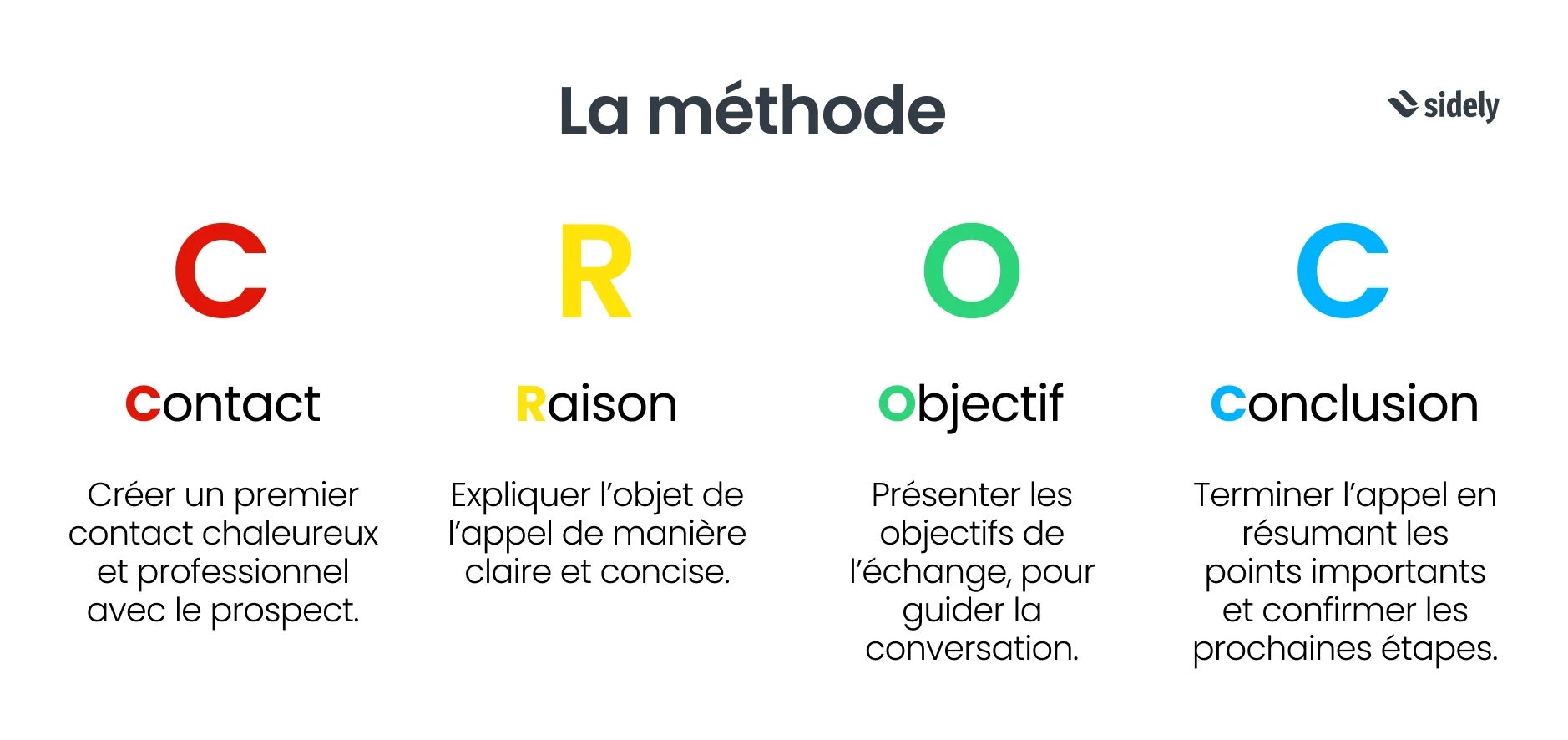
The CROC method (Contact, Reason, Objective, Conclusion) is a structured technique for conducting sales meetings effectively.
The strength of the CROC method lies in its simplicity: four easy-to-remember steps that are enough to frame an outbound call from the first hello to taking leave.
Here is what each of them covers:
Contact: create a warm and professional first contact with the prospect. This step is crucial for establishing trust and putting your interlocutor at ease.
Reason: explain the purpose of the call in a clear and concise manner. This makes it possible to set the framework and capture the customer's interest.
Objective: present the objectives of the discussion, whether it is to propose a solution, gather information, or close a sale. This step makes it possible to guide the discussion while keeping the contact engaged.
Conclusion: end the interview by summarizing the important points, confirming the next steps and - if applicable - ensuring that the client is satisfied.
The Croc method is widely used in telephone prospecting because it helps to stabilize and fluidize the conversation in an uncertain context, whereas the prospect had not solicited the contact. It is therefore a particularly useful framework for structuring telephone conversations and enhancing their effectiveness while optimizing time management.
Benefits for the Sales Department
Once mastered, the CROC method brings numerous advantages to the sales department:
Clear structuring: an easy-to-remember method for clear and organized exchanges;
Time-saving: get straight to the point while meeting the expectations of the relevant contact;
Transparency: the customer immediately understands the subject and goal of the exchange;
Concrete results: promotes the achievement of commercial objectives (sales, appointments, etc.);
Professionalism: a mastered approach that strengthens the credibility of the employees;
Simplified follow-up: allows summarizing key points and planning next steps;
Harmonization of practices: a structured guide to anchor a common discourse and positioning, and thus promote the company's image; ;
Performance measurement: when salespeople use a common framework, it is easier to analyze performance differences;
Continuous improvement: by sequencing the call, managers can identify the moment when sales are lost. This is the equivalent of the marketing funnel.
Setting Up a Script to Prepare for Calls
The CROC method can lead to the creation of a call scenario, also called a script or a call guide, which allows anticipating the different paths the exchange might take, in order to prepare for them effectively.
Translating the C.R.O.C framework into a call guide is recommended in the following cases:
Uniform practices: in a sales team, a script based on the CROC method can be used to ensure a homogeneous approach;
Train beginners: help recruits and juniors structure their interviews and master the fundamentals;
Stay on track: for salespeople who find it difficult to structure their approach, moving from method to script allows outlining a call structure to follow. Once mastered, the salesperson can again let their creativity flow, as long as it remains within the framework.
⚠️ If a script is created, it is preferable that it be flexible and serve as a guide rather than a rigid framework. We will return to this below.
Creating a Prospecting Guide with CROC: Method and Example
Creating a script from the CROC method consists of converting these steps into a concrete and adaptable teleprospecting tool for your phone calls. This is of course theoretical and requires testing and reworking depending on your sector and the product/service sold.
Here is how to proceed:
1. Introduction (Contact)
Goal: establish a climate of trust from the very first seconds.
Script example:
"Hello [customer name], I am [your name] from [your company]. Thank you for the time you are giving me today."
2. Presentation (Reason)
Goal: briefly explain the reason for the call to capture attention.
Script example:
"I am contacting you to discuss [reason]. Our goal is to see how we can [main benefit or solution offered]."
3. Objectives of the Exchange
Goal: state what you hope to achieve while remaining customer-centric.
Script example:
"At the end of this discussion, the idea is to [specific objective: better understand your needs, offer you a suitable solution, arrange a demonstration, etc.]. Does that work for you?"
4. Development and Questions
Prepare open or closed questions depending on the context.
Example of questions:some text
"What are your main challenges today in [field]?"
"How are you currently managing [specific need]?"
"What priorities do you have for [goal related to your solution]?"
💡 You will notice that this discovery sequence is an addition that does not appear in the initial acronym, otherwise it would be called CRODC (Contact / Reason / Objective / Discovery / Conclusion)! We are touching upon the main difficulty of the exercise here. You can also draw inspiration from the CERC method which we will discuss a little further below.
5. Conclusion
Goal: summarize, then confirm the next steps and thank them.
Script example:
"To summarize, we have seen that [summary of key points]. I suggest that we [next action, e.g.: set up an appointment, send you an offer]. What do you think about that?"
"Thank you for this discussion, I remain at your disposal for any questions."
💡 For a more directive approach, close with a closed question: “for a meeting at your offices, would you prefer Tuesday the 8th or Thursday the 9th?”
Tips for an Effective Script
This is where your script will go beyond the CROC framework, because you will need to:
Personalize the approach: adapt the examples and phrasings to your customers' situations and profiles;
Prepare variations: try to anticipate all possible objections. A workshop with the sales reps can help enrich this ideation phase, because it will also be necessary to invent counters to these different objections.
Leave room for improvisation: the script must be a guide, not a constraint.
With these steps, you get a clear, structured script based on the CROC method, while remaining flexible enough to adapt to each interaction.
💡 Keep it concise: clarity and simplicity in sales communication are synonymous with efficiency.
Limitations of the CROC Method
As we mentioned, using the CROC method still presents some risks. We will expand here on the two main ones.
When the script harms the sale!
There is nothing worse than a salesperson reading a script! In cold calling, naturalness and spontaneity are irreplaceable, especially because your interlocutors more easily trust a sales counselor who is at ease - and enthusiastic - than a staff member who is just "doing their job."
The scenario should therefore be used as a guideline, and not a primary school recital! In other words, it allows for preparation to avoid being speechless in the face of an unforeseen objection, but it is preferable that the caller knows how to adapt their words and attitude to the context and interlocutor.
Mastering the pitch and objections: yes.
Reading text mechanically: no.
🧠 In 2026, where do we stand?
The automation of phoning has passed a milestone. AI voice agents now handle end-to-end outbound call campaigns: they follow a framework, qualify a prospect, handle the initial objections, and enrich the CRM file automatically after each call. What was science fiction two years ago is marketed today, often for a few cents a minute.
Should we conclude that the CROC method, and the salesperson who carries it, are threatened? It is the opposite. The boundary between technology and human talent is becoming clearer: AI suggests a posture and analyzes tone in real time, but only humans perceive an unformulated opportunity or defuse real tension. And the phone has lost none of its power: it remains one of the most effective channels for booking qualified B2B meetings. Since everything that is scriptable will eventually be automated, the salesperson's value shifts to what no voice agent can do: listening, adaptation, relationship-building.
So, the real issue is not the tool, but the framework given to it. Our study of 128 field sales managers shows this: nearly 4 out of 10 already use AI daily, but 76.6% without any training and 63.8% outside of any structured framework. The parallel with the CROC method is striking; a powerful tool loses most of its value when nobody gives it structure.
A limited methodology for complex discussions
The CROC method is based on four sequences, and two fundamental parts of the sale are missing from it: discovery and handling objections.
Result: while the CROC method is completely suitable when the objective needs to be reached quickly and long discussions avoided, its utility will be very limited when it comes to supporting the prospect in deeper reflection.
B2B is a good example of this, as business relationships there are generally more complex, with long sales cycles and a more substantial budget commitment. Selling to companies often requires several meetings and presentations, with different interlocutors, and thoughts that can relate as much to the terms of the offer as to the implementation of the service or countless operational constraints on the client side that are impossible to anticipate with the CROC method.
The CERC method: listening at the center of the sale
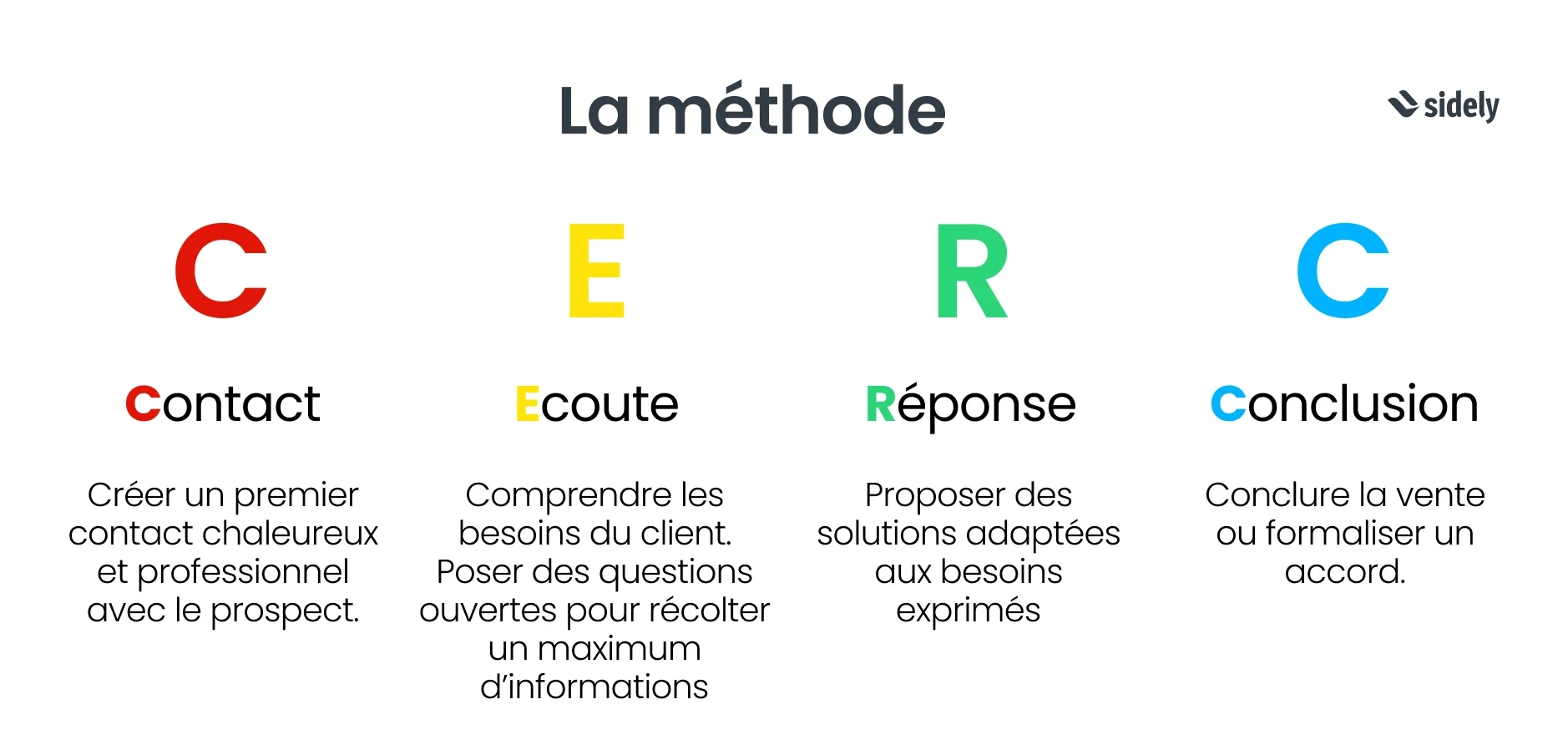
For an approach more focused on listening to the prospect's needs, you can also adopt the CERC method, an acronym for the following steps:
C for Contact: the opening phase with the client, a welcoming stage where it is crucial to create a climate of trust and establish a positive first contact.
E for Listen (Écoute): the salesperson adopts an active listening posture to understand the customer's needs. They must ask open questions to collect as much information as possible.
R for Response (Réponse): the salesperson proposes solutions adapted to the expressed needs. They argue based on the elements gathered to demonstrate the relevance of their offer.
C for Conclusion: this involves closing the sale or formalizing an agreement. This includes a successful sign-off, leaving a positive and professional impression.
→ Difference between CROC and CERC: the CERC method emphasizes prior active listening before responding, which makes it possible to adjust one's argumentation precisely.
CROC method or CERC method: which one to choose?
Criterion | CROC Method | CERC Method |
|---|---|---|
Meaning | Contact, Reason, Objective, Conclusion | Contact, Listening, Response, Conclusion |
Logic | Frame the exchange and get to the point | Understand the need before arguing |
Ideal for | Booking appointments, telesales, short calls | High-stakes sales, discovery needed |
Role of listening | Secondary (no dedicated step) | Central (Listening step) |
Main risk | Too directive, skips the discovery | Longer, less easy to script |
In summary, CROC sets up a quick and reassuring framework when the objective is clear; CERC takes the time to listen when the sale depends on understanding the need.
What conclusion can be drawn from this?
Some situations fully justify using the CROC method. Notable examples include:
Launching a new telephone operation;
Training a recruit for a teleprospecting position;
Harmonizing practices - even temporarily - to establish a framework and define common performance indicators.
The salespeople will need to reinvent themselves twice:
Force themselves to apply this method, because it works;
Force themselves to deviate from it so that the human element takes over once the processes are mastered.
By knowing the advantages and limits of the CROC method, your company can significantly improve its telemarketing results, while letting the salespeople draw on their personality and creativity to enrich the initial contact!
FAQ
What is the difference between the CROC method and the CERC method?
Does the CROC method work in B2B?
Can the CROC method be used in cold prospecting?
How do you construct a call script using the CROC method?
What are the limits of the CROC method?
It was by observing the still-fledgling digitalization of sales forces that Arthur envisioned Sidely. A graduate of EM Lyon and Le Wagon, he combines a rare commercial rigor with a true product culture. This dual expertise allows him to decipher the shifts in the profession and build a product that truly speaks to sales teams.
See also

Artificial intelligence and field professions: what our 2026 studies reveal
Adoption, barriers, use cases: discover what our three studies reveal about the role of AI among sector managers, sales representatives, and foodservice sales reps.

CHR and RHF Sales Representatives: portrait of a relationship-driven profession in the era of data
Equipment, productivity, AI: discover the major trends for the HORECA and food service sales profession in 2026 through our field study.

Pharmaceutical Sales Representative in France: Portrait of a Field Job Under Pressure
Compensation, aspirations, AI usage: discover the major trends in the pharmaceutical sales representative profession in 2026 through our field study.

Area Sales Managers in France: who are they and how is the profession evolving in 2026?
Compensation, aspirations, AI usage: discover the major trends in the field sales representative profession in 2026 through our field study.
The area manager professions in 2026
Discover the trends, the challenges, and the key figures.