

Churn rate: definition, calculation, and application
Learn how to define, calculate, and use the churn rate. A KPI that can be useful.

In short
4 min read
The churn rate measures the percentage of customers lost over a given period within the framework of a commitment (subscription, loyalty card).
The universal formula is: (Number of terminated customers over the period / Total number of customers at the start of the period) x 100.
In retail (FMCG), churn can be equated to product delisting and is calculated as: (Points of sale that stopped selling / Number of distributing points at the start) x 100.
Numeric distribution (ND) remains the key KPI for manufacturers, although they can indirectly exploit retailer rates through panel data or customer segments.
A robust loyalty program and a controlled churn rate allow brands to better target their final consumers, thanks to the quality of the retailer's database.
The cancellation rate (or churn rate) is a well-known indicator in subscription or service industries. But in retail, it can also reveal valuable trends, especially when evaluating the attrition of a loyalty program, a subscription, or even a product listing.
In this article, we explain how to define, calculate, and use the cancellation rate in retail, with concrete cases and practical advice.
Cancellation rate: definition
In retail, the cancellation rate corresponds to the percentage of customers or contracts that stop buying or subscribing to a given service over a given period. It is used when there is an engagement, whether in the form of a subscription or a loyalty card.
This is a customer attrition or churn indicator, vocabulary more commonly used in B2B.
How to calculate a cancellation rate?
The cancellation rate is always calculated over a given period (month, quarter, year) and measures the proportion of customers or contracts that have been lost compared to the starting base.
Here is the cancellation rate formula:
(Number of canceled customers over the period / Total number of customers at the beginning of the period) x 100
For example, if you had 1,000 subscribers to your service at the beginning of the year, and you only have 950 at the end of the year, your cancellation rate is: 50 / 1000 = 5%
How to calculate a cancellation rate in retail?
In retail, the cancellation rate can be calculated on loyalty cards or subscriptions. For example, if a retailer offers a discount card to 4,000 customers at the beginning of the year, and 700 cancel during the year, this gives a cancellation rate of (700 / 4000) x 100 = 17.5%.
This can also be calculated by region, by store size... to understand the reasons for customer attrition.
What is the place of cancellation rates in supermarkets/FMCG?
In supermarkets, cancellation can be likened to product delisting (number of stores that stopped carrying the product ÷ number of stores that distributed it at the beginning). This is then referred to as ND (numeric distribution), shelf share, or out-of-stock.
The term cancellation rate applies mainly when there is a contractual relationship with the end customer.
That being said, if you are ever asked for a cancellation rate, we can assume that when the retailer stops distributing it (delisting), it is the equivalent of a cancellation. You can calculate it as follows:
Cancellation rate = (Number of points of sale that stop selling your brand or product / Number of points that distributed it at the beginning of the period) x 100
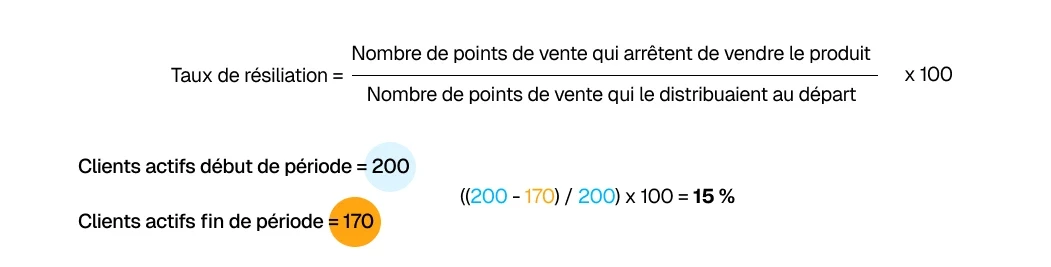
For example, if in January your product is present in 200 stores and in June, 30 stores have delisted it (no longer have it on the shelves), you have a cancellation rate of: 30 ÷ 200 = 15%.
How to leverage the cancellation rate of retailers?
As we have just seen, the cancellation rate is not a KPI for you as a manufacturer. Numeric distribution is the indicator to follow in this case. Nevertheless, you can indirectly exploit the retailers' rate.
Indeed, even if as a brand you do not have access to the cancellation rate of the loyalty card (which is internal retailer data), you can leverage:
data from retailer panels: through the loyalty card, retailers measure purchase frequency, average basket size, changes in behavior...
customer segments: regular buyers of premium beer, families consuming sodas, young urbanites buying in specialty stores...
marketing targeting: some retailers offer brands the opportunity to sponsor campaigns using their loyalty database. For example, an emailing to cardholders who already buy orange juice, to promote a new clementine juice to them.
The cancellation rate of a loyalty card does not directly impact the brand, but it influences the quality and size of the database it can benefit from through the retailer.
The stronger the loyalty program and the more customers are retained, the more the brand can precisely target its end consumers.
Margot has been working in Tech and SaaS for 8 years, with a multi-product experience that has given her a unique understanding of business challenges. On a daily basis, she analyzes, relentlessly tests, and relies on facts to shed light on market trends and help sales teams move forward.
See also

Artificial intelligence and field professions: what our 2026 studies reveal
Adoption, barriers, use cases: discover what our three studies reveal about the role of AI among sector managers, sales representatives, and foodservice sales reps.

CHR and RHF Sales Representatives: portrait of a relationship-driven profession in the era of data
Equipment, productivity, AI: discover the major trends for the HORECA and food service sales profession in 2026 through our field study.

Pharmaceutical Sales Representative in France: Portrait of a Field Job Under Pressure
Compensation, aspirations, AI usage: discover the major trends in the pharmaceutical sales representative profession in 2026 through our field study.

Area Sales Managers in France: who are they and how is the profession evolving in 2026?
Compensation, aspirations, AI usage: discover the major trends in the field sales representative profession in 2026 through our field study.
The area manager professions in 2026
Discover the trends, the challenges, and the key figures.