

How to build an effective data strategy for field sales teams?
Learn how to structure, secure, and leverage your field data to improve your sales performance across physical distribution networks.

In short
7 min read
Define performance indicators that are truly useful and impactful, rather than multiplying the collection of superfluous data.
Standardize input formats (drop-down lists, standards) to ensure consistent and comparable data across points of sale.
Centralize all information in a single platform to eliminate silos (Excel, paper) and obtain a consolidated view.
Establish data governance with clear responsibilities and automated quality controls to detect anomalies.
Train field teams on data entry accuracy by concretely illustrating the impact of errors on decision-making.
In physical distribution networks, sales performance no longer relies solely on instinct or experience: it depends more and more on the quality of available data. At a time when artificial intelligence and automation tools are being integrated into sales departments, one question arises: is the data reliable, consistent, and structured enough to power these tools?
Building an effective data strategy means laying the foundations for smarter, more responsive, and more precise management. Here are the key steps to achieve this, particularly for mobile field sales forces operating in the field.
Understanding the Fundamentals of a Sales Data Strategy
What is "good" data?
Good data is not abundant data, but useful data. This data must be:
relevant for decision-making,
reliably entered,
contextualized (date, location, network),
structured for analysis,
accessible to those who need it.
Collecting information that is too vague or rarely used (such as un-analyzable comments or shelf-facings that are never reviewed) is counterproductive. On the other hand, a few well-chosen indicators can be enough to generate effective management.
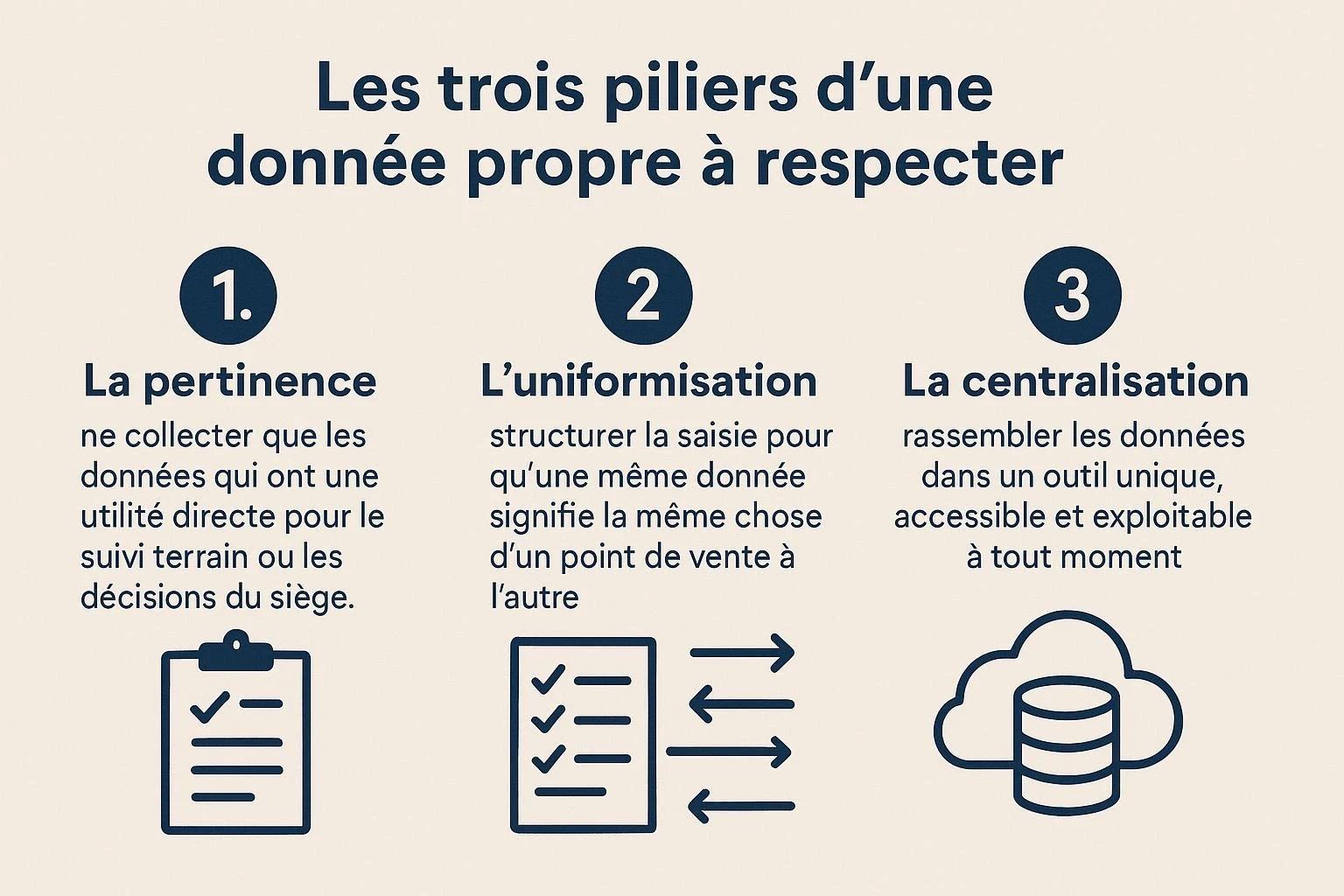
Three Pillars to Respect
A sales data strategy rests on three fundamental principles:
Relevance: only collect data that has direct utility for field monitoring or headquarters decisions.
Standardization: structure the entry process so that the same data entry means the same thing from one point of sale to another.
Centralization: gather data in an unique, accessible, and exploitable tool at any time.
Defining the Data That is Truly Useful to Your Activity
There is no need to multiply the fields to fill out if the data is neither read nor used. The challenge is to define, in consultation with field and headquarters teams, the indicators that have a real impact:
product presence rate,
evolution of linear shelving,
observed stockouts,
visit frequency,
promotional execution,
numeric distribution (ND) per point of sale.
These data must reflect the goals of the sales team, but also those of management (territory coverage, regional growth, operational execution, etc.).
If you distribute in supermarket chains and do not know where to start, we present you with the 5 key metrics to analyze as a priority.
Standardizing Collection Formats
Establishing a Common Language
Unstandardized data is worth nothing. If each sales rep uses their own terms, formats, or units of measurement, analysis becomes impossible. It is therefore essential to:
provide drop-down lists to limit variations,
enforce standard formats (dates, categories, nomenclatures),
add validation rules in the tools to prevent errors.
As the guardian of the data, it is up to you to define the surveys your sales reps will use in the field. They should not choose which data to collect, nor how to structure it. Your role is to provide them with the right tools to guarantee a homogeneous, reliable collection that meets the needs of the business. This controlled standardization is essential to fully exploit the potential of data reported from the field.
Training Teams for Rigorous Data Entry
Standardization also involves people. Sales reps must understand why this rigor is necessary. Showing concrete examples where poorly entered data skewed an analysis or slowed down decision-making can convince them more effectively than a simple theoretical reminder.
Centralizing All Data into a Single Tool
Breaking Down Silos
As long as data is scattered across Excel, paper documents, personal notes, or unconnected business applications, it is impossible to draw reliable feedback from it. Centralization in a single platform allows you to:
reduce duplicates,
prevent omissions,
obtain a consolidated view by territory, network, or distribution channel.
Improving Responsiveness
A centralized database allows real-time access to field data. A sales director can monitor weekly visit coverage, detect an abnormal stockout rate in a region, or react quickly to under-execution of a national campaign.
Continuously Improving Data Quality
Setting up Simple Governance
To guarantee data reliability over the long term, you need to define:
who is responsible for data quality,
how often data is reviewed,
how errors are corrected or escalated.
On this subject, see also this external article on data governance strategy.
Automatically Detecting Anomalies
Modern tools allow the integration of automated quality checks:
blocking incomplete forms,
alerts in the event of an unusual discrepancy (for example, 0 products on shelf + validated order),
visualization of completions rates of the reports.
Using Data to Better Guide Your Actions
From Information to Action Plan
Well-structured data can be used to:
prioritize points of sale to visit based on stockout rates,
detect under-exploited geographical areas,
adjust sales goals based on inventory levels and observed performance.
Relying on AI Only When Foundations are Solid
AI can do nothing without reliable data. It can accelerate analysis, spot correlations, suggest forecasts... but only if it is built on a coherent foundation.
Before equipping yourself with an AI-boosted CRM or predictive tools, you must therefore ensure that:
data is well-targeted,
formats are consistent,
sources are centralized,
quality is monitored over time.
Before Being Smart, Data Must Be Useful
Building an efficient data strategy is not about adding layers of complexity. On the contrary, it is about simplifying, structuring, and making reliable the way teams collect, share, and exploit field information.
This foundational work is the prerequisite for any more ambitious transformation. Automation, artificial intelligence, real-time dashboards... will only perform well if the raw material – your data – is robust.
For a sales department managing an indirect network with a scattered field sales force, this data strategy is no longer an option: it is a lever for management, alignment, and performance.
Margot has been working in Tech and SaaS for 8 years, with a multi-product experience that has given her a unique understanding of business challenges. On a daily basis, she analyzes, relentlessly tests, and relies on facts to shed light on market trends and help sales teams move forward.
See also

Artificial intelligence and field professions: what our 2026 studies reveal
Adoption, barriers, use cases: discover what our three studies reveal about the role of AI among sector managers, sales representatives, and foodservice sales reps.

CHR and RHF Sales Representatives: portrait of a relationship-driven profession in the era of data
Equipment, productivity, AI: discover the major trends for the HORECA and food service sales profession in 2026 through our field study.

Pharmaceutical Sales Representative in France: Portrait of a Field Job Under Pressure
Compensation, aspirations, AI usage: discover the major trends in the pharmaceutical sales representative profession in 2026 through our field study.

Area Sales Managers in France: who are they and how is the profession evolving in 2026?
Compensation, aspirations, AI usage: discover the major trends in the field sales representative profession in 2026 through our field study.
The area manager professions in 2026
Discover the trends, the challenges, and the key figures.