

Margin rate: everything you need to know in less than 5 minutes
How to calculate the margin rate? Formula, difference with mark-up rate, numerical examples, and interpretation to drive the profitability of your products in large food retailers.

In short
5 min read
The margin rate measures the profitability of a product from the distributor's perspective by evaluating the share of commercial margin in the selling price excluding tax.
The calculation formula is: Margin rate = (Commercial margin excl. tax / Selling price excl. tax) x 100.
It should not be confused with the markup rate: the former is calculated on the selling price (distributor logic), while the latter is calculated on the purchase price (supplier logic).
It is used as a key criterion in pricing negotiations, with distributors often setting minimum thresholds to accept the listing of a product.
Retailers use it to validate the profitability of a promotion or to decide on assortments by prioritizing high-profitability items.
A slow-moving product can be kept in the catalog if it generates a good margin rate, whereas a product with average rotation but a low rate risks being delisted.
The gross margin rate is one of the most widely used indicators in retail. Behind this term, which is sometimes confused with the mark-up rate, lies an essential piece of data: it makes it possible to evaluate the profitability of a product from the retailer's perspective.
Whether you are a brand selling in supermarkets (GMS) or specialized stores (GSS), a category manager, or a retail store manager, understanding what the gross margin rate is, and how it is used in negotiations, promotions, or assortment choices, is essential for driving an effective commercial strategy.
In this article, we look back at the definition of the gross margin rate, its calculation formula, its difference from the mark-up rate, as well as its practical applications in distribution channels, whether in supermarkets or specialized retail.
Gross margin rate: definition
The gross margin rate is a profitability indicator that measures the share of commercial margin in the pre-tax selling price of a product.
In retail, this indicator is primarily useful for retailers, such as major supermarket chains or specialized stores. For the retailer, it helps track the profitability of its sales (how much margin relative to the price billed to the customer).
Nevertheless, this indicator is also of interest to manufacturers. For the supplier, it helps anticipate pricing policy and understand the retailer's pressure.
How to calculate a gross margin rate?
The gross margin rate is calculated based on the commercial margin of a product. Therefore, you must first know your pre-tax commercial margin. It is calculated as follows:
Pre-tax commercial margin = Pre-tax selling price - Pre-tax purchase price
Then, you can calculate your Gross margin rate as follows:
Gross margin rate = (Pre-tax commercial margin / Pre-tax selling price) x 100
Let's take an example.
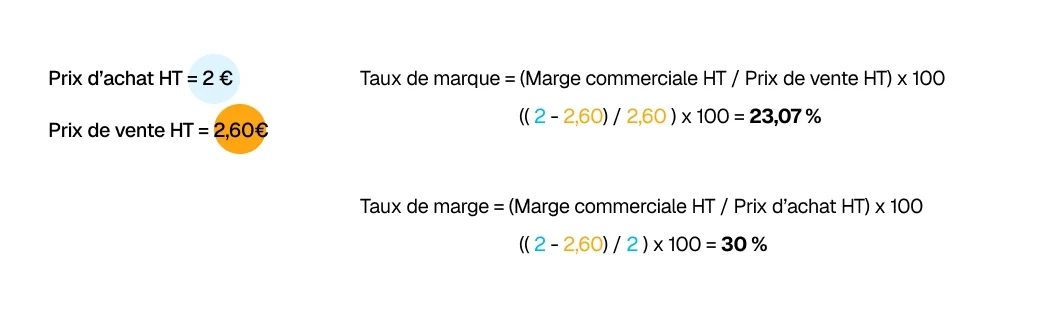
The pre-tax purchase price by the retailer is €2.
The retailer resells it for €2.60.
Its commercial margin is therefore 2.6 – 2 = €0.60
Its gross margin rate is therefore (0.6 / 2.6)x100 = 23.07 %

Difference from the mark-up rate
It is important not to confuse the gross margin rate (taux de marque) with the mark-up rate (taux de marge). While the gross margin rate is related to the pre-tax selling price, the mark-up rate is related to the pre-tax purchase price:
Gross margin rate: margin ÷ selling price → profitability indicator for the retailer.
Mark-up rate: margin ÷ purchase price → profitability indicator for the supplier.
If we take the example above, the result for each would be:
Mark-up rate: 0.6 / 2 = 30 %
Gross margin rate: 0.6 / 2.6 = 23.07 %
How is the gross margin rate used in supermarkets (GMS) and specialized stores (GSS)?
In tariff negotiations
Retailers often set target gross margin rates by category (e.g., drinks, home appliances, clothing). For example, a retailer may require a minimum gross margin rate of 10% to list a drink.
The gross margin rate therefore determines both the price at which you will sell your products to retailers. To respect its gross margin rate, they will ask you to make concessions. You can then negotiate larger volumes or a minimum contract duration to compensate.
In promotion management
It is all about money here, and promotions are no exception. During a promotion, the retailer calculates whether its net gross margin rate remains acceptable, in order to know if the promotion is profitable for them or if it must be partly "funded" by your efforts.
Let's take an example:
A product is purchased for €4 pre-tax from a manufacturer.
This product is sold for €10 pre-tax, and will be on promotion as "buy one, get one free", changing the pre-tax selling price to €5.
Before the promotion, the gross margin rate is: (10 - 4 ) / 10 = 60 %
After the promotion, the gross margin rate is: (5 - 4) / 5 = 20 %
The retailer has a minimum gross margin rate policy of 10%: the promotion is validated.
In listing and assortment management
Department managers or category managers compare the gross margin rates of products. Products with a high gross margin rate are favored because they are more profitable for the retailer.
In supermarkets, the gross margin rate is scrutinized to judge the profitability of the aisle. Even if the unit margin is low, the volume of sales compensates. This means that a slow-moving product can remain in the catalog if it generates a good gross margin rate. Conversely, a product with medium turnover but a low gross margin rate risks being delisted.
The difference between specialized stores (GSS) and supermarkets (GMS)
Supermarkets (GMS): high volumes, lower gross margin rates but compensated by turnover (e.g., beverages, food products).
Specialized stores (GSS): lower volumes, but higher gross margin rates required (e.g., home appliances, sports, DIY).
Margot has been working in Tech and SaaS for 8 years, with a multi-product experience that has given her a unique understanding of business challenges. On a daily basis, she analyzes, relentlessly tests, and relies on facts to shed light on market trends and help sales teams move forward.
See also

Artificial intelligence and field professions: what our 2026 studies reveal
Adoption, barriers, use cases: discover what our three studies reveal about the role of AI among sector managers, sales representatives, and foodservice sales reps.

CHR and RHF Sales Representatives: portrait of a relationship-driven profession in the era of data
Equipment, productivity, AI: discover the major trends for the HORECA and food service sales profession in 2026 through our field study.

Pharmaceutical Sales Representative in France: Portrait of a Field Job Under Pressure
Compensation, aspirations, AI usage: discover the major trends in the pharmaceutical sales representative profession in 2026 through our field study.

Area Sales Managers in France: who are they and how is the profession evolving in 2026?
Compensation, aspirations, AI usage: discover the major trends in the field sales representative profession in 2026 through our field study.
The area manager professions in 2026
Discover the trends, the challenges, and the key figures.