

7 concrete ways to use artificial intelligence to boost your sales in supermarkets
Discover how AI optimizes presence, promotions, and sales performance in large food retail (supermarkets and hypermarkets).

In short
8 min read
Smart prioritization of points of sale through predictive analysis to maximize growth potential.
Simulation of negotiation scenarios to anticipate economic impacts and secure margins.
Dynamic adjustment of logistics flows by predicting sell-out to prevent stockouts and overstocks.
Optimization of merchandising and shelf placement through factual performance analysis.
Rapid detection of commercial underperformance areas for agile deployment of resources.
Automation of field action plans to align sales representatives with strategic priorities.
Maximization of the ROI of promotional campaigns through precise modeling of their effectiveness.
Retail distribution is a demanding environment: long negotiation cycles, margin pressure, logistical complexity, and high retailer standards for performance, data, and responsiveness. For brands, the goal is no longer just to sell more, but to sell smarter across all levels of the P&L: better visibility, better promotional efficiency, and better in-store execution.
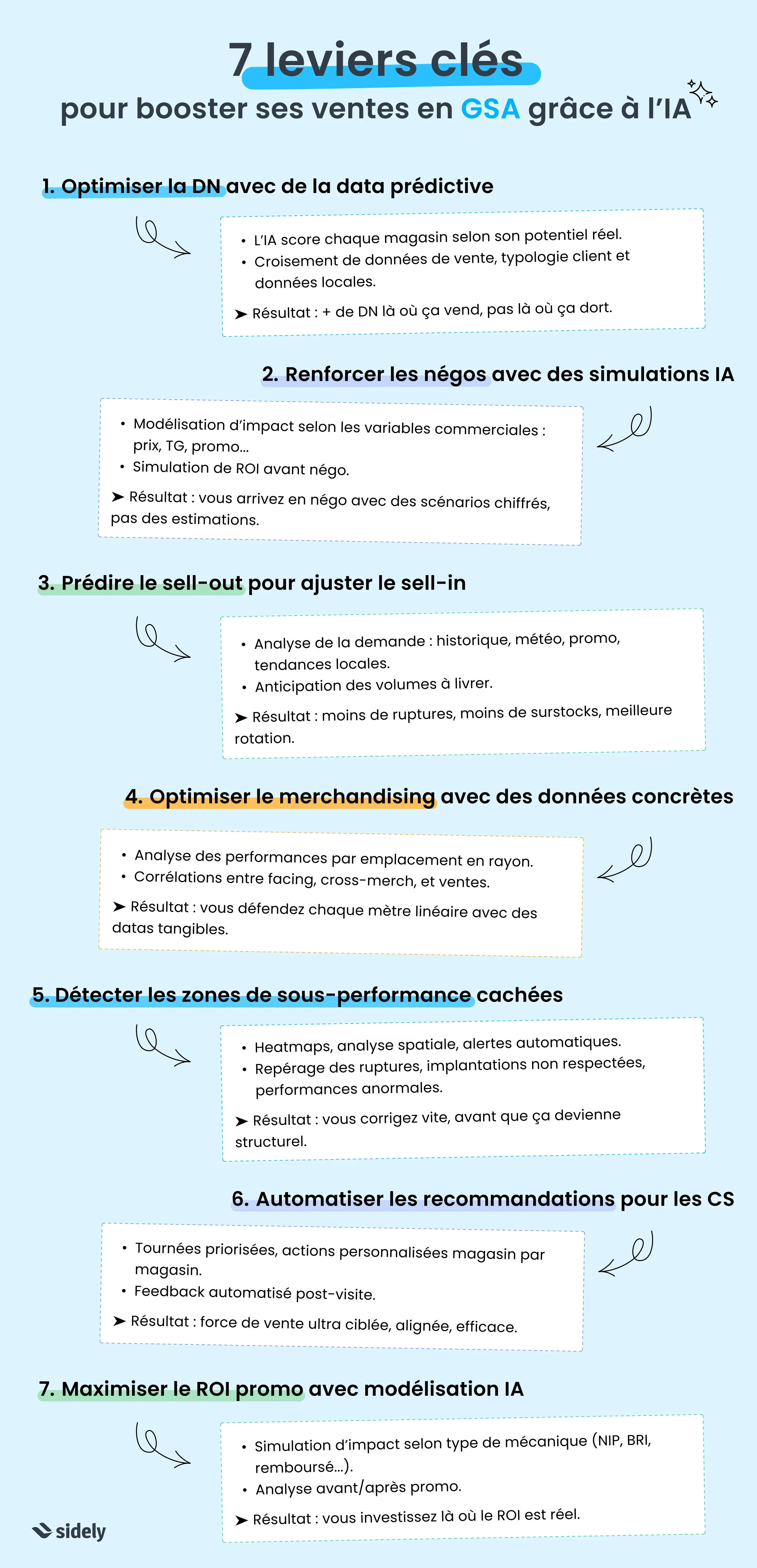
Artificial intelligence, when used correctly, becomes a strategic asset. Here are 7 concrete levers to leverage it starting today.
1. Prioritize points of sale with predictive data
In retail distribution, product presence relies partly on numeric distribution (ND), meaning the number of points of sale where the brand is listed. However, expanding ND at all costs can generate unnecessary costs if the targeted stores do not convert into sales volume.
How AI helps: Artificial intelligence allows you to identify high-potential stores by cross-referencing different data sources:
Performance of similar products (from IRI, Nielsen panels, or internal data)
Customer profile in the catchment area
Local indicators (standard of living, density, buying habits, etc.)
Result: You focus your sales and logistical efforts on stores that present real growth potential, and you improve the profitability of your distribution.
2. Strengthen sales negotiations with AI simulations
Annual negotiations in retail are complex: they involve multiple variables (prices, discounts, volumes, promotional campaigns, marketing support...). It is difficult to anticipate the actual impact of each concession.
How AI helps: By simulating different scenarios, artificial intelligence allows you to quantify the commercial and economic impact of your choices before entering negotiations:
Does a price drop compensate for better visibility?
Does an endcap display presence for two more weeks actually increase volume?
Which product offer combination maximizes ROI for the year?
Result: You protect your margins, arrive with quantified proposals, and structure your negotiations around factual data rather than rough estimates.
3. Predict sell-out to adjust sell-in
In retail, logistical efficiency is essential. Overstock generates costs and unsold goods, while out-of-stock items disrupt sales momentum. Flow management is often based on history and intuition.
How AI helps: AI allows you to anticipate real demand (sell-out) to adapt the delivered volume (sell-in), taking into account:
Sales history by store
Impact of previous promotions
Weather forecasts
Local consumption data
Result: You deliver the right quantity, at the right time, to the right place, which reduces waste, improves inventory turnover, and secures your relationship with retailers.
4. Optimize your merchandising plans with concrete data
Merchandising – the way your products are displayed on shelves – has a direct impact on sales. But without field data, it is difficult to prove that a certain facing or shelf placement generates more volume.
How AI helps: Through image analysis, store foot traffic data, or sales correlated with shelf position, AI can:
Measure the impact of an additional facing
Compare performance based on shelf location
Identify cross-merchandising effects (presence in other aisle sections)
Result: You have strong arguments to negotiate your store placements and protect your visibility against competitors.
5. Identify areas of commercial underperformance
Some stores or regions underperform for no apparent reason: unnoticed stockouts, non-compliant displays, or poorly suited product ranges. These weak signals are often hard to detect quickly.
How AI helps: Thanks to spatial analysis algorithms and visualizations like heatmaps, AI can:
Identify performance gaps between similar stores
Detect recurring issues (frequent stockouts, abnormally low order rates, etc.)
Automatically surface alerts
Result: You react faster, redeploy resources to the right place, and limit hidden losses.
6. Automate field recommendations for sales reps
Sales reps juggle dozens of stores, often without a clear view of priorities. The risk: spending too much time in the wrong points of sale or missing short-term opportunities.
How AI helps: It provides each sales representative with a personalized action plan, including:
High-priority stores to visit
Actions to take (restock, promo setup, cross-selling)
An automated post-visit follow-up
Result: Field teams are aligned with the sales strategy, focus on concrete impact, and gather structured data.
7. Maximize the ROI of promotions with AI modeling
Promotional campaigns consume a large portion of sales budgets. Yet, their actual profitability is often hard to evaluate, and their effectiveness varies greatly by time of year, region, or format.
How AI helps: It allows you to:
Simulate different promotional scenarios (discount type, duration, format)
Integrate contextual factors (competition, weather, history, current market share)
Measure the actual ROI after execution
Result: You invest your promo budgets where they have real leverage, reducing ineffective campaigns and maximizing your profitability.
AI in the retail sector acts as a decision support system at all levels of your sales organization. It allows you to allocate your resources more intelligently, negotiate better, execute better, and optimize your return on investment, aisle by aisle, store by store.
But this advantage only materializes if you rely on:
Reliable data
Clear objectives
And well-controlled field execution
This is precisely where Sidely comes in.
Our field CRM is designed to guide brands in their retail business development. It structures your activity, equips your teams with the right data, and strengthens the impact of every store visit.
👉 Want to see how Sidely can boost your retail performance? Request a personalized demo to discover how our tool can adapt to your specific challenges.
Margot has been working in Tech and SaaS for 8 years, with a multi-product experience that has given her a unique understanding of business challenges. On a daily basis, she analyzes, relentlessly tests, and relies on facts to shed light on market trends and help sales teams move forward.
See also

Artificial intelligence and field professions: what our 2026 studies reveal
Adoption, barriers, use cases: discover what our three studies reveal about the role of AI among sector managers, sales representatives, and foodservice sales reps.

CHR and RHF Sales Representatives: portrait of a relationship-driven profession in the era of data
Equipment, productivity, AI: discover the major trends for the HORECA and food service sales profession in 2026 through our field study.

Pharmaceutical Sales Representative in France: Portrait of a Field Job Under Pressure
Compensation, aspirations, AI usage: discover the major trends in the pharmaceutical sales representative profession in 2026 through our field study.

Area Sales Managers in France: who are they and how is the profession evolving in 2026?
Compensation, aspirations, AI usage: discover the major trends in the field sales representative profession in 2026 through our field study.
The area manager professions in 2026
Discover the trends, the challenges, and the key figures.