

AI Assistant in CRM: how artificial intelligence empowers your sales teams
Discover how AI agents enhance the autonomy of field teams and reduce the need for support through intelligent guidance.

In short
8 min read
AI agents integrated into the CRM transform the data storage tool into an active assistant that guides sales representatives in real time.
Unlike a simple chatbot, the AI assistant analyzes contextual data to provide personalized and actionable recommendations.
The technology helps with task prioritization and the optimization of sales rounds, thereby increasing operational efficiency in the field.
AI improves CRM data quality by guiding data entry and reducing form-filling errors on a daily basis.
The AI assistant acts as a virtual coach helping sales representatives manage their objectives and stay focused on high-potential accounts.
Deploying an AI agent strengthens team autonomy and reduces the internal support burden, allowing managers to focus on higher value-added tasks.
Your sales representatives are in the field all day long, and generally all week long. As a National Sales Director, you cannot always be present or answer their call. Consequently, your sales force may find themselves alone when facing a doubt or an obstacle. Thus, your sales reps hesitate, wait... or make the wrong decision.
Added to this are the difficulties related to getting to grips with the CRM: poorly filled-out forms, incomplete reports, unclear priorities, dependence on support... Many obstacles that persist despite increasingly feature-rich tools.
With the arrival of AI agents integrated into the CRM, this logic is evolving profoundly. The CRM no longer just stores data, it actively supports users in their daily actions. The new AI agents are designed to guide each user in real time, according to their role and business context.
In this article, we show concretely how AI assistants support users in the field.
What is an AI assistant?
First, let's align on what we mean by "AI assistant".
A sales assistant based on artificial intelligence in a CRM is an agent that supports sales reps and/or managers directly within their sales tool. It does not just answer questions. Unlike a simple chatbot, it analyzes CRM data, detects inconsistencies, reminds users of priority actions, and guides them in real time, directly within their work environment.
Its main goal is to help sales teams in their daily lives by providing concrete, personalized, and actionable recommendations. For a new sales representative as well as for an experienced regional manager, AI becomes an operational copilot. They gain autonomy and reduce their errors, without depending on internal (or external) support.
How does an AI sales assistant work?
An AI sales assistant relies on several data sources:
customer and point-of-sale information,
retail audit information,
visit and action histories,
the sales rep's schedule and calendar,
sales targets,
business rules defined by the company,
etc.
Based on this data, the AI:
analyzes the user's situation,
identifies priorities or anomalies,
suggests contextualized advice.
These recommendations are integrated directly into the CRM interface, in the form of messages, alerts, or suggestions, whenever the sales rep or sales director requests them.
Wherever CRM users are in their day or during their visit (managing schedules, starting routes, filling out reports, writing visit summaries...), the assistant will understand the context, analyze the available data, and offer concrete actions to take based on the user's request.
Concrete examples of an AI sales assistant in a CRM
Generally, AI virtual assistants intervene at the user's request. When the user makes a query, the assistant springs into action to guide them through their request.
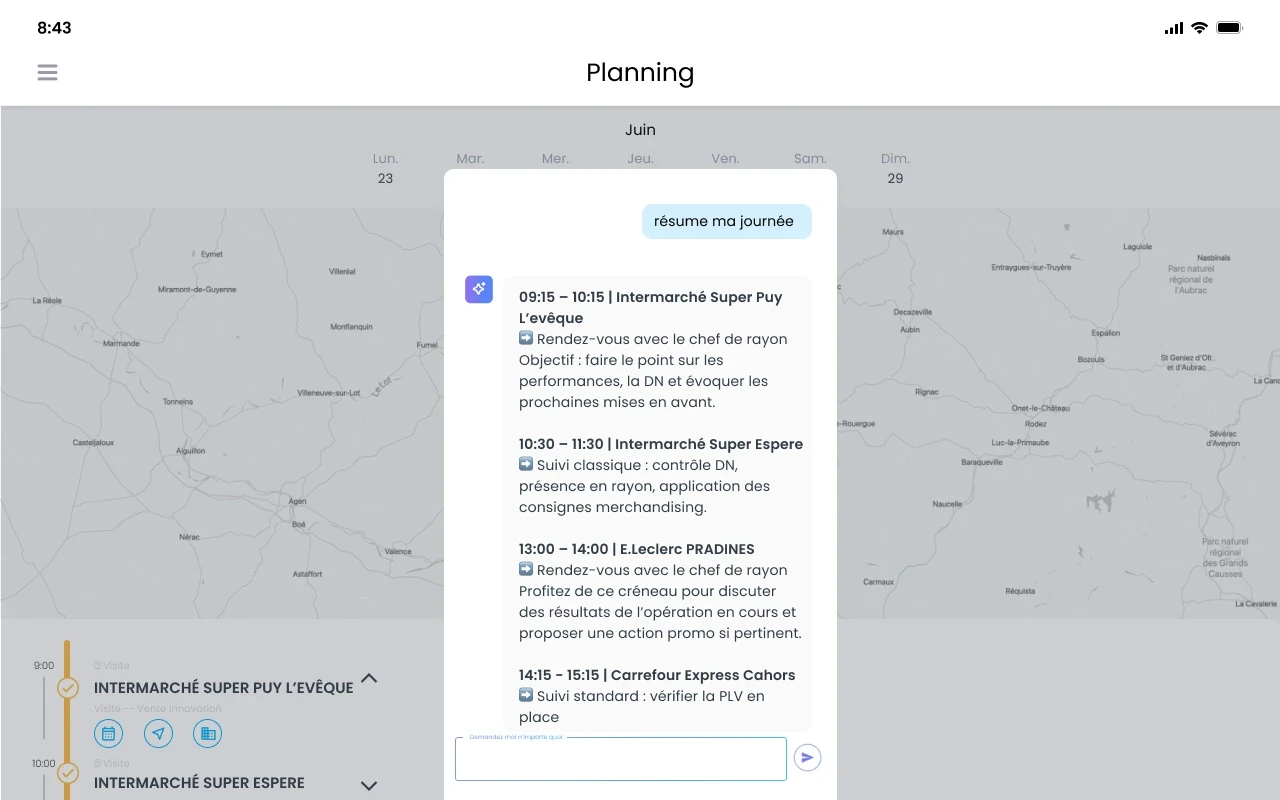
Example of the AI assistant on the sales rep's schedule
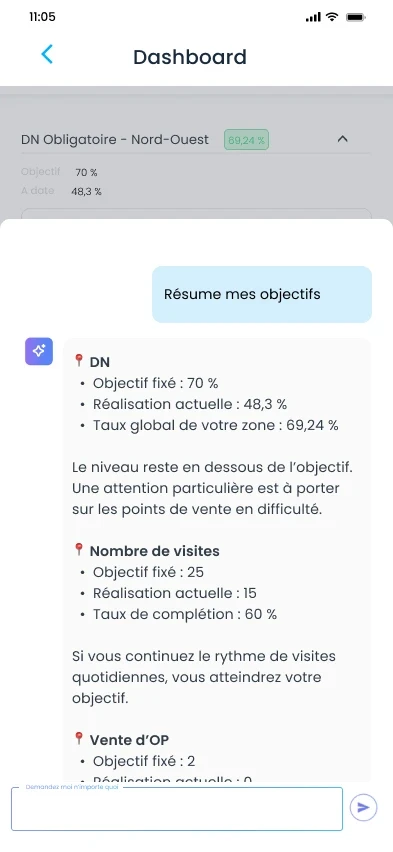
Example of the AI assistant on the sales rep's target dashboard
Here are some examples of concrete use cases for AI in the CRM:
Helping prioritize actions
AI agents leverage CRM data to provide concrete, immediately actionable recommendations. The goal is not retrospective analysis, but acting at the right moment.
"This client has not been visited for 45 days even though they show high potential. A visit is recommended."
"Three scheduled actions have not been completed, would you like to reschedule them?"
"This route can be optimized; you can group two visits to save 45 minutes."
Depending on the CRM's capabilities, the assistant can also implement the recommendations.
CRM data entry assistance
AI agents intervene directly during CRM usage.
"This form cannot be submitted, a photo is required."
"An essential field is missing to ensure customer follow-up."
"The visit report is not submitted. The retail audit cannot be completed."
"Warning: your retail audit is not linked to any event. It cannot be integrated into the sales visit tracking."
This assistance significantly reduces data entry errors and improves data quality starting from first use.
Supporting sales targets
The virtual assistant can also turn into a coach for your sales reps.
"Your monthly target is 62% achieved, focus on high-potential accounts."
"You are 12% behind on your monthly target, prioritize visits to high-potential points of sale this week."
These messages allow the sales rep to know what to do immediately, without having to interpret complex dashboards.
AI sales assistant: field representative vs. manager
We have mainly focused on the benefits that an AI virtual assistant can bring to your sales force in the field. However, its impact does not stop there: it is just as valuable for headquarters teams.
Indeed, an AI sales assistant adapts its recommendations according to the user's role, making it a cross-functional tool useful at all levels of the organization.
For a field sales representative, it helps to:
structure routes,
fill out reports correctly,
ensure crucial actions are not forgotten.
For a manager, it allows you to:
detect delays or anomalies,
prioritize coaching actions,
monitor CRM adoption and completeness.
A driver of adoption
Thanks to contextual guidance, new users quickly become independent. The AI acts as a permanent guide.
Instead of getting stuck, new users can ask the AI to guide them step-by-step through a request, whether technical or operational (related to your company's sales culture).
For a CRM manager, this translates into a smoother rollout and more consistent adoption across teams.
Reduced support load
From a CRM manager's perspective, AI agents bring a major benefit: a significant reduction in internal inquiries.
Common questions such as:
"Why can't I submit my form?"
"I skipped a step, how do I fix it?"
"Which actions should I prioritize?"
are now handled directly by the AI agent.
This allows the CRM Manager to refocus on higher-value tasks.
The CRM thus becomes simpler, more intuitive, and more powerful.
Better visibility
As a manager, you can't be everywhere. To better understand what is happening in the field and never miss critical information, you can count on an AI agent to automatically alert you in the event of notable achievements or issues.
"Two territories show delays exceeding 15%. Targeted coaching is recommended this week."
"Three scheduled actions have not been completed for 10 days. Would you like to check why?"
Management support
Being a manager is a profession in its own right. To support your sales reps effectively, you need a clear, global view of the field. The AI assistant helps you run your sales force, track your negotiations, and inspire your teams with greater impact, for management that is better aligned with field realities.
An AI sales assistant in a CRM acts as a business copilot, integrated into users' daily routines.
It supports field regional managers, network executives, sales managers... by providing contextual and action-oriented advice.
As teams become more autonomous, the CRM ceases to be perceived as an administrative constraint and becomes a genuine tool for management and sales performance. Thus, it transforms the CRM into a true operational assistant.
Margot has been working in Tech and SaaS for 8 years, with a multi-product experience that has given her a unique understanding of business challenges. On a daily basis, she analyzes, relentlessly tests, and relies on facts to shed light on market trends and help sales teams move forward.
See also

Artificial intelligence and field professions: what our 2026 studies reveal
Adoption, barriers, use cases: discover what our three studies reveal about the role of AI among sector managers, sales representatives, and foodservice sales reps.

CHR and RHF Sales Representatives: portrait of a relationship-driven profession in the era of data
Equipment, productivity, AI: discover the major trends for the HORECA and food service sales profession in 2026 through our field study.

Pharmaceutical Sales Representative in France: Portrait of a Field Job Under Pressure
Compensation, aspirations, AI usage: discover the major trends in the pharmaceutical sales representative profession in 2026 through our field study.

Area Sales Managers in France: who are they and how is the profession evolving in 2026?
Compensation, aspirations, AI usage: discover the major trends in the field sales representative profession in 2026 through our field study.
The area manager professions in 2026
Discover the trends, the challenges, and the key figures.