

Agentic AI: definition, how it works, and differences with generative AI
What is agentic AI? Definition, architecture, differences from generative AI and chatbots, first enterprise applications. The reference guide.

In short
8 min read
Agentic AI refers to systems capable of pursuing a goal autonomously, by sequencing actions, using tools, and adapting without human intervention at every step.
Unlike generative AI, which is limited to producing content (input → output), agentic AI reasons, plans, and acts on its environment to fulfill a complex mission.
Its operation relies on an iterative 'perception → reasoning → action' loop that allows the agent to learn from intermediate results to adjust its path.
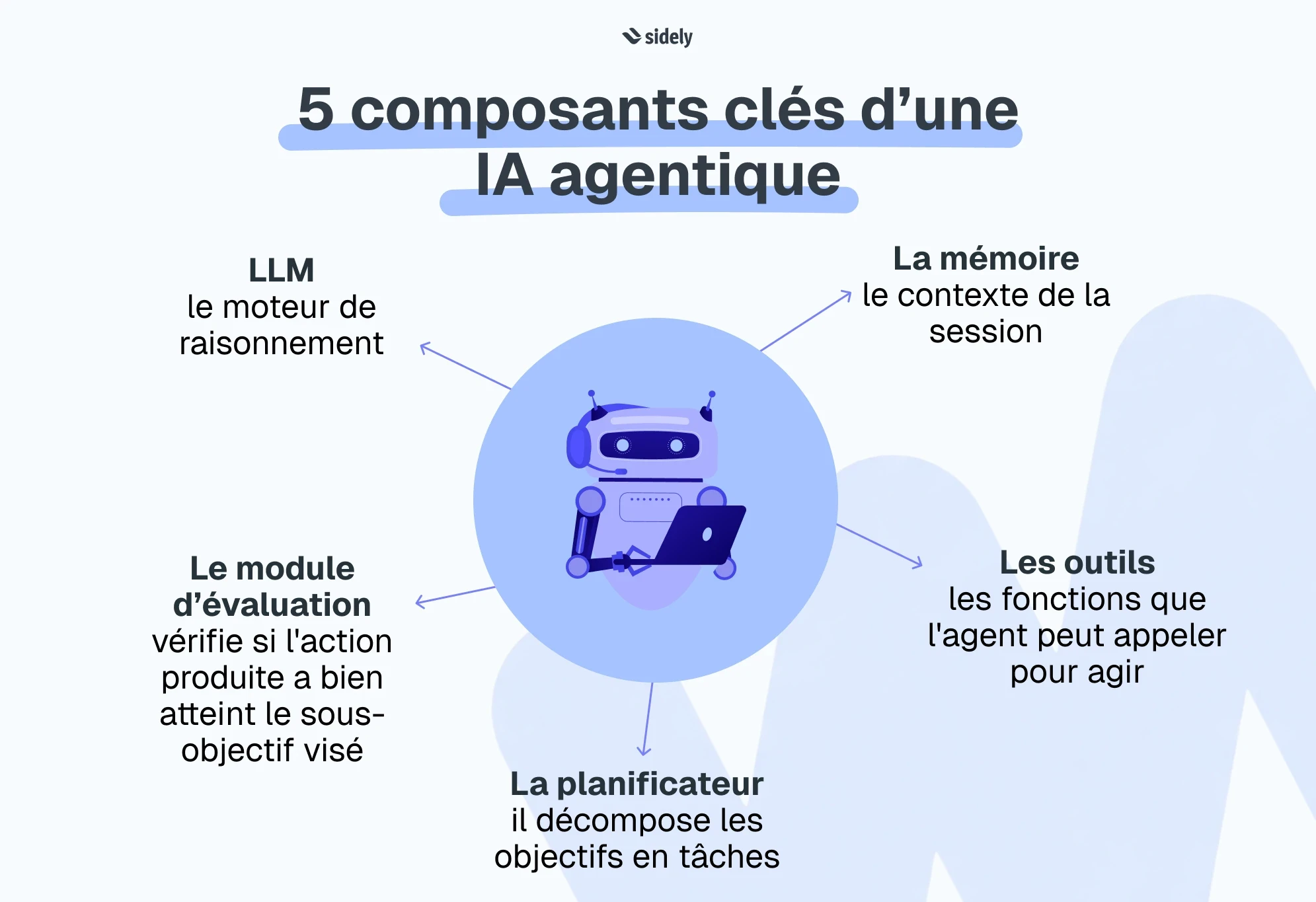
An AI agent is built around five technological pillars: a large language model (LLM) for reasoning, memory (short and long-term), execution tools, a planner, and an evaluation module.
The distinction from a chatbot is structural: while a chatbot remains passive while waiting for an instruction, the agent can be proactive and trigger sequences of actions based on external events.
In business, this technology enables the automation of multi-step tasks (CRM, support tickets, reporting) and the orchestration of complex workflows, freeing up time for higher-value decision-making.
Generative IA has changed the way we produce content. Agentic AI is changing the way we make decisions and act. These are two distinct revolutions, often confused under the same term "artificial intelligence".
Since 2024, the term "Agentic AI" has established itself in tech and business discussions. It appears in product roadmaps, investor presentations, and analyst reports. But behind the word, the realities are very different: some speak of AI agents when describing a simple improved chatbot, others refer to systems capable of executing complex tasks fully autonomously.
Agentic AI refers to systems capable of pursuing a goal autonomously, by chaining actions, using external tools, and adapting to intermediate results, without human intervention at every step.
This article sets the groundwork for the different terms related to artificial intelligence: what Agentic AI is, how it works, how it differs from Generative AI and chatbots, and what its first concrete business applications are.
What is Agentic AI?
Definition
Agentic AI is an artificial intelligence system capable of receiving a goal and achieving it autonomously, taking a series of decisions and actions to do so.
What fundamentally distinguishes it from other forms of AI is that it does not wait for an instruction at every step. It plans, acts, observes the result of its action, adjusts, and continues, usually until the goal is reached or until human intervention is required.
Concretely, if you ask a Generative AI system to "write a follow-up email for this prospect", it produces the email. If you assign the same task to an AI agent, it identifies the prospects to follow up with on its own, consults their history in the CRM, writes a personalized email for each, sends it, records the action, and schedules the follow-up. All of this, without you having to intervene between each step.
Origin of the term and emergence context
The word "agentic" comes from the Latin agere, which means to act. In philosophy and cognitive sciences, agency refers to the capacity of a system to act intentionally on its environment. In artificial intelligence, the concept of an agent has existed since the 1990s, with work on reactive and deliberative agents.
💡 Reactive agents respond to a request from their environment, without planning, to execute predefined behaviors. If they are asked X, they answer Y.
Deliberative agents reason about the actions to be taken and their environment, to reach a goal before acting. They reflect on the request, and do not execute it "blindly".
What is changing today is the engine. Large Language Models (LLMs) like GPT-4, Claude, or Gemini have become capable enough to serve as the reasoning brain for an agent. They understand complex goals formulated in natural language, break down problems, choose the right tools, and adapt to unforeseen situations. It is this combination (LLM + tools + action loop) that has made Agentic AI operational on a large scale since 2023-2024.
How does Agentic AI work? The basic mechanisms
The perception → reasoning → action loop
The functioning of an AI agent relies on a continuous three-step loop:
Perceive. The agent observes its environment: available data, results of the previous action, current constraints...
Reason. It decides on the next action to take to get closer to the goal.
Act. It executes the action, then observes the result, which becomes the new perception.
This loop iterates until the goal is reached, an error blocks progress, or human validation is required.
What fundamentally differentiates the agent from a simple prompt is that it does not stop after producing an answer. It continues, adapts, corrects. A single prompt yields a single output. An agent pursues a goal through as many iterations as necessary.
The key components of an agent
An AI agent relies on five fundamental building blocks to function:
The LLM
The Large Language Model is the reasoning engine. It interprets the goal, decides on the actions to be taken, and generates instructions for the tools. It does not just produce text; it also reasons about what to do next.
Memory
Memory can function in the short term (the context of the current session: what the agent "knows" in the moment) and long term (database, interaction history, reference documents persisting between sessions). Without persistent memory, the agent starts from scratch with each new task.
Tools
These are the functions that the agent can call to act in the physical world: APIs, web browser, database, messaging, code interpreter, CRM... This is what distinguishes an agent from an LLM alone: the agent can change the state of the world, not just produce text.
The Planner
The planner breaks down the goal into sequenced or parallel sub-tasks. A goal like "identify the hot 10 prospects this quarter and prepare a follow-up sequence for each" requires several coordinated steps that the planner organizes.
The Evaluation Module
The evaluation module checks if the action produced has indeed achieved the targeted sub-goal, decides whether to continue, correct, or escalate to a human.
Agentic AI vs Generative AI: what are the differences?
This is the most common confusion, and the most important one to clear up.
What Generative AI does
Generative AI produces content from an instruction: text, image, code, audio. Its mode of operation is simple: a request (input), a response (output). It does not take initiative, does not-chain actions, and does not act in external systems. It only responds.
ChatGPT writing an email, Midjourney generating an illustration, GitHub Copilot suggesting code: these are uses of generative AI. They are powerful, but limited to producing a single output.
What Agentic AI does in addition
Agentic AI generally uses a generative LLM as an internal building block, but it goes much further. It uses it not to produce an answer, but to reason on what to do next, call tools, act, verify, and start over.
Dimension | Generative AI | Agentic AI |
|---|---|---|
Operating Mode | An input -> An output | Goal -> loop of actions |
Autonomy | None (waits for an instruction) | Partial to high |
Use of tools | No (context limited to session) | Yes (long-term possible) |
Ability to change environment | No | Yes |
Human intervention | At each step | Defined by guardrails |
💡 Generative AI is an expert we consult: we ask a question, they answer. Agentic AI is a collaborator we mandate: we entrust them with a goal, they execute it.
Agentic AI vs Chatbot: a common confusion
A chatbot answers questions within the framework of a conversation turn. It can be highly sophisticated, use a powerful LLM, appear "smart", but it remains reactive. It waits for us to speak to it.
An AI agent can act proactively, without being prompted at every step. It can be triggered by an event (new incoming lead, expiring contract, stock alert) and chain a sequence of actions without human intervention.
The distinction is not a matter of the power of the underlying model, but rather of architecture: the agent has tools, memory, a planner, and an action loop. The chatbot does not.
First applications of Agentic AI in business
What is being deployed today
Agentic AI is not a futuristic horizon. Operational applications exist today in several areas:
Automation of multi-step tasks
Qualifying leads, processing support tickets, sales follow-ups, report generation... Tasks that previously required human intervention at every step are delegated to an agent that executes them from end to end.
Complex research and synthesis
An agent can browse through dozens of sources, extract relevant information, cross-reference it, and produce a structured synthesis in a few minutes, where a human would spend several hours.
Orchestration of multi-tool workflows
The agent coordinates actions across multiple systems (CRM, messaging, ERP, calendar) without a human having to manually transfer information from one tool to another.
For concrete examples by sector, I invite you to read our article on concrete examples of Agentic AI by sector.
Can Agentic AI replace an employee?
What are the risks of Agentic AI?
How does Agentic AI integrate into a CRM?
Agentic AI is not an evolution of Generative AI, but rather a paradigm shift. We are moving from "asking an AI to produce something" to "entrusting an AI with executing a goal".
This shift has concrete implications for businesses: repetitive multi-step tasks can be delegated, teams repositionated towards decisions and relations, systems interconnected without manual friction.
The challenge is no longer to understand what Agentic AI is. It is to know where and how to deploy it within your organization, with the right prerequisites, the right constraints, and the right governance.
Margot has been working in Tech and SaaS for 8 years, with a multi-product experience that has given her a unique understanding of business challenges. On a daily basis, she analyzes, relentlessly tests, and relies on facts to shed light on market trends and help sales teams move forward.
See also

Artificial intelligence and field professions: what our 2026 studies reveal
Adoption, barriers, use cases: discover what our three studies reveal about the role of AI among sector managers, sales representatives, and foodservice sales reps.

CHR and RHF Sales Representatives: portrait of a relationship-driven profession in the era of data
Equipment, productivity, AI: discover the major trends for the HORECA and food service sales profession in 2026 through our field study.

Pharmaceutical Sales Representative in France: Portrait of a Field Job Under Pressure
Compensation, aspirations, AI usage: discover the major trends in the pharmaceutical sales representative profession in 2026 through our field study.

Area Sales Managers in France: who are they and how is the profession evolving in 2026?
Compensation, aspirations, AI usage: discover the major trends in the field sales representative profession in 2026 through our field study.
The area manager professions in 2026
Discover the trends, the challenges, and the key figures.